Facebook
 Google
 GitHub
 Linkedin
High-Voltage Data Centers: AI Driving 48V and Beyond
The proliferation of AI has significantly reshaped data center infrastructure, pushing the limits of power systems to meet unprecedented demands. This rapid growth is driving power supply providers to innovate toward 48 V, or even higher, power architectures.
As tech giants, chip manufacturers, and data center operators work to meet AI’s full potential, energy consumption is surging. In 2023, data centers in the United States consumed a combined 176 terawatt hours (TWh), roughly 4.4% of total U.S. energy consumption. This is predicted to rise to between 325 and 580 TWh by 2028, translating to up to 12% of total U.S. energy consumption.
This rapid growth is driving power supply providers to innovate, delivering solutions that support higher computing capacity while maintaining compact footprints and improved efficiency. It also influences the Open Compute Project (OCP), whose community-sourced data center standards serve as guideposts across global technology industries. One solution to address these challenges and meet industry standards is migrating to 48 V, or even higher, power architectures.
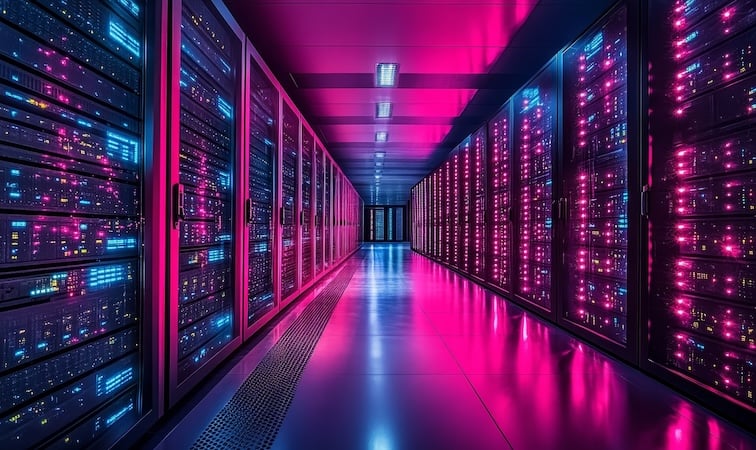
The rise of AI has driven the need for data center expansion. Image used courtesy of Adobe Stock
48 V Architectures Becoming Minimum Requirement for AI
Data center operators are increasingly leveraging 48 V bus architectures instead of traditional 12 V DC power to improve efficiency and support growing power demands. By enabling more effective power conversion and reducing current demands, 48 V systems offer better thermal management and support higher-density power delivery than their 12 V predecessors.
In late 2024, the OCP highlighted 48 V architectures as the standard for meeting the electrical, mechanical, and thermal requirements of evolving data centers. This standard is meant to empower hyperscalers and solution-level suppliers with a common 48V footprint that reliably meets voltage requirements while enabling efficient and responsible power consumption.
Once just a consideration, 48 V architectures have become critical to support the power needs of artificial intelligence, machine learning (ML), and other advanced technologies. By streamlining power distribution and reducing conversion steps, 48V systems can lower costs, improve scalability, and facilitate the dense configurations of modern servers and networking equipment.
The Advantages of 48 V Bus Architectures
Improved Power Efficiency and Reduced Copper Costs
A primary advantage of implementing 48 V rack power architectures is the improved energy efficiency they provide. Unlike the traditional 12 V DC power distribution historically utilized in data centers, 48V systems reduce currents and minimize resistive losses throughout the rack. More efficient architectures also require less overall wiring, enabling data center operators to save on traditionally significant copper costs.
Scalability and Futureproofing
Data centers must be adaptable to evolving workloads and technological advancements. 48 V architectures are inherently more scalable than their 12V counterparts, better enabling operators to meet growing demands for high-performance computing and dense server configurations. As AI applications such as large language model (LLM) development and machine learning (ML) continue to drive demand, 48 V systems can provide a robust foundation for future expansion.
Support for High-Density Server Configurations
Modern data centers increasingly employ high-density server setups, such as blade servers and GPU clusters, which pack more computing power into smaller spaces. These configurations often require more power per unit of space, which can strain traditional power distribution systems. 48 V architectures are well-suited for high-density environments because they can deliver large amounts of power with greater efficiency using compact power delivery components. This makes them ideal for supporting dense server configurations and large-scale cloud computing environments.
Components of a 48 V Power Architecture
In a 48 V architecture, AC utility power is distributed to the rack and converted to 48V DC, which is then distributed via a bus to high-powered servers, storage, and networking equipment. The networking equipment uses onboard bus converters to step down to the lower voltages required by other components such as CPUs, memory, and storage devices. This step-down can be from 48 V to 12 V or 5 V, and additional voltage step-downs can be achieved with DC/DC Point of Load converters as needed.
Power distribution units manage the allocation of power from the 48V bus to various devices, helping to ensure reliable and balanced distribution. Additionally, 48V systems are often integrated with battery backup or uninterruptible power supplies to maintain continuity during outages, safeguarding critical workloads.
Challenges of Implementing 48 V Systems
While 48 V architectures offer many advantages, there are challenges to consider during implementation, including:
- Availability of 48 VDC Input Gear: Not all existing data center loads are offered with 48 VDC input power. Data center operators may need to update their hardware to facilitate the migration to 48 V architectures.
- Heat Management: High-efficiency power conversion is critical for minimizing heat generation, but in dense data centers, even small increases in thermal load can have significant consequences. To resolve this and maintain optimal operating conditions, managing heat dissipation within the power infrastructure is essential.
- Complex Design: A 48V system that effectively integrates with existing power systems and data center infrastructure can require specialized knowledge to design and implement. All components must be appropriately sized and configured to handle the data center’s power demands.
Shifting to Even Higher Voltage at the Rack
To address the growing power needs of modern computing, some data centers are implementing even higher voltage architectures, shifting from 48V systems to architectures as high as 400 V. These higher-voltage systems can help further reduce power loss during power distribution. With hyperscale racks reaching an average of 150 kW, 48 V systems will remain vital. In comparison, 400 VDC systems may become the preferred choice for supercomputing applications that require up to 500 kW of power.
When it comes to scalability, 400 V-powered data centers can support growing workloads and higher computational demands without needing to redesign the power infrastructure. The efficiency improvements, lower losses during power distribution, and a reduced need for bulky infrastructure can also drive long-term cost savings. OCP members, including industry players from startups to hyperscalers, are beginning to explore the feasibility of 400 V implementation for more efficient and reliable data center ecosystems.
As AI continues to revolutionize industries, the infrastructure supporting its growth must evolve in tandem. Innovations like 48 V and 400 V architectures are paving the way for data centers to handle higher workloads, improve efficiency, and adapt to the demands of next-generation computing.
While challenges remain, such as ensuring compatibility and managing heat dissipation, the benefits of these advancements outweigh the hurdles. By adopting strategic power solutions, data centers can achieve greater scalability, reduce energy costs, and prepare for the future demands of AI, LLMs, and ML.