 Facebook
 Google
 GitHub
 Linkedin
Big Turbine for Small Winds: Nordex Reaches for Low Wind Sites
German-based Nordex Group has introduced a towering wind turbine targeted for low- and medium-wind conditions.
Nordex Group has added its tallest wind turbine to date—277.5 meters tall—to its Delta4000 series. The wind developer says it will generate more energy and lower wind project costs. With a 193-meter rotor and 7.3 MW of installed capacity, the N/193.7X targets medium- and low-wind sites, where project economics are often most challenging.
That focus is important as the clean energy industry looks to expand wind power beyond the highest-quality sites. Larger turbines can help developers capture more energy from lower-wind sites, potentially making more projects financially viable while expanding the range of sites suitable for wind development.
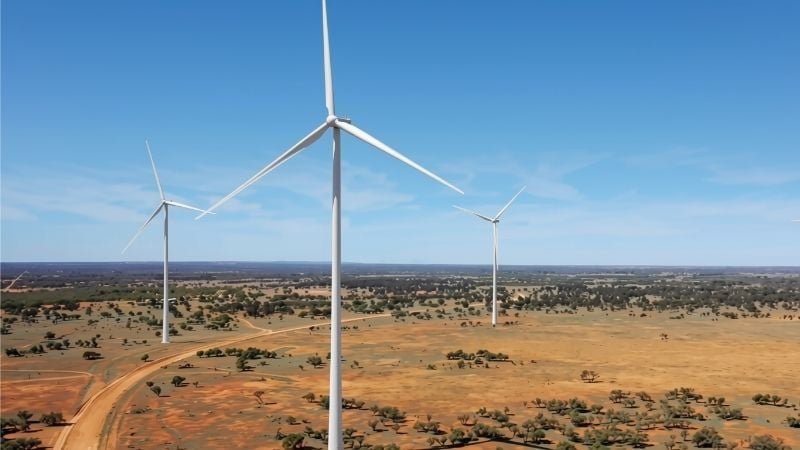
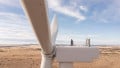
At 277.5 meters tall, the N193/7.X is Nordex's tallest wind turbine. Image used courtesy of Nordex
Size Matters in Wind Energy
Nordex is using a larger rotor to increase energy production without moving to an entirely new turbine platform.
The effectiveness comes from the turbine's size. Each 95-meter blade is made in a single piece, and the rotor sweeps 29,255 square meters, about 22% more than the N175/6.X, the model just below it in range.
At typical low- to medium-wind locations, Nordex says that extra reach translates to up to 14% more yield than the smaller turbine.
Technology Reuse for Efficiency
The N193/7.X infrastructure design reuses the proven Delta4000 platform. This approach is significant for an industry under continued pressure to reduce the cost and complexity of new wind projects. Rather than introducing an entirely new architecture, Nordex is combining a larger rotor with established technology.
The nacelle, turbine control system, and electrical architecture carry over from the existing platform and are optimized for efficiency. According to Nordex, this gives customers high reliability and shorter product introduction and production times because the logistics and installation processes are already proven.
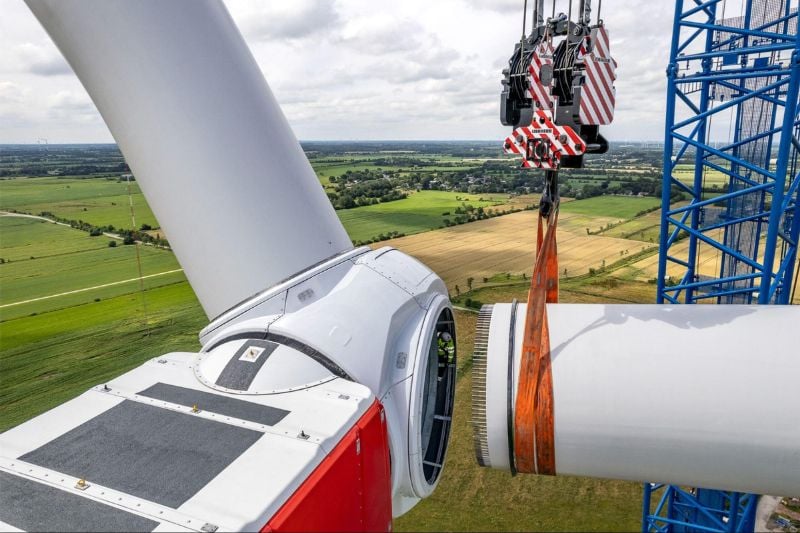
Installing a Delta4000 wind turbine. Image used courtesy of Nordex
Additional cost reductions come from improved component design and efficient use of space. However, the company has not yet published pricing or a cost-per-megawatt-hour comparison.
Design Adaptations
Not everything in the N193/7.X is carried over from previous designs. To handle the larger rotor, Nordex reinforced the main frame and rotor-lock system and redesigned the gearbox. The turbine uses a high-speed gearbox and a doubly fed asynchronous generator with liquid/air cooling, and it works on both 50 and 60 Hz grids.
The wind turbine starts generating at wind speeds of 3 meters per second and shuts down at up to 24 meters per second. Hub heights reach up to 181 meters, with several tower technologies available depending on the project.
Flexibility is another key component of the new turbine design, addressing the challenge of meeting local conditions rather than a one-size-fits-all specification. The turbine will come in several nominal capacity configurations and multiple operating modes. Operators can tune the balance between energy yield, capacity factor, noise, and service life to fit local economics and regulations. Sound power levels range from roughly 99.5 to 109 dB(A), depending on the mode.
Product Launch
The design's adaptability is especially useful in Germany, where complex permitting and grid-connection rules often shape project design. The turbine will initially be offered there with a maximum capacity of 6.6 MW, a limit intended to optimize project economics at medium- and low-wind sites.
Large-scale production of the N193/7.X is scheduled for 2029.