Facebook
 Google
 GitHub
 Linkedin
STMicro Adds High-Efficiency Synchronous-Rectifier Controllers
The tiny SRK1004 increases efficiency and saves space in flyback-based power supplies.
STMicroelectronics has released the SRK1004 family of synchronous-rectifier controllers. Designed for the secondary side of non-complementary active clamp, resonant, and quasi-resonant flyback converters, the SRK1004 is intended specifically for applications like high-density USB power delivery chargers and in-wall smart outlets.
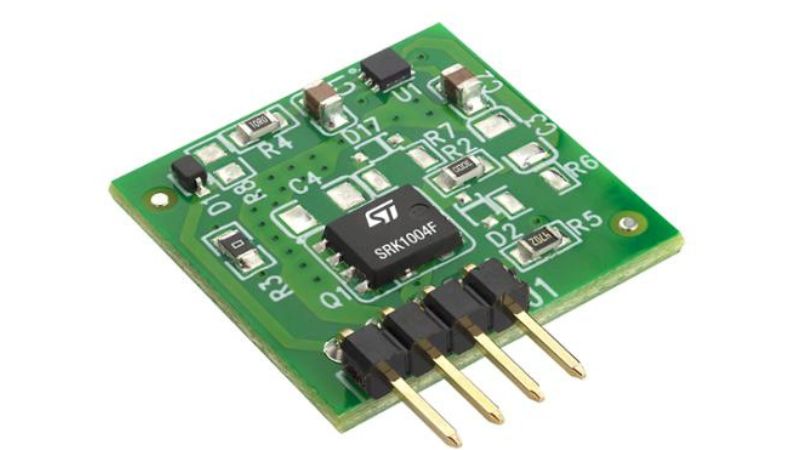
The synchronous-rectifier controllers save space. Image used courtesy of STMicroelectronics
The SRK1004 Family
In a 2 x 2 mm, 6-lead DFN package, the SRK1004 is designed to drive an external N-channel MOSFET in several flyback topologies. The controller uses a voltage-based approach control scheme that senses the drain-to-source voltage of the SR MOSFET through a high-voltage input (rated up to 190 V). The MOSFET switches on when current begins to flow through its body diode and the detected voltage crosses a slightly negative threshold.
Conversely, the MOSFET switches off when the detected voltage approaches zero, indicating that secondary current is decaying to zero. Using this voltage-based scheme, the controller can closely align MOSFET conduction with the transformer demagnetization interval and reduce residual diode conduction time.
The controller’s gate driver can source up to 0.6 A and sink up to 1.7 A for fast transitions with moderate gate charge devices.
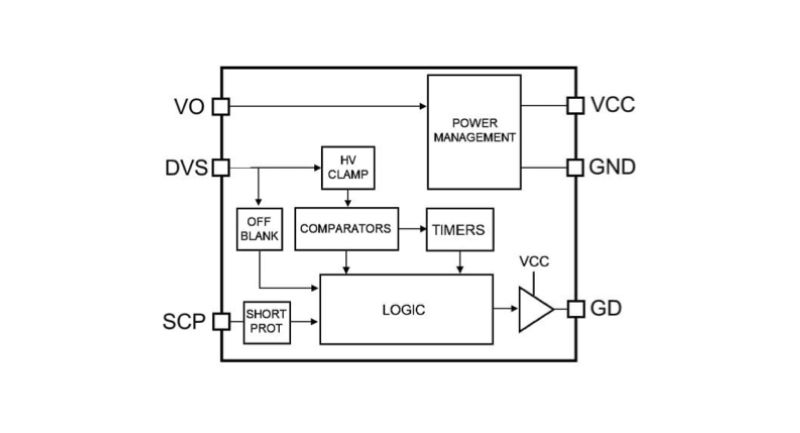
Block diagram of the SRK1004. Image used courtesy of STMicroelectronics
ST offers six device variants to provide flexibility for different power stages. Designers can select logic-level or standard-level MOSFET gate drive, with internally regulated gate-drive voltages of 5.5 V or 9 V.
The SRK1004 also offers two turn-off delay options, 25 ns and 150 ns, so designers can allow compensation for parasitic drain inductance that would otherwise advance zero-crossing detection and degrade efficiency. For additional design flexibility, the SRK1004 supports both low-side and high-side synchronous rectifier configurations.
The SRK1004 also incorporates a defined turn-on enable window to improve robustness in discontinuous conduction mode. This circuit permits MOSFET turn-on only if the drain-voltage transition occurs within a tightly defined time interval associated with transformer demagnetization. By rejecting slower voltage-ringing events that occur during idle or reverse-current intervals, the controller prevents unintended MOSFET conduction, which would increase switching losses.
Synchronous Rectification Timing in Flyback Converters
In flyback converters, energy transfer from primary to secondary occurs during the transformer demagnetization interval, when secondary current flows after the primary switch turns off. Traditional diode rectification conducts throughout this interval but incurs a forward voltage drop that directly translates into power loss at low output voltages and high currents.
To address this problem, synchronous rectification replaces the diode with a MOSFET, whose channel resistance can be an order of magnitude lower than a diode’s dynamic resistance.
However, the MOSFET must turn on only when secondary current is forward flowing and turn off precisely as current approaches zero. Any delay in turning on increases diode conduction losses, while a delay in turning off increases losses and stress from reverse current or body-diode conduction.
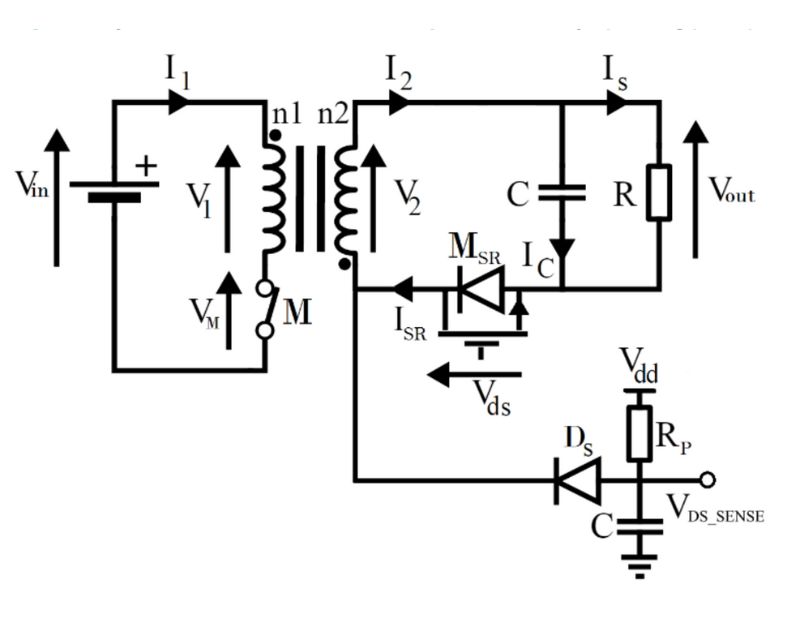
Synchronous rectification operation principle. Image used courtesy of STMicroelectronics
In non-complementary active clamp and quasi-resonant flyback topologies, timing is more complex. Converters in these topologies often operate near the boundary between continuous and discontinuous conduction modes. At light loads, idle intervals and drain-voltage ringing appear between energy-transfer phases. Voltage-based sensing schemes must distinguish between true demagnetization events and parasitic oscillations caused by leakage inductance and device capacitances.
Therefore, effective synchronous rectification control depends on fast comparators, blanking intervals, and carefully defined timing windows. Under these conditions, MOSFET conduction can align with the intended energy-transfer window without noise, ringing, or topology-dependent switching behavior.
Toward Denser and More Efficient Flyback Designs
The SRK1004 family is now in production. Six evaluation boards are also available to support variant selection and prototyping for different flyback configurations.