Facebook
 Google
 GitHub
 Linkedin
Advancing Power Efficiency With SiC Merged-Pin Schottky (MPS) Diodes
By combining Schottky and PiN diode structures in a single, monolithic device, SiC MPS diodes overcome the historical trade-offs between low conduction loss, high blocking capability, and ruggedness.
This article is published by EEPower as part of an exclusive digital content partnership with Bodo’s Power Systems.

Image used courtesy of Adobe Stock
Within the SiC diode family, Merged-PiN Schottky (MPS) diodes represent a critical evolution beyond conventional SiC Schottky Barrier Diodes (SBDs). By combining Schottky and PiN diode structures in a single, monolithic device, SiC MPS diodes overcome the historical trade-offs between low conduction loss, high blocking capability, and ruggedness.
Conventional SiC Schottky Barrier Diodes (SBDs) are majority-carrier devices that offer near-zero reverse recovery charge (Qrr), extremely fast switching and low switching losses. However, at higher voltages and temperatures, traditional SiC Schottky diodes face inherent limitations like increased leakage current, reduced surge current capability and higher sensitivity to overload and short-term fault conditions. These factors can constrain their robustness in demanding applications such as traction inverters, grid-connected converters, and industrial power supplies.
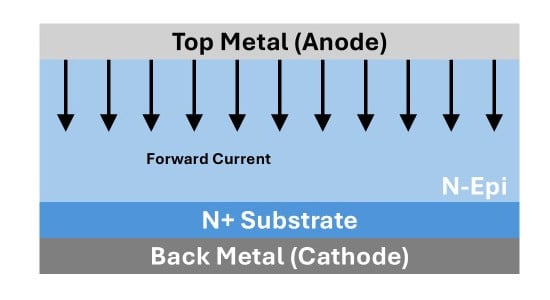
Pure Schottky Diode (SBD). Image used courtesy of Bodo’s Power Systems [PDF]
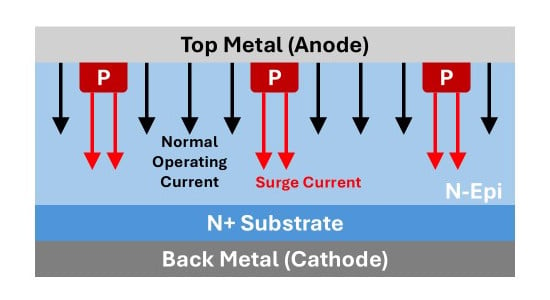
Merged PiN Schottky Diode (MPS). Image used courtesy of Bodo’s Power Systems [PDF]
Figure 1. Structural differences between SBD and MPS.
Comparison of SiC MPS and SiC Schottky diodes
MPS diodes remove the need to choose between efficiency and ruggedness.
Table 1. Characteristic differences between SBD and MPS.
|
Parameter |
SiC Schottky Diode (SBD) |
SiC Merged-PiN Schottky (MPS) Diode |
Customer Value |
|
Conduction Mechanism |
Majority carrier (Schottky) |
Majority carrier with PiN assist |
Best of both worlds |
|
Reverse Recovery |
Near-zero |
Near-zero |
High-frequency efficiency |
|
Forward Voltage (Nominal Load) |
Low |
Low |
Comparable efficiency |
|
Forward Voltage (High Current / Surge) |
Increases rapidly |
Stabilized via PiN conduction |
Improved overload handling |
|
Leakage Current @ High Temperature |
Higher |
Significantly lower |
Better high-temp reliability |
|
Surge Current Capability |
Limited |
High |
Robust against inrush & faults |
|
Avalanche Capability |
Limited |
Enhanced |
Grid and industrial resilience |
|
Thermal Stability |
Moderate |
Superior |
Extended operating range |
|
System Derating Required |
Higher |
Lower |
Smaller, lower-cost systems |
|
Typical Use Case |
Light to medium duty |
Mission-critical, High stress |
Broader applicability |
SiC Merged-PiN Schottky (MPS) Diodes
The Merged-PiN Schottky (MPS) structure integrates a PiN diode region within the Schottky architecture. Under normal forward operation, the device behaves like a Schottky diode, maintaining low forward voltage and fast switching. Under high current or high voltage stress (surge current), the PiN regions become active, dramatically enhancing device ruggedness. This intelligent self-adapting behavior allows MPS diodes to deliver the best attributes of both Schottky and PiN devices—without their traditional drawbacks.
Key Performance Advantages of SiC MPS vs. SiC Schottky Diodes
One of the key advantages of SiC MPS diodes is in the forward conduction loss curve. These SiC MPS diodes closely match SiC Schottky diodes at low to nominal current, maintaining low forward voltage and high efficiency during normal operation. At higher current and overload conditions, MPS diodes exhibit lower incremental conduction loss as the embedded PiN regions conduct, stabilizing forward voltage and reducing thermal stress compared to conventional SiC Schottky diodes.
MPS diodes can safely conduct significantly higher surge currents due to the activation of PiN regions during overload events. This makes them far more robust in real-world systems exposed to inrush currents, short circuits, and grid disturbances. While standard SiC Schottky diodes experience rapidly increasing leakage current as junction temperature rises, MPS structures suppress leakage through their PiN regions—enabling stable operation at elevated temperatures.
The merged structure enhances high-voltage blocking stability and avalanche capability, making MPS diodes better suited for highvoltage DC-link and grid-tied applications. Like Schottky diodes, SiC MPS diodes remain majority-carrier devices during normal operation, preserving ultra-fast switching and negligible reverse recovery losses—critical for high-frequency power conversion. By combining efficiency with fault tolerance, MPS diodes reduce the need for over-design, snubber circuits, and excessive derating, improving overall system reliability and lowering total cost of ownership.
Application Impact
RIR’s SiC MPS diodes enable higher system efficiency and reliability across demanding applications by combining Schottky-like switching performance with enhanced surge, thermal, and high-voltage robustness. This makes them well-suited for EV traction inverters, renewable energy systems, industrial drives, aerospace, and green hydrogen applications where high-power density, efficiency, ruggedness, and thermal performance are equally critical.
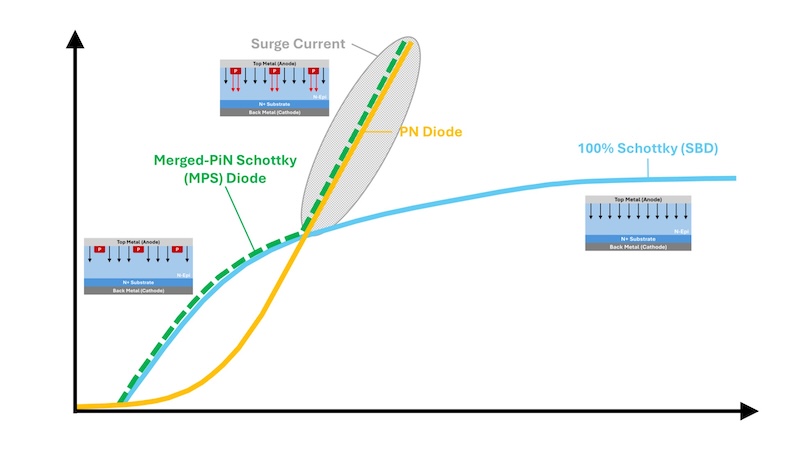
Figure 2. Forward Surge Capability (IFSM) of SBD and MPS Diodes. Image used courtesy of Bodo’s Power Systems [PDF]
Who is RIR?
RIR is India’s only company with existing high-power semiconductor fabrication capability, with experience in devices rated up to 20,000 V and 12,000 A. Through its U.S. development operations and its forthcoming first-of-its-kind SiC manufacturing facility in Odisha, RIR is building a vertically integrated SiC ecosystem spanning wafer processing, device design, packaging, and application support. This foundation enables RIR to deliver high-voltage, high-reliability SiC MOSFETs and diodes, optimized not only for electrical performance, but also for manufacturability, long-term reliability, and system-level value.
This article originally appeared in Bodo’s Power Systems [PDF] magazine.