Facebook
 Google
 GitHub
 Linkedin
ST Intros Automotive Drivers for Load Protection & High-Voltage Switching
STMicroelectronics has introduced an automotive high-side driver for harsh electrical transients and isolated gate drivers for high-voltage switching applications in EVs and hybrid vehicles.
STMicroelectronics has introduced two automotive driver solutions targeting different parts of the automotive power landscape. As more automotive functions become electrically controlled, from lighting and pumps to traction inverters and onboard chargers, the drivers responsible for controlling those loads must handle increasing electrical stress while maintaining efficiency and reliability. Voltage transients during events like cold cranking, for example, can push electronic components well outside normal operating conditions.
ST's new drivers address these needs: the VNQ9050LAJ intelligent high-side driver focuses on reliable load control in 12-V automotive systems, while the STGAP2SA and STGAP2HSA isolated gate drivers target high-voltage switching in power electronics used throughout electric and hybrid vehicles.
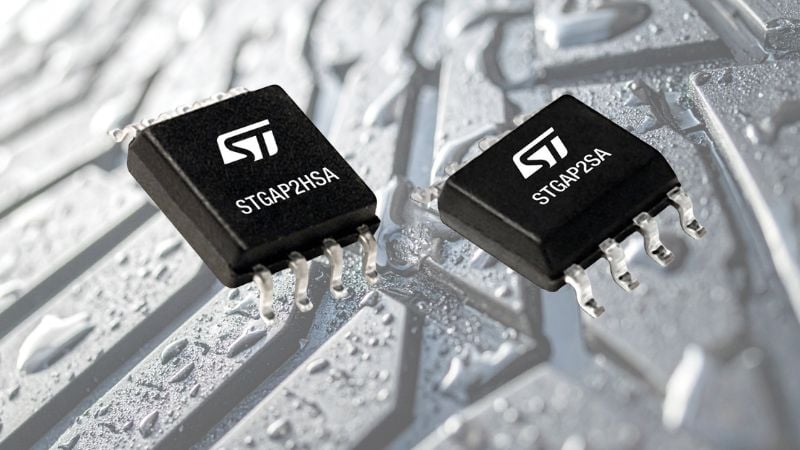
The STGAP2SA and STGAP2HSA suit IGBTs and silicon MOSFETs operating with a high-voltage rail up to 1,200 V.
Intelligent High-Side Driver for Vehicle Load Control
The VNQ9050LAJ (datasheet linked) is a four-channel automotive high-side driver designed to power and protect 12-V ground-connected loads. One of the key characteristics of the device is its ability to continue operating during severe voltage disturbances. The driver has a minimum operating voltage of 4 V and can tolerate cold-cranking conditions down to 2.7 V, allowing systems to remain functional even when battery voltage temporarily drops during engine start.
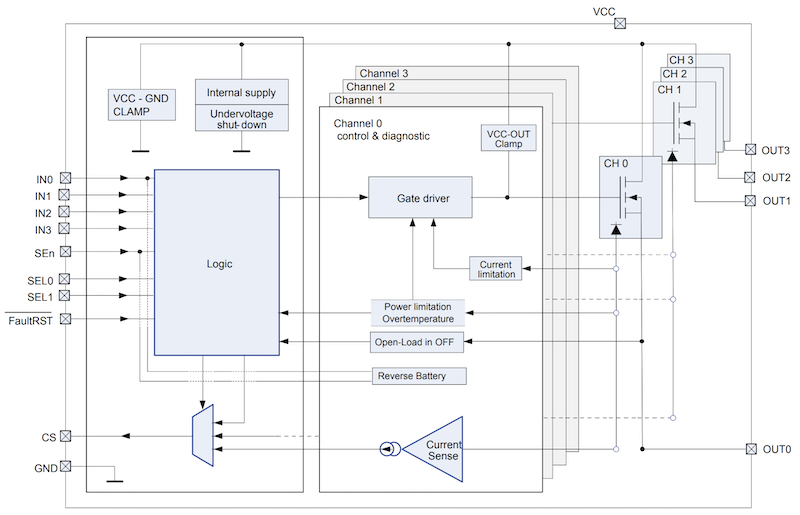
Functional diagram of STMicroelectronics’ VNQ9050LAJ four-channel intelligent high-side driver.
The device is built using ST’s latest VIPower-M09 technology and offers a typical on-resistance as low as 50 mΩ. Lower on-resistance reduces power losses and helps improve energy efficiency in vehicle electrical systems. The driver also accepts both 3-V and 5-V logic signals, simplifying integration with common automotive control electronics.
Reliability during electrical transients is another design focus. The driver complies with the latest version of the LV124 automotive electrical stress standard, which evaluates the ability of electronic components to withstand voltage fluctuations and disturbances commonly found in vehicle environments.
Diagnostics and Protection for Automotive Loads
The VNQ9050LAJ also includes monitoring and protection functions that allow engineers to observe how the load is behaving during operation. The device uses a current-mirror sensing scheme built around an on-chip sense FET that mirrors the main power transistor's behavior. By placing an external resistor on the current-sense pin, the mirrored current can be converted into a voltage signal, allowing the load current to be measured and monitored.
This configuration enables continuous load monitoring as well as diagnostic functions such as overload detection, short-to-ground and short-to-VCC detection, power-limitation alerts, and thermal shutdown indication. The device also supports OFF-state open-load detection, allowing systems to identify disconnected loads even when the driver output is inactive.
Additional protection mechanisms include an overvoltage clamp, reverse-battery protection, loss-of-ground and loss-of-VCC protection, and electrostatic discharge protection. The device also features thermal-transient management and configurable latch-off behavior during overheating or power-limitation events.
The VNQ9050LAJ is currently available in a thermally enhanced power-SSO16 package.
Isolated Gate Drivers for High-Voltage Automotive Power
While the high-side driver focuses on controlling 12-V vehicle loads, STMicroelectronics’ STGAP2SA and STGAP2HSA devices are intended for high-voltage switching in automotive power electronics. The AEC-Q100-qualified isolated gate drivers are designed to operate with IGBTs and silicon MOSFETs in systems with voltage rails up to 1,200 V.
With up to 4-A source/sink capability and drive voltages up to 26 V, the devices are designed for switching stages operating at higher frequencies. In practice, higher switching frequency can translate into smaller magnetics and higher power density, with efficiency gains in DC-DC converters, onboard chargers, and traction-related power modules. The drivers provide a typical response time of approximately 60 ns, along with close part-to-part matching, helping maintain consistent switching behavior across multiple channels in a system.

Block diagram of the STGAP2HSA.
Isolation performance is another key difference between the two devices. The STGAP2SA is housed in a standard SO-8 package and provides transient and surge isolation voltages of 4,800 V. The STGAP2HSA uses a wide-body SO-8W package with 8 mm creepage and clearance and supports surge-isolation voltages up to 6,000 V while complying with IEC 60747-17 insulation standards.
Typical automotive applications include DC-DC converters, pumps, fans, heaters, e-compressors, and onboard chargers, as well as traction inverters and other high-voltage systems used in electric and hybrid vehicles.
Switching Protection and Development Support
The drivers handle a few safety items internally, so the power stage doesn’t fail during startup or under fault conditions. There’s undervoltage lockout (UVLO), thermal shutdown, and a default safe output state during power-up and power-down.
The devices also have Miller clamping to prevent unintended transistor turn-on caused by switching transients. In addition, a watchdog mechanism monitors communication from the low-voltage control side and forces the output into a safe condition if communication is lost. The devices also include a standby mode that reduces power consumption when both input signals are held high.
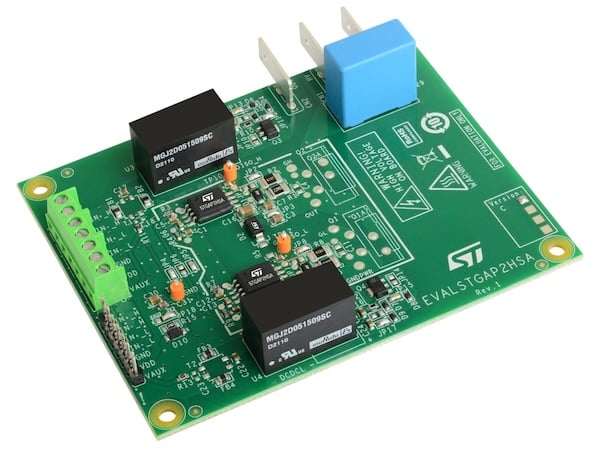
Evaluation board for STMicroelectronics’ STGAP2HSA isolated gate driver.
To assist with development, ST provides dedicated evaluation boards for each device. The EVALSTGAP2SAC board supports the STGAP2SA driver, while the EVALSTGAP2HSAC board is designed for applications requiring higher isolation.
Targeting Different Corners of Automotive Electronics
The two driver families address very different areas of automotive electronics. The VNQ9050LAJ is designed for 12-V vehicle load control, where switches must remain operational under voltage disturbances and electrical faults common in automotive systems. In contrast, the STGAP2SA and STGAP2HSA are designed for high-voltage power stages in hybrid and electric vehicles, where gate drivers must handle fast switching, electrical isolation, and the efficiency demands of modern power electronics.
By addressing both load-control and power-conversion environments, the devices reflect the growing diversity of driver requirements across modern automotive electrical systems.
All images used courtesy of STMicroelectronics.