Facebook
 Google
 GitHub
 Linkedin
Keysight Launches MCS and High-Power EV Charging Systems
The two high-power testing systems give engineers a faster path to validating next-generation heavy-duty EV charging.
Keysight Technologies has introduced two solutions to speed up the validation of electric vehicle charging equipment serving heavy-duty and industrial fleets: the megawatt-capable SL2600A Megawatt Charging Discovery System and the high-power SL1047A Scienlab Charging Discovery System.
Long-haul electric trucks and transport buses increasingly need ultra-fast, high-power charging, and the industry is moving toward the Megawatt Charging System (MCS), a CharIN-led global standardization effort designed for much higher power than today’s light-duty fast charging. MCS targets up to 3.75 MW (3,000 A at 1,250 V DC), charging from 20-80% in 30-45 minutes.
For comparison, that's over seven times the power of typical CCS fast-charging connectors for light-duty electric cars (up to 500 kW).
.jpg)
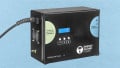
SL1047A (left) and SL2600A (right), alongside electric vehicle supply equipment and other hardware (far right). Image used courtesy of Keysight Technologies
Demand for Higher-Power Test Hardware
Keysight aims to address the growing demand for more flexible, scalable testing solutions as manufacturers must comply with changing international standards. The company cited examples such as the upcoming MCS standard, ISO 15118 for bidirectional charging, CHAdeMO and Combined Charging System (CCS) for fast charging, and China's GB/T national standards.
MCS connectors will deliver 3.75 MW of maximum power for heavy-duty batteries ranging in capacity from 500 kWh to 1,000 kWh. At such high power levels, MCS compliance adds new considerations for thermal management, safety, and efficiency.
The proposed connector design lays out critical requirements such as a liquid cooling system and actively cooled cable, new galvanic isolation and safety systems, an integrated electrical lock mechanism for coupler retention, and other thermal management systems to ensure consistent performance.
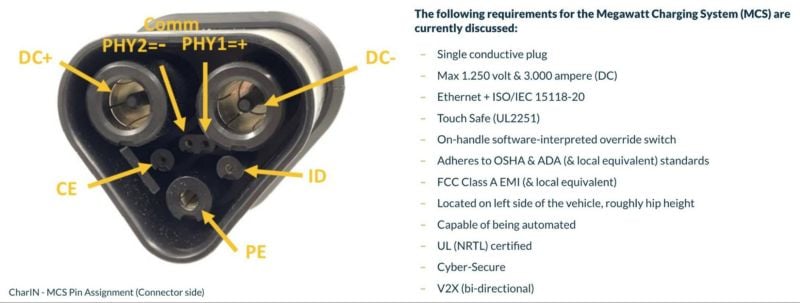
CharIN's proposed MCS requirements. Image used courtesy of CharIN
Manufacturers of heavy-duty EVs and charging systems are already recentering their vehicle lineups and development around this transition, with the first MCS-capable buses and trucks likely to roll out in the next few years. Daimler Truck just launched a real-world demonstration of a demanding long-haul test drive with two MCS-compatible trucks. Scania announced last year that its electric trucks with MCS will be available to order in early 2026, and the updated Tesla Semi will transition to the MCS standard to charge at up to 1.2 MW.
SL2600A Megawatt-Class Testing System
Keysight's SL2600A Megawatt Charging Discovery System covers megawatt-level testing at voltages up to 1,500V and currents reaching 1,500A. The modular design allows engineers to test both vehicle compatibility and charging station equipment.
The product was designed to support future updates to the CCS and North American Charging System (NACS) standards. NACS is quickly becoming the dominant charging connector choice for most new EVs in the U.S. and Canada, expanding access to Tesla’s Supercharger network as more vehicles add native NACS ports or use approved adapters.
SL1047A High-Power Series
Keysight also released a high-power series, the SL1047A Scienlab Charging Discovery System. The high-power SL1047A supports scalable testing requirements, from 400 A and 1,000 V to 800 A and 1,500 V charging.
According to the company, the software-integrated system can ramp up charging without replacing hardware, and it’s compliant with global standards like China's GB/T, allowing broader interoperability in testing.
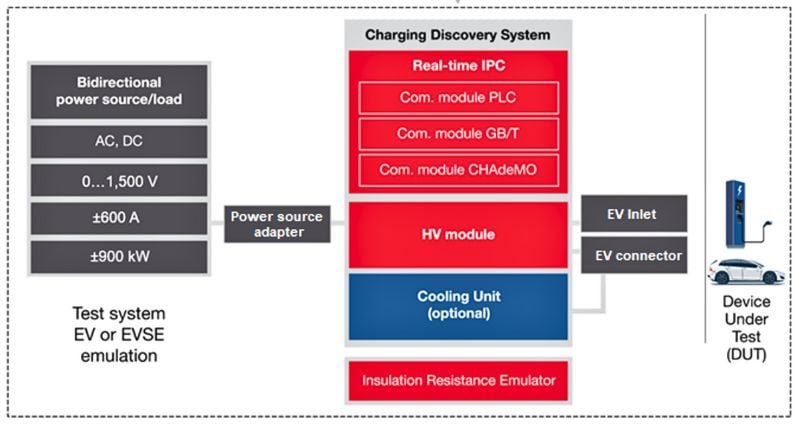
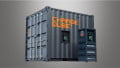
An overview of SL1047A's modularity. Image used courtesy of Keysight Technologies
Keysight provides several examples of possible configurations using its SL1047A hardware, including a standalone setup for AC man-in-the-middle analysis and V2G communication testing, a higher-power configuration connected to DC emulators up to 900 kW, or the full power range for testing EV supply equipment.