Facebook
 Google
 GitHub
 Linkedin
Fit for Duty: High-Voltage Batteries for Military Vehicles
Epsilor’s military-grade battery system is robust enough for demanding field applications.
In the military, batteries face technical and safety challenges due to the harsh environments they are used in. Many lithium-ion (Li-ion) batteries are unsafe enough to be used in highly variable temperatures. Moreover, Li-ions lack the energy density necessary to ensure that vehicles remain at their operational peak. Vehicles operating below their required capabilities could pose dangers in combat environments.
Epsilor has launched a military high-voltage battery system based on the existing NATO standard. Its 6T Li-on vehicle batteries can stack up to 1000 V and provide the required levels of power expected by demanding military applications.
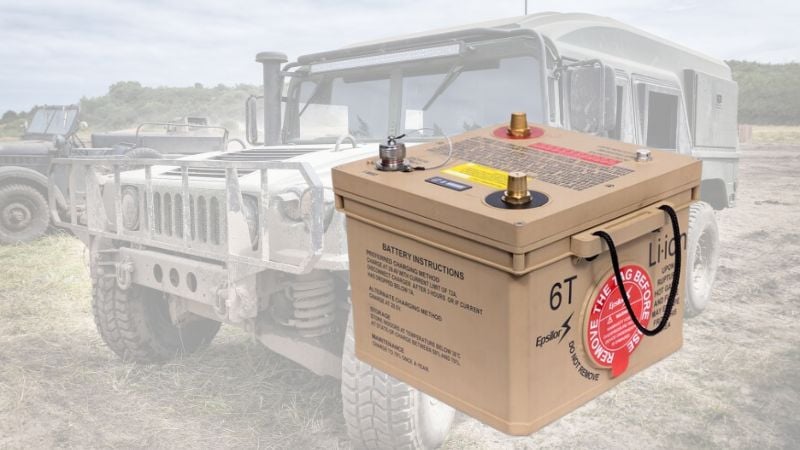
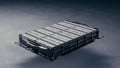
6T Li-on battery. Adapted from images used courtesy of Canva and Epsilor
Field Demands of Military Batteries
Military combat vehicles are put in many environmental scenarios in the field. Onboard these vehicles are multiple electronic systems requiring a continuous power supply. Some examples of the systems that require all this power include:
- Manned turrets
- Unmanned turrets
- Missile launchers
- RADARs
- Protection systems
- Jamming systems
- C3 systems
- Situational awareness systems
- Air conditioning
In combination, these systems on board military vehicles cause a high energy demand. They consume power when the vehicle is on the move and when the vehicle is stationary during missions (known as a “silent watch”).
It’s crucial to ensure vehicles have sufficient stored energy and high power rates during a silent watch. While they may not be actively engaged in combat, static vehicles still face threats in modern-day warfare scenarios. At any point, vehicles may need to maneuver and fight quickly, so they need a sufficient energy supply that is readily available in these scenarios.
Epsilor Offers a Robust Solution
Modern-day asymmetric and urban warfare requires robust battery systems. Epsilor’s new 6T COMBATT battery line uses lithium nickel-cobalt-aluminum oxide (NCA) and lithium iron phosphate (LFP) electrochemistry.
The battery system has been developed to address the growing power needs in various military applications, including:
- High-power defense systems
- Forward operating bases (FOB)
- Hybrid defense vehicles
- Electric defense vehicles
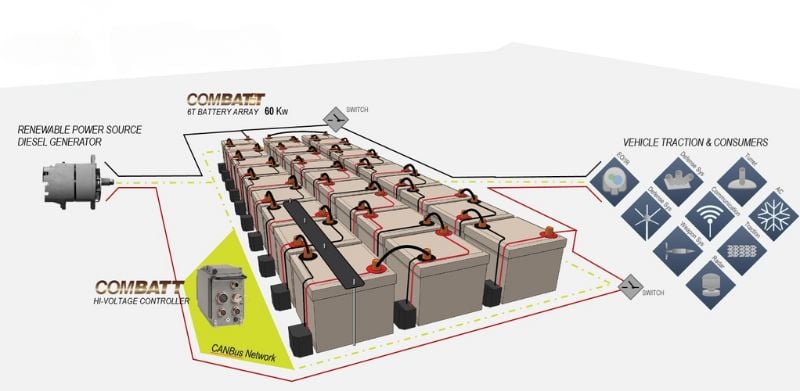
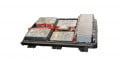
Connected battery systems. Image used courtesy of Epsilor
While the 6T batteries have been available individually, Epsilor has connected and developed into a new robust system to deliver more power for high-demand applications. The company connected the 6T batteries in series to build up a high voltage in parallel to increase the system’s capacity. The battery system now contains connected battery strings within the unit, controlled by a high-voltage battery management system for managing and monitoring each 6T battery.
The Battery System’s Advantages
The COMBATT 6T batteries can store up to 4,400 Wh (25.2 V/175 Ah) of energy. This is six times more than is possible with lead acid batteries of a similar weight and 50% more than other lithium-based military batteries. The batteries can withstand the varying and harsh conditions that wheeled and tracked military vehicles operate in, reducing maintenance needs.
In operating environments, the batteries can work in temperatures as low as - 40°C (-40°F) up to 71°C (160°F). Many Li-ion batteries are not usable at such extremes (especially the cold extremes), but 6T batteries have rapid internal heating mechanisms to operate in ultra-cold environments. The batteries can also undergo 3,000 deep discharge cycles in the Li-ion LFP configuration and over 1,000 deep discharge cycles in the Li-ion NCA configuration.
The COMBATT batteries were developed and tested according to the military performance specification MIL-PRF-32565C and are undergoing rigorous testing at the U.S. Army Ground Vehicle Systems Center (GVSC) in Michigan. The tests will ensure the batteries are reliable in demanding military applications, including ground military robotics, defense vehicles, and tactical energy storage applications. The specific tests include extreme temperature performance (up to 500°C), long cycle life testing, and bullet penetration tests.
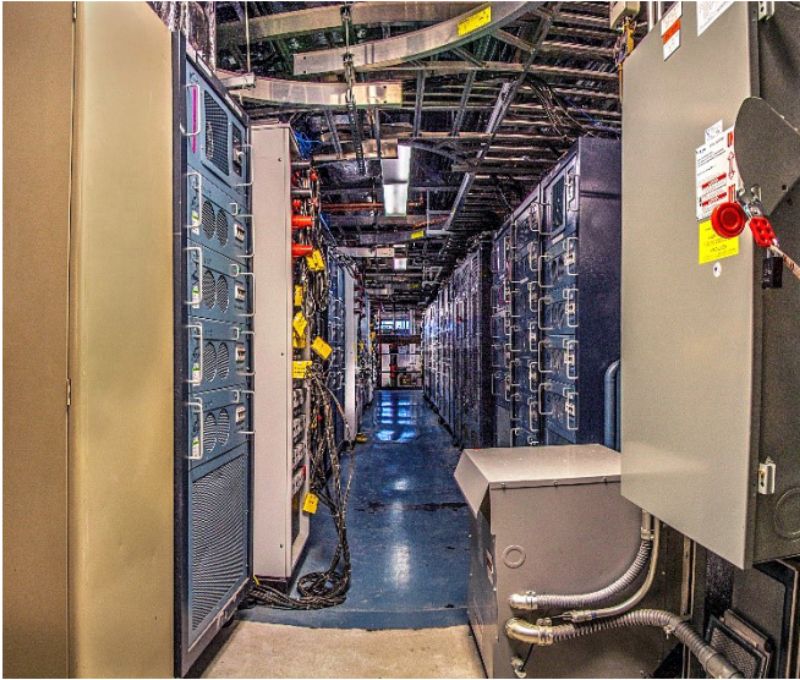
Battery testing equipment at the GVSC. Image used courtesy of the U.S. Army
Epsilor presented the 6T COMBATT batteries at the Ground Vehicle Systems Engineering & Technology Symposium in Michigan this August, showcasing how they can be connected to create a robust system.