Facebook
 Google
 GitHub
 Linkedin
Rectifier Series Delivers Big Performance in Small Package
Package design enables Nexperia’s rectifiers to meet more stringent creepage and clearance standards without compromising performance.
As automotive, industrial, and consumer applications evolve, the need grows for components that can handle higher voltages while maintaining reliability and efficiency. Simultaneously, safety standards and regulations have become more stringent, requiring manufacturers to adapt their designs to meet enhanced clearance requirements between pins. These collective challenges have necessitated advancements in semiconductor technology and packaging techniques.
Explaining recovery rectifiers. Video used courtesy of Nexperia
Nexperia has devised a novel approach to rectifier packaging to address efficiency while improving adherence to high-power clearance standards. Nexperia’s innovation could benefit engineers needing rectifiers for electric vehicles and other high-voltage applications.

650 V rectifiers in D2PAK Real-2-Pin packaging. Image used courtesy of Nexperia
Major Rectifier Challenges
Rectifiers are specialized diode devices that convert alternating current (AC) to direct current (DC) through the process of rectification. Fast recovery rectifiers are optimized for high-frequency conversion applications using specialized diodes designed for rapid switching between conducting and non-conducting states. Their key feature is the ability to transition quickly from forward conduction to reverse blocking when voltage polarity changes.
Rectifiers used in high-power applications require adherence to special standards and compliance regulations. For example, proper spacing is required between conductors to prevent arcing and electrical breakdown and to lessen the risk of shocks and electrical fires. In technical terms, creepage is the shortest distance between conductors along the insulator surface. Clearance refers to the shortest distance between conductors along the air medium. Adequate creepage and clearance are necessary to maintain the long-term reliability of insulation materials, which can degrade over time due to electrical stress.
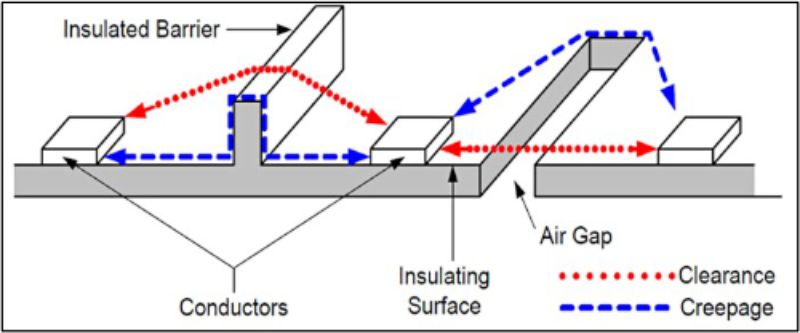
Creepage vs. clearance. Image used courtesy of EEPower
However, the dilemma in rectifier design lies in balancing the need for adequate creepage and clearance distances with the demand for small form factor devices in modern applications. Achieving this in compact devices is challenging due to space constraints. Ultimately, this necessitates innovative packaging solutions that maintain electrical integrity while minimizing the rectifier’s size.
Redefining Safety and Performance
Nexperia has launched a new 650 V hyperfast recovery rectifier line that better balances the tradeoff between size, safety, and performance. These devices utilize planar die technology coupled with an advanced junction termination design to achieve high power density, rapid switching capabilities, and soft recovery characteristics.
The key to this innovation is Nexperia’s D2PAK Real-2-Pin (R2P) packaging, designated SOT8018. This packaging functionally maintains the standard D2PAK outline while eliminating the middle cathode pin. This design modification increases the pin-to-pin distance from 1.25mm to over 4mm, enabling compliance with IEC 60664 creepage and clearance standards.
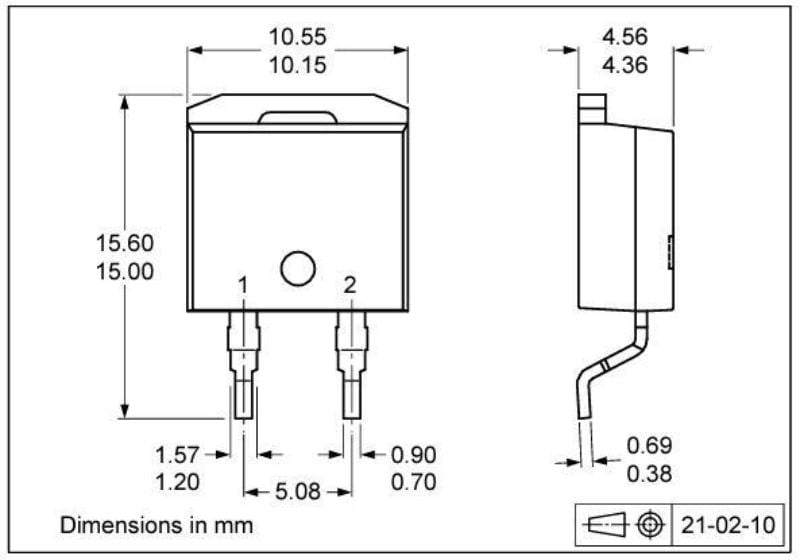
The D2PAK R2P package outline. Image used courtesy of Nexperia
Performance-wise, the rectifiers boast impressive specifications, including a 650 V peak repetitive reverse voltage and continuous forward current of up to 30 A at 25°C ambient temperature. They also offer low forward voltage drop, with typical values of 1.7 V at 25°C.
According to Nexperia, this unique combination of features makes these rectifiers well-suited for automotive, industrial, and consumer applications such as charging adapters, photovoltaic systems, inverters, servers, and switched-mode power supplies.
Electronics for the Future
Modern power electronics face the unique challenge of balancing size, efficiency, and safety. With a new package and impressive performance specifications, Nexperia’s rectifier solutions could be an important tool for power electronic engineers to consider in their latest designs.