Facebook
 Google
 GitHub
 Linkedin
Gate Driver from Rohm Runs Cooler Without Stirring Up EMI
ROHM’s BD67871MWV-Z three-phase BLDC motor gate driver uses TriC3 technology to cut MOSFET heat generation while maintaining low EMI in 12 to 48 volt systems.
Motor designers working in the 12 to 48 V range know the familiar trade-off they face when driving external MOSFETs. Increasing switching speed improves efficiency, yet faster edges tend to generate higher electromagnetic noise. While slowing things down reduces EMI, it increases switching losses and heat, which can complicate the usual manufacturing efforts to improve energy efficiency across industrial equipment, consumer appliances, and compact mobility systems that rely on brushless DC motors.
Rohm’s BD67871MWV-Z gate driver approaches that problem with a more adaptive strategy. The device incorporates the company’s TriC3 active gate-drive technology, which adjusts the gate current of the MOSFETs in real time based on voltage conditions detected at the switching nodes. By dynamically shaping the turn-on and turn-off behavior of each device, the BD67871MWV-Z reduces switching losses and resulting thermal buildup while keeping ringing under control.
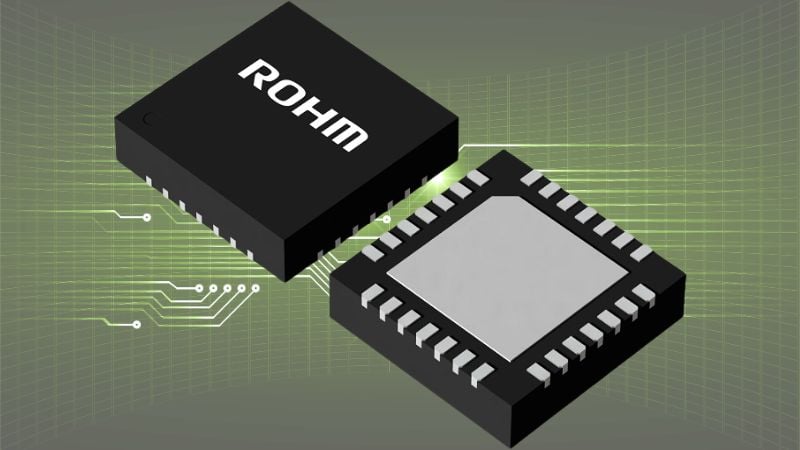
The BD67871MWV-Z gate driver. Image used courtesy of Rohm
A More Controlled Switching Profile
Traditional constant-current gate drivers deliver the same drive strength throughout the switching transition. This approach works well enough for basic motor drives, but as system efficiency requirements increase, so does the need for a switching profile that can adapt to the changing conditions around the MOSFET.
With TriC3, the BD67871MWV-Z interprets voltage information at the MOSFET terminals and adjusts gate current on the fly. This can result in a waveform that minimizes overshoot and high-frequency oscillations that contribute to EMI, yet still enables rapid transitions that lower switching losses.
Integration That Fits Existing Layouts
The BD67871MWV-Z uses UQFN28 package with a pin configuration already familiar to teams working with Rohm’s medium-voltage motor-driver lineup, which maintains consistency and can reduce the engineering time needed to evaluate or migrate to the new part. The device supports both six-PWM and three-PWM control schemes, giving designers flexibility in how they interface their microcontrollers or motor-control firmware.
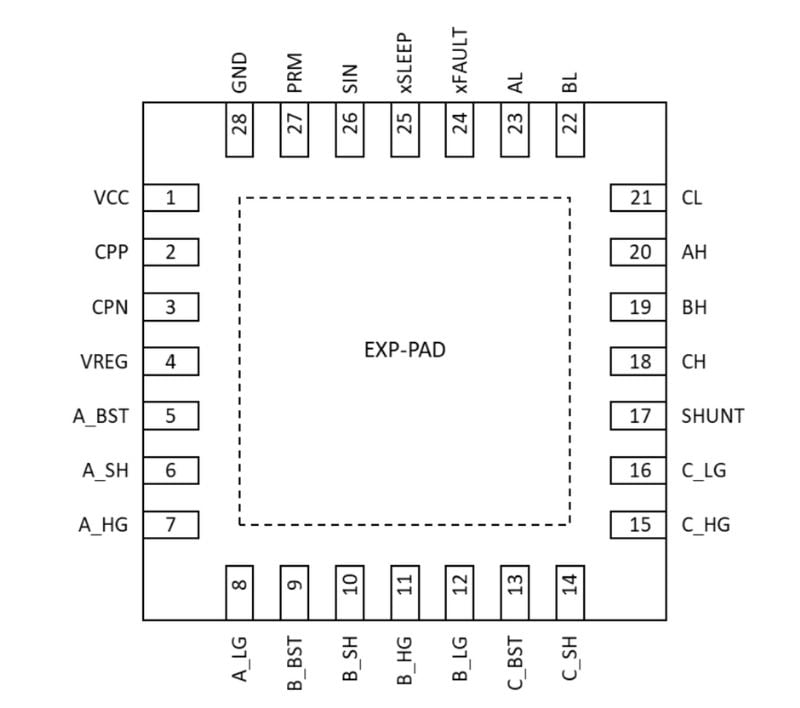
Packaging reference. Image used courtesy of Rohm
It can drive three half-bridges with six external N-channel MOSFETs at supply voltages up to 60 V. The architecture includes synchronous rectification during bootstrap capacitor charging, allowing efficient operation across the full duty-cycle range, including one hundred percent duty-cycle conditions. The sleep-mode current remains in the microamp range, an advantage for equipment that spends long periods in standby before sudden, high-load operation.
Broader Application Coverage
The BD67871MWV-Z shares its package and pinout with two related Rohm drivers, the BD67870MWV-Z and BD67872MWV-Z. Those devices use a constant-voltage drive method instead of TriC3’s adaptive approach. Keeping the same mechanical and electrical footprint allows engineers to compare control methods or build variants of a design without reworking the board layout. This lineup gives designers a modular approach: the same PCB can support different performance tiers without major redesign.
Target applications for the BD67871MWV-Z range from power tools and industrial ventilation systems to e-bikes, air purifiers, and general-purpose industrial motion systems. Any three-phase BLDC motor system operating within a 12 to 48 volt supply window can potentially benefit from lower switching losses and controlled EMI behavior.
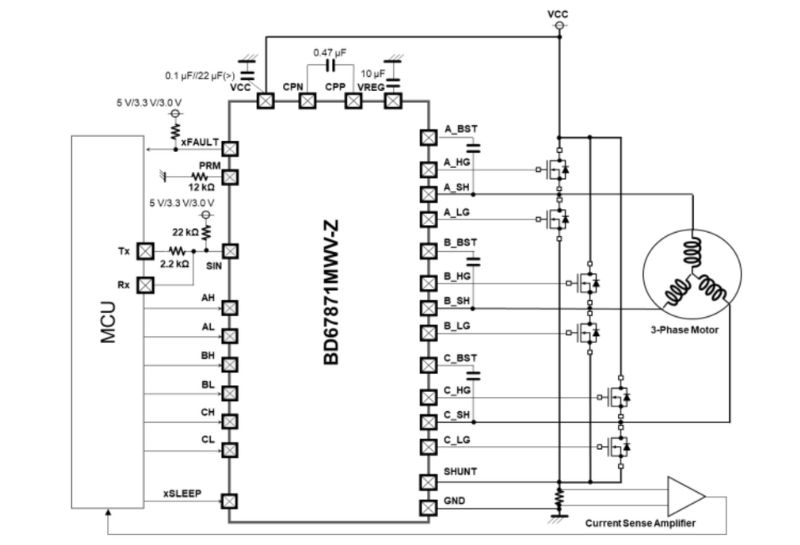
Typical application circuit for the BD6781MWV-Z. Image used courtesy of Rohm
The BD67871MWV-Z and its evaluation board are available through standard distributors, giving engineers a straightforward way to examine switching behavior, thermal characteristics, and dead-time settings under their own MOSFET and motor conditions.
Balancing switching efficiency and low EMI has long been a limiting factor in BLDC motor control. With its real-time gate-drive adjustment, the BD67871MWV-Z gives engineers a way to reduce MOSFET heat generation while keeping electromagnetic noise in check. For equipment that depends on compact, tightly managed thermal and electrical performance, that balance is becoming increasingly important.