Facebook
 Google
 GitHub
 Linkedin
Dukosi Releases 2 Solutions for Battery Pack Management
Dukosi is combining cell-level data tracking with a wireless communication architecture to address traceability requirements and reduce wiring complexity in battery systems.
Battery management is moving beyond pack-level monitoring toward architectures where individual cells can be measured, authenticated, and tracked over time. A combination of regulatory pressure, particularly around the European Union's upcoming Battery Passport requirements, and ongoing engineering challenges tied to complexity, traceability, and system reliability is driving this change.
U.K.-based Dukosi has introduced two solutions following that trend: a secure, Battery Passport-aligned data architecture that starts at the cell, and a near-field wireless link aimed at removing wiring inside battery packs.
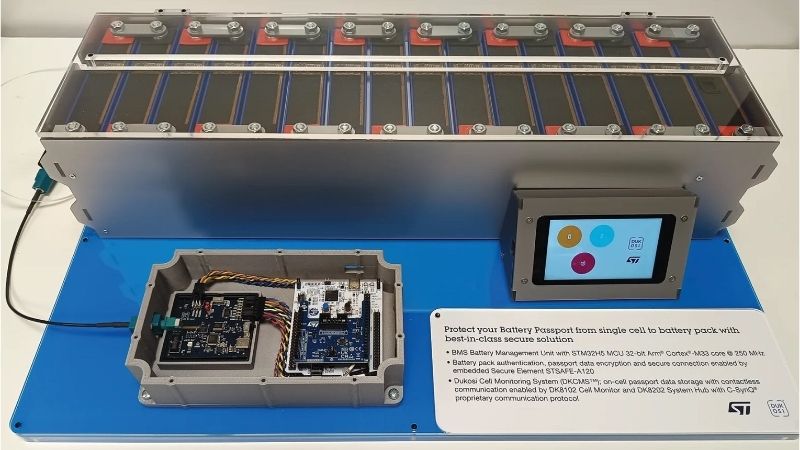
Dukosi and STMicroelectronics developed a single-bus architecture for secure Battery Passport data management. Image used courtesy of Dukosi
Cell-Level Monitoring and Secure Data Flow for Battery Passports
In the 16-cell proof-of-concept for the Battery Passport demonstrator, Dukosi uses its chip-on-cell architecture, alongside STMicroelectronics’ MCU and Secure Element, to enable cell-level data to be authenticated and transferred through a secured path. The monitoring devices are linked using Dukosi’s C-SynQ contactless communication protocol, which synchronizes data acquisition across cells.
The system secures communication by integrating ST’s STSAFE secure element, providing authentication and encryption across the system.
This structure aligns with the European Union's new Battery Passport regulation, which calls for traceable lifecycle data. The phased rollout has already begun, with full requirements expected by next year. The policy will require each battery to carry a digital record covering origin, composition, and performance data across its lifecycle.
In Dukosi’s architecture, cell monitors provide a unique identifier and store cell-level data that can be accessed and transferred through the system.
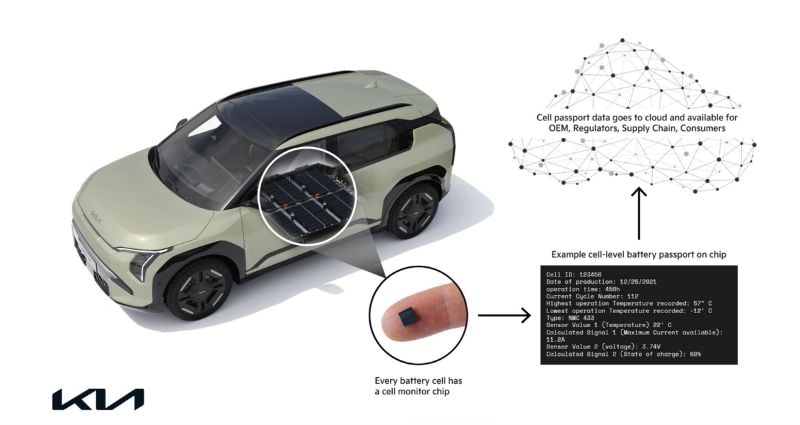
Dukosi's Battery Passport concept on a Kia EV3. Image used courtesy of Dukosi and Kia
Last year, this approach was tested in a Europe-wide trial using a Kia EV3, where cell-level data—including state-of-health information—was stored on-chip at the cell and made available through the vehicle and cloud interfaces.
By associating data with individual battery cells, the system supports more granular tracking of battery condition over time. In the trial, this enabled cell-level analysis and provided data for evaluating cells for reuse beyond their original application.
Near-Field Wireless Link (DK-NFLNK) Targets Wiring Complexity in Battery Packs
Running in parallel with the Battery Passport data solution is Dukosi’s DK-NFLNK communication system, which focuses on reducing wiring complexity inside battery packs.
Conventional designs rely on harnesses and connectors to link modules to a central controller, adding weight, space, and integration complexity. In large electric vehicle battery packs, wiring harnesses can extend across multiple modules and represent a nontrivial share of both assembly effort and potential failure points.
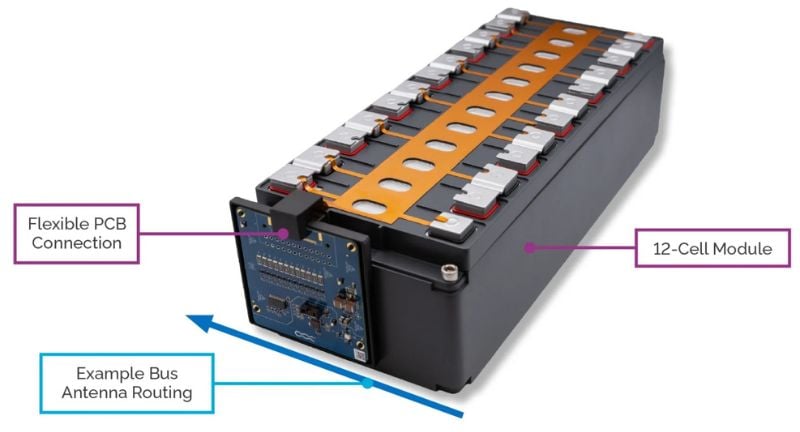
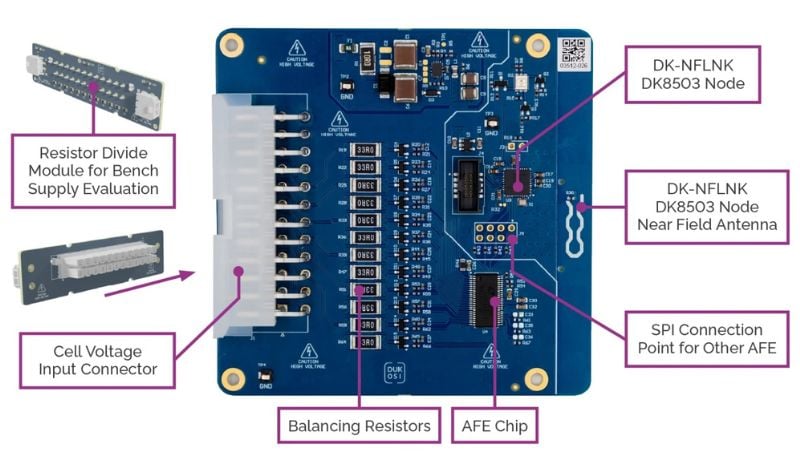
An integrated module with the DK-NFLNK EVK board. Image used courtesy of Dukosi
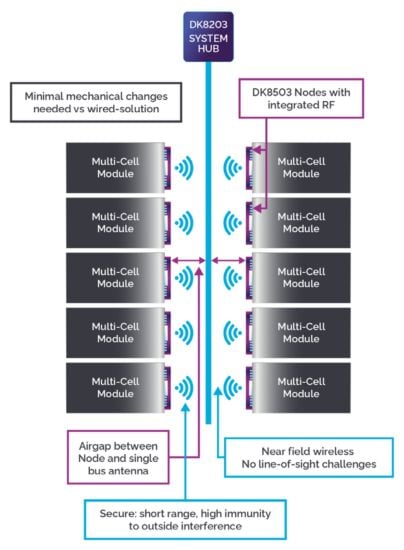
DK-NFLNK replaces complex wiring harnesses with a near-field communication layer in which each module is assigned a DK8503 node that couples to a shared bus antenna. The system forms a star network in which all nodes communicate directly with a central DK8203 System Hub, enabling contactless data transfer within the pack.
The near-field approach also changes how the communication layer behaves as pack designs evolve. Because it operates using low-power RF and does not rely on line-of-sight transmission, the system is less sensitive to physical layout changes within the pack. This can reduce the need for repeated RF validation when module configurations, cooling structures, or busbar layouts are modified.
Dukosi's DK-NFLNK EVK board. Image used courtesy of Dukosi
The DK8503 node is designed to interface with existing multi-channel AFEs, allowing integration with a range of battery monitoring solutions. Communication is based on Dukosi’s C-SynQ protocol, providing deterministic, synchronized data transfer from all modules to the BMS host processor.
Dukosi's solution also advances the communication architecture itself. Near-field connectivity minimizes the need for complex wiring harnesses, preserves data, and provides inherent isolation within the pack. Because each node links directly to the central hub, a fault affecting one module does not interrupt communication from the others.
DK-NFLNK system overview. Image used courtesy of Dukosi
The company is also pitching DK-NFLNK as a scaling tool. Additional modules can be added with less redesign effort, giving battery designers more flexibility when pack layouts or supply chain choices change.
Related Content