
 Facebook
 Google
 GitHub
 Linkedin
Shell Concept EV Tackles Charging, Efficiency, and Sustainability
The Triple 10 Challenge concept challenges conventional EVs with a lightweight, thermally efficient design
This electric vehicle is lightweight, energy-efficient, and eco-friendly, and it comes from a surprising maker: Shell. The oil giant’s Triple 10 Challenge concept car is a proof-of-concept design to inspire a new generation of EVs.
While Shell isn’t becoming an EV manufacturer, it has long been invested in batteries and EV chargers. The concept car is intended to demonstrate an alternative to heavy, expensive EVs that rely on large battery packs. The Triple 10 Challenge refers to goals for future EVs: charging times under 10 minutes, 10-km/kWh energy efficiency, and a lifecycle 10-tonne CO2 footprint.
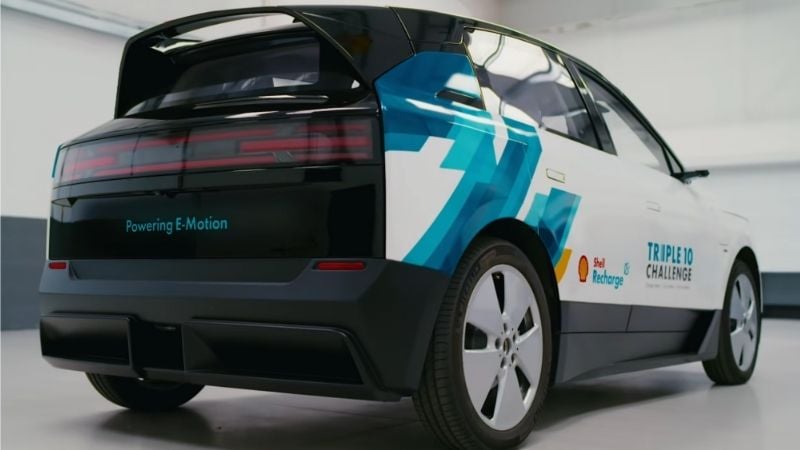
The Triple 10 Challenge concept car. Image used courtesy of Shell
A Radical Approach to Thermal Design
Shell emphasized that the compact car offers the automotive industry a viable alternative to the current reliance on ever-larger batteries.
The vehicle demonstrates the potential of a simplified, single-circuit cooling architecture. Advanced thermal fluids unlocked the potential for faster charging, lighter systems, and improved lifecycle efficiency. This system manages the thermal load of the entire powertrain simultaneously, functioning effectively even under extreme fast-charging scenarios in real-world conditions.
At the center is the proprietary Shell Recharge thermal fluid. Conventional electric vehicles typically depend on water-glycol cooling systems to regulate temperature. Shell’s advanced dielectric fluid enables direct immersion cooling of the battery and indirect cooling of critical powertrain components, such as the motor and power electronics. This comprehensive shift in heat management allowed the engineering team to optimize performance.
Record-Breaking Charging Speeds
The vehicle generates real-world data to support Shell’s engineering claims. During testing, the Triple 10 Challenge vehicle successfully recharged its battery from 10% to 80% in exactly 9 minutes and 54 seconds. This ultra-fast charge was achieved without compromising the thermal stability or the overall lifespan of the battery pack.
The car was unveiled at Horiba Mira’s proving ground in London. Image used courtesy of Shell
The vehicle does not require specialized, ultra-rapid charging infrastructure to hit these numbers. It achieves this rapid turnaround on the existing public network using a standard 175-kW charger. On this standard setup, the vehicle adds 24 km of range per minute of charging, representing an increase of nearly 90% over typical battery-electric vehicles, which average roughly 13 km per minute on the same hardware.
Driving Economy and Reduced Costs
Pairing the advanced thermal fluid with a smaller, more efficient battery system allows the concept car to achieve its target driving economy of 10 kilometers per kilowatt-hour. This marks an improvement of over 30% in overall energy efficiency when compared to many current-generation electric models.
Smaller batteries and simplified housing architectures with fewer internal modules lower the financial barriers to electric vehicle ownership. These structural improvements contribute to an estimated 25% reduction in the overall cost of the battery pack compared to conventional electric setups.
Environmental Sustainability and Co-Engineering
Environmental sustainability is another benchmark for the project. The concept car achieves a 50% reduction in lifecycle emissions compared to typical battery-electric vehicles currently on the European market. This reduced carbon footprint is the cumulative result of lightweight engineering, optimized battery capacity, reliance on low-carbon and recyclable construction materials, and the assumption of using 100% renewable electricity for vehicle charging.
Shell collaborated with prominent automotive pioneers to fully integrate the thermal fluid and maximize the vehicle's output. The project follows a long heritage of ultra-efficient concepts developed by the company, including Project M, introduced in 2016 as an ultra-efficient city car concept designed for mass mobility.









Great concept car - from an unlikely source. Good job Shell! Will this concept car or the tech behind it ever be manufactured, by Shell or another auto manufacturer?
manufactured byconsinget to the next stage of to the next step and actually manufactureutally further to