Facebook
 Google
 GitHub
 Linkedin
Enhancing Battery Safety With AI, ML, and Computer Modeling
Artificial intelligence and machine learning are helping design safer battery control systems and innovative battery materials.
Artificial intelligence and computer modeling are transforming lithium-ion EV battery safety and battery management system (BMS) design. These tools can accelerate development, allowing the exploration of new ideas, addressing critical failure mechanisms, optimizing materials, and enabling real-time monitoring.
AI and machine learning can enhance safety, extend battery life, and improve operational efficiency through advanced diagnostics and predictive capabilities. This enables engineers to design safer, more efficient BMS architectures while reducing prototyping costs and accelerating time-to-market. In addition, AI has created bespoke battery materials that can also enhance safety and prevent fires and explosions.
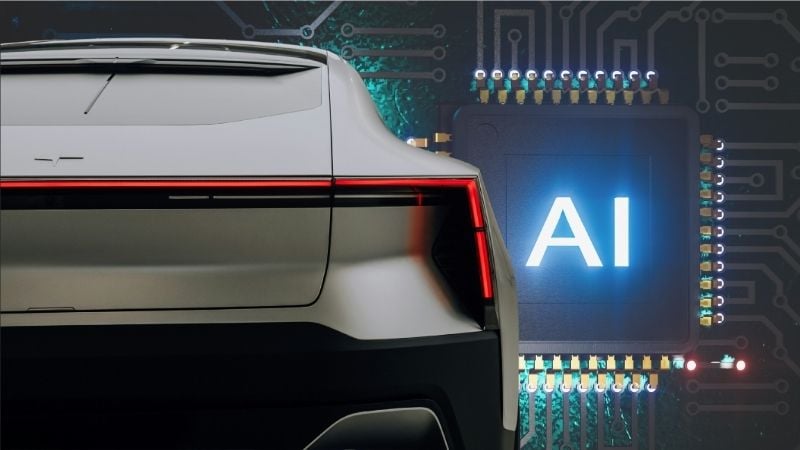
AI and machine learning are pushing the boundaries of EV technology. Adapted from image used courtesy of Unsplash
Predicting Problems
Advanced computational models simulate battery behavior under stress to predict thermal runaway, a chain reaction that overcharging, manufacturing defects, or physical damage to the battery cell can cause. These stresses can cause overheating or fires. Computer models can integrate chemical, thermal, and aging data to forecast failure risks based on battery chemistry, usage patterns, and degradation.
AI-enhanced BMS platforms use predictive analytics to estimate a battery system’s state of health by tracking resistance changes. The BMS can optimize charge-discharge cycles to prolong battery life and detect faults like gas leaks or internal shorts early to provide real-time safety warnings.
Lithium plating, a dangerous phenomenon where metallic lithium accumulates on the anode during fast charging or at low temperatures, can lead to dendrite formation and short circuits.
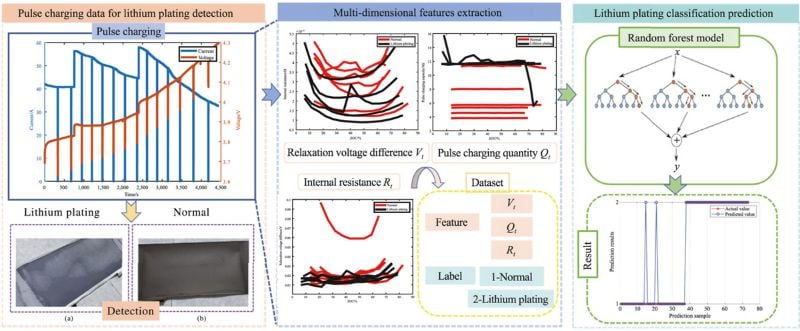
AI system to detect lithium plating. Image used courtesy of Zhu et al.
Researchers at the University of Shanghai for Science and Technology have developed an AI-driven system that detects early signs of plating with over 97% accuracy by analyzing electrical patterns during pulse charging without requiring hardware modifications. Computational models also reveal the interplay between ion transport and electrochemical reactions, enabling physics-based charging protocols to reduce plating risks.
Industry Leaders in AI and ML
Two industry leaders in modeling for multiphysics analysis are MathWorks and Ansys. Each company has tools allowing engineers to design, validate, and optimize BMS algorithms and hardware through virtual prototyping, real-time testing, and analysis.
MathWorks’ programming (Simulink and Simscape Battery) streamlines BMS development through model-based design, enabling multiple rapid iterations and validations. Engineers can create custom battery models using Simscape Battery’s equivalent circuit or electrochemical approaches. These models replicate real-world behaviors like aging, thermal dynamics, and charge and discharge cycles. Prebuilt BMS blocks in Simscape Battery support functions like cell balancing, fault detection, and thermal management. Engineers use the programs to simulate these algorithms under diverse conditions (for example, fast charging or extreme temperatures). Simulink Coder auto-generates C or HDL code for rapid prototyping and hardware-in-the-loop testing. Engineers can virtually test BMS responses to overvoltage, thermal runaway, and cell imbalances to enhance battery cell safety.
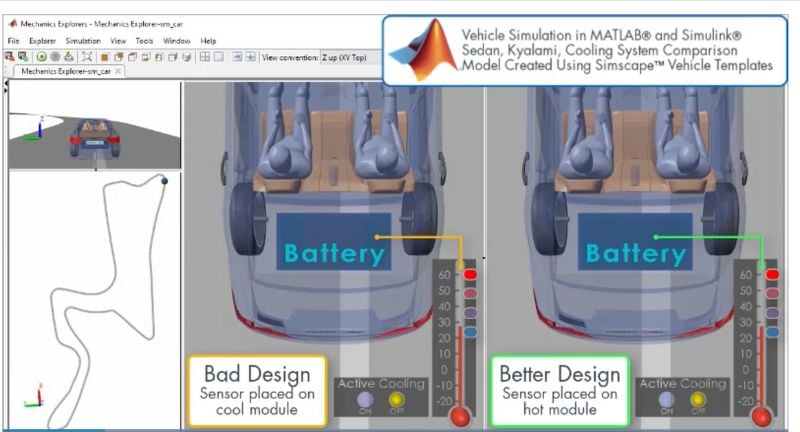
Example of Simscape Battery modeling. Image used courtesy of MathWorks
Ansys focuses its modeling on multiphysics integration and system-level validation, which are critical for addressing thermal, electrical, and mechanical interactions in BMS design. Ansys Fluent can be used to simulate heat generation and propagation in battery cells, while Twin Builder creates reduced-order models for pack-level thermal analysis. Ansys SCADE Suite generates certified code for BMS control logic, ensuring compliance with applicable functional safety standards.
MathWorks and Ansys provide complementary tools for BMS development. MathWorks excels in algorithm design and real-time code deployment, while Ansys prioritizes multiphysics safety validation and system integration. Together, they enable engineers to design safer, more efficient BMS architectures while reducing prototyping costs and accelerating time-to-market.
AI-Driven EV Batteries
In addition to aiding in better BMS development, AI can be used to accelerate the development of safer battery components and materials. IBM’s multi-modal AI models screen millions of molecules to identify optimal electrolyte formulations, balancing safety and performance.
Sepion Technologies used AI to design a nonflammable electrolyte with a high flash point and fast-charging compatibility, reducing fire risks.
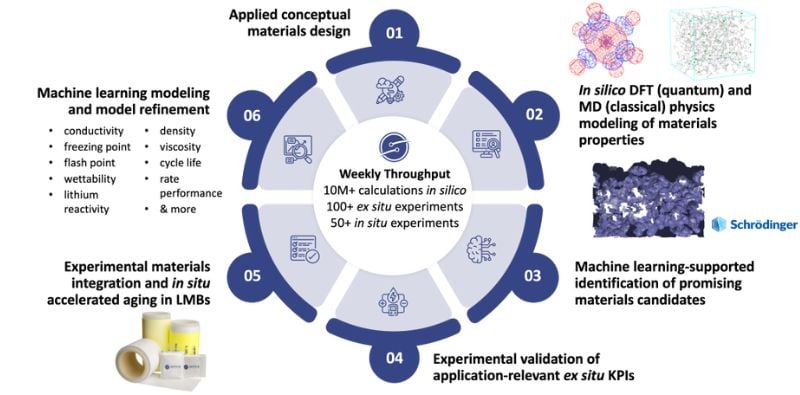
Sepion’s AI design. Image used courtesy of Sepion
By combining AI’s predictive power with computational modeling’s precision, researchers and manufacturers are creating safer, longer-lasting EV batteries while streamlining development. These innovations are critical as the industry pushes toward faster charging and higher energy densities.