Facebook
 Google
 GitHub
 Linkedin
Can Machine Learning Prevent EV Battery Fires?
The National Renewable Energy Laboratory is using machine learning to predict a battery’s risk of thermal runaway.
Before batteries can be used in commercial applications, they must be certified safe and reliable in conventional and extreme operating conditions, under changing temperatures, after repeated charging and discharging cycles, and over a full driving cycle range. Cell failure can result in extreme temperatures generated inside a battery pack, leading to thermal runaway. This can cause toxic fires to spread from the single cell across the whole battery pack.
Watch thermal runaway take hold within a lithium-ion battery. Video used courtesy of National Renewable Energy Laboratory
Using machine learning, researchers from the National Renewable Energy Laboratory (NREL) can predict battery thermal runaway behavior.

Thermal runaway can lead to fires in electric vehicles. Image used courtesy of Adobe Stock
Thermal Runaway Issues
Since batteries can operate in harsh environmental conditions, there is always a risk that they will undergo thermal runaway. The main issue within battery packs is propagation, where a thermal runaway in one cell heats neighboring cells, causing it to spread out across the battery pack.
With the chance for major propagation issues, understanding the heat output of lithium-ion cells during thermal runaway is key for designing safe batteries. However, the heat output can vary greatly depending on the properties of the cell, cycle history, and test conditions. The main challenge is the variability in thermal runaway under identical test conditions.
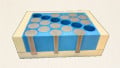
Currently, measuring thermal runaway relies on the fractional breakdown of the ejected heat and the heat that remains in the cell casing. This measures a cell’s fractional heat and measures the ejected material at either end of the cell and through the casing. These are calculated using a fractional thermal runaway calorimeter (FTRC). The variability arises under the same test conditions because what happens inside individual cells can differ, leading to different heat distributions.
Current methods to account for the variance in the results are time-consuming and expensive. The challenges with thermal runaway have slowed the adoption of new cell architectures for electric vehicles.
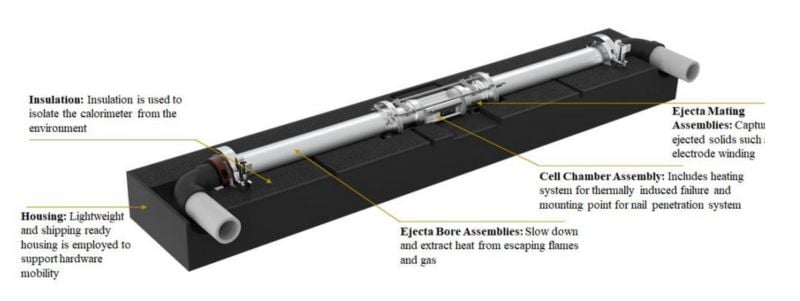
Cutaway view of the FTRC. Image used courtesy of NASA
Machine Learning Approach Predicts Thermal Runaway Variability
NREL’s approach uses machine learning to streamline the data on the ejected mass during thermal runaway. It has been used to predict complex thermal runaway behavior in new cell types with a much higher accuracy and speed.
The approach took calorimetry measurements from commercial lithium-ion cells in the open-access Battery Failure Databank created by NREL and NASA. This is the largest public database available containing information on thermal runaway data. These data measurements were used to train a machine-learning model to identify which battery architectures are likely to fail.
The machine-learning model predicted the variable fractional heat output of cells undergoing thermal runaway without needing physical or electrochemical properties or experimental calorimetry techniques. The model could predict the heat distribution (including outlier data) and quantitatively predict the mean and variance of a new cell type's total and fractional heat output using only 0-5 FTRC measurements. The method could also predict heat ejection from the cell’s positive and negative ends through the casing. This approach offered a more streamlined framework for accurately predicting any new cell’s thermal behavior and estimating its safety risks.
Data-Driven and Experimental Methods
Machine learning is used in the battery and wider energy sector to provide better prediction capabilities. It offers the chance to significantly reduce the resources required for battery testing by relying on a few calorimetry measurements. Machine learning is not meant as a replacement for physical testing. Instead, it should be used with physical measurements to streamline and speed up the testing process and produce more accurate results in the safety of new batteries.