Facebook
 Google
 GitHub
 Linkedin
AI Warns of Imminent EV Thermal Runaway Danger
A deep learning model proved more accurate than other methods in predicting thermal runaway in lithium-ion batteries.
In electric vehicles, thermal runaway in lithium-ion batteries threatens the safe charging of batteries and the vehicle operation. More powerful batteries need higher charge and discharge currents, which can raise the internal temperature more rapidly. An inability to monitor the temperature causes batteries to experience poor battery performance and thermal runaway, which leads to safety issues.
Why does thermal runaway make batteries catch fire? Video used courtesy of UL Research Institutes
Qingdao University of Science and Technology researchers tried using deep learning algorithms as an early warning model for thermal runaway events.

Thermal runaway can cause fire in EV batteries. Adapted from images used courtesy of Wikimedia Commons and Canva
Thermal Runaway in EV Batteries
Thermal runaway is a rapid increase in temperature within a battery in response to overcharging and over-discharging, physical damage to the battery, and short-circuiting. These rapid temperature events often lead to battery fires and sometimes battery explosions.
Statistics show that thermal runaway accounts for around one-third of all lithium-ion (Li-ion) battery accidents. Excessive charging temperatures from EV charging infrastructure can cause battery damage and performance degradation and potentially lead to thermal runaway. Monitoring and predicting how batteries will behave while charging and assessing their risk of thermal runaway are key to ensuring that EV batteries remain safe for use.
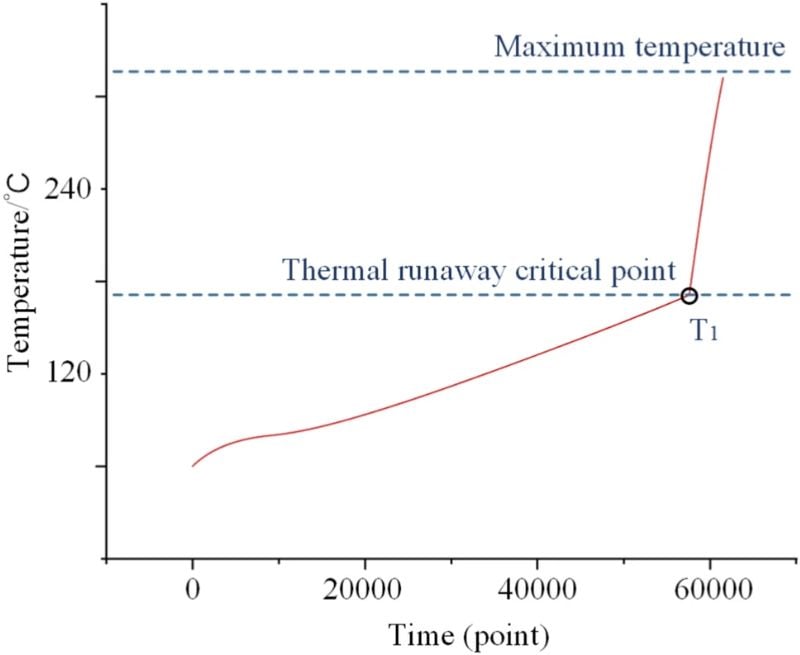
Internal temperatures increase the risk of thermal runaway. Image used courtesy of Cheng et al.
Three main avenues are used to address thermal runaway in EV batteries. The first is a material-focused approach to replace the internal cooling systems with more efficient thermally dissipating materials. This can be done in conjunction with prediction and software-based methods.
The second is to use numerical modeling simulations from the sensor data to deduce early warning characteristics. While modeling has been useful, sensor defects have been an issue that doesn’t always lead to the most robust models.
The third and most recent approach is to use big data predictions, such as AI algorithms, to intelligently manage EV charging infrastructure to ensure the batteries are safe during charging and not subjected to overcharging.
Using Deep Learning for Early Thermal Runaway Warnings
Researchers have tried using deep learning algorithms to model and predict the non-linear characteristics of the EV battery charging process. The algorithms act as a battery fault early warning system by analyzing different characteristic signals associated with fault identification, including terminal voltage, surface temperature, internal impedance, gas generation, and expansion forces within the battery. Using these characteristics, the deep learning model can predict thermal runaway before it actually occurs.
In this study in Nature Scientific Reports, the researchers developed a long- and short-term memory network and temporal convolutional network (LSTM-TCN) model that provided an early warning detection based on the nonlinear relationship between the current, charging voltage, temperature, and battery status.
The researchers first gathered the data from the charging network before selecting the model parameters to establish in the LSTM-TCN model to predict the charging temperature of the EV battery. They collected data from both normal and abnormal charging scenarios using two different types of EV Li-ion batteries—lithium iron phosphate and lithium nickel manganese cobalt oxides—at various temperatures.
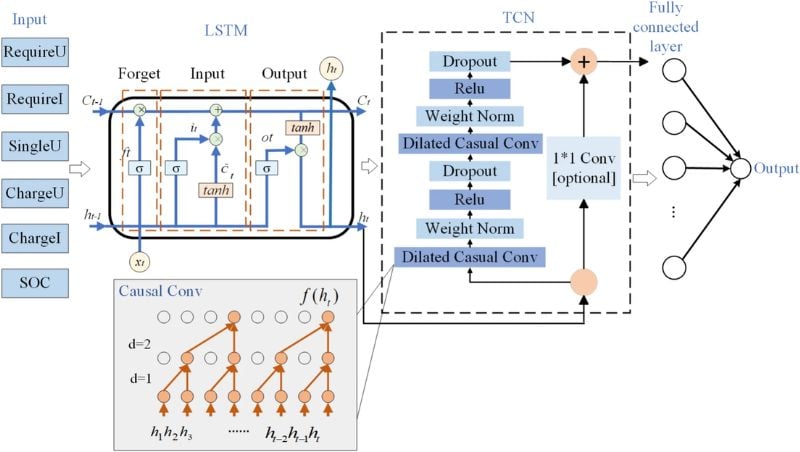
LSTM-TCN model. Image used courtesy of Cheng et al.
The real-time charging data was then compared to the predicted data to build a highly accurate model. The researchers also performed a residual analysis using a sliding window method to monitor the real and predicted temperatures and obtain the pre-warning temperature thresholds for the point where the temperature causes concern and indicates that thermal runaway could happen. The threshold is set before the thermal runaway temperatures to provide an early warning before it physically occurs and ensure safe EV charging.
Experimental results showed that the LSTM-TCN early warning model had higher accuracy than other early warning models, allowing it to react quicker and more accurately to potential charging accidents before they occur. The LSTM-TCN early warning model reduced the mean absolute error by up to 9.4% (the measure of error between observations) and reduced the root mean squared error by up to 10.2% (the difference between predicted and actual values). The deep learning model showed an early warning detection time from a minimum of 9.95 seconds to a maximum of 22.00 seconds before thermal runaway was initiated, providing a proactive approach to ensuring higher safety during EV charging.
Approach Shows Improvements but Still Needs Work
The model has shown improvements over other early warning models, but like many detection systems and other AI models, there’s often room for improvement. The researchers have stated that there was insufficient research into various charging methods, and investigating other charging configurations in the future could improve the model’s effectiveness of the model further.
Since EVs are relatively new technologies, there are no swaths of historical data to work with, which deep learning algorithms rely on for learning. This restricts the system to specific vehicle models. Obtaining more diverse EV battery data in the future could also help to improve the model further.