Facebook
 Google
 GitHub
 Linkedin
Battery Research Could Lead to EV Performance, Longevity
The findings aim to prolong battery lifespan to support the rise of battery-driven products and electric vehicles.
As electric vehicles surge toward mainstream adoption, their widespread success hinges on overcoming technical limitations. These limitations include safety risks from fast charging, performance loss due to unstable battery chemistry, and reduced lifespan caused by aggressive discharge cycles.
Researchers in China and South Korea are poised to address some of these most persistent challenges with breakthroughs in battery chemistries and technology.
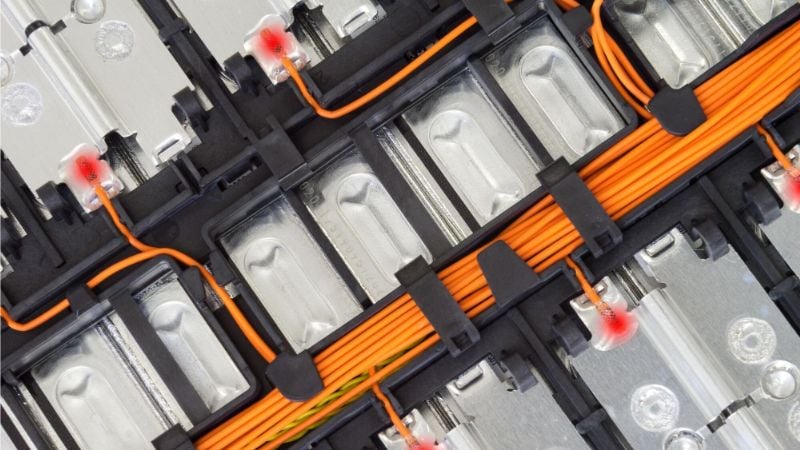
Lithium-ion batteries in an EV. Image used courtesy of Adobe Stock
Shanghai’s Lithium Plating Detection
Lithium plating in lithium-ion batteries happens when unwanted metallic lithium forms on the anode surface during charging instead of the intended intercalation of lithium ions into the anode material. This process can cause capacity loss, reduced battery life, and even short circuits. Chinese researchers at the University of Shanghai for Science and Technology have developed a machine learning-based detection method to address this problem.
The system combines pulse charging with a random forest algorithm to identify lithium plating events with an accuracy exceeding 97.2%. By collecting voltage and current signals during controlled pulse charging intervals and calculating normalized internal resistance at 5% state-of-charge intervals, the method identifies deviations associated with lithium deposition. To enhance precision, the researchers extracted multi-dimensional features, including relaxation voltage difference, pulse charging capacity, and internal resistance, from 24 test batteries (150 Ah and 3.7 V) under sub-zero temperature conditions to trigger plating.
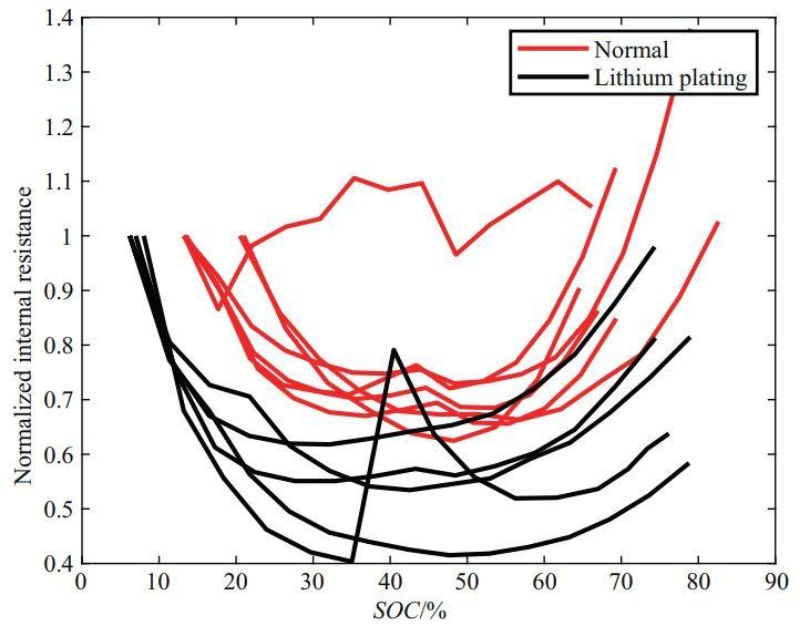
Graph of normalized internal resistance. Image courtesy of Zhu et al.
Compared to single-feature detection methods, which reached only 68.5% accuracy, this multi-feature approach improved detection reliability. The detection algorithm can also integrate into cloud platforms or battery management systems for real-time monitoring and preventative intervention. The team stated that future work will include expanding the dataset for cross-chemistry versatility and integrating it with fast-charging systems for real-time parameter optimization.
Huazhong University’s Alloy Anode
Interfacial instability in solid-state batteries happens when the contact between the solid electrolyte and the electrode breaks down over time. This poor contact can block lithium from moving smoothly across the interface, leading to dendrites and a slew of safety and longevity concerns.
Chinese researchers have developed a mixed ion-electron conducting LixAg alloy anode. This alloy, synthesized in situ on a garnet-type LLZTO electrolyte, demonstrates superior lithium diffusion kinetics due to its high mutual solubility and low eutectic point. These properties reduce lithium concentration gradients and shift local overpotentials to promote lithium plating and stripping at the LixAg/current collector interface rather than at the LixAg/LLZTO interface (the major bottleneck).
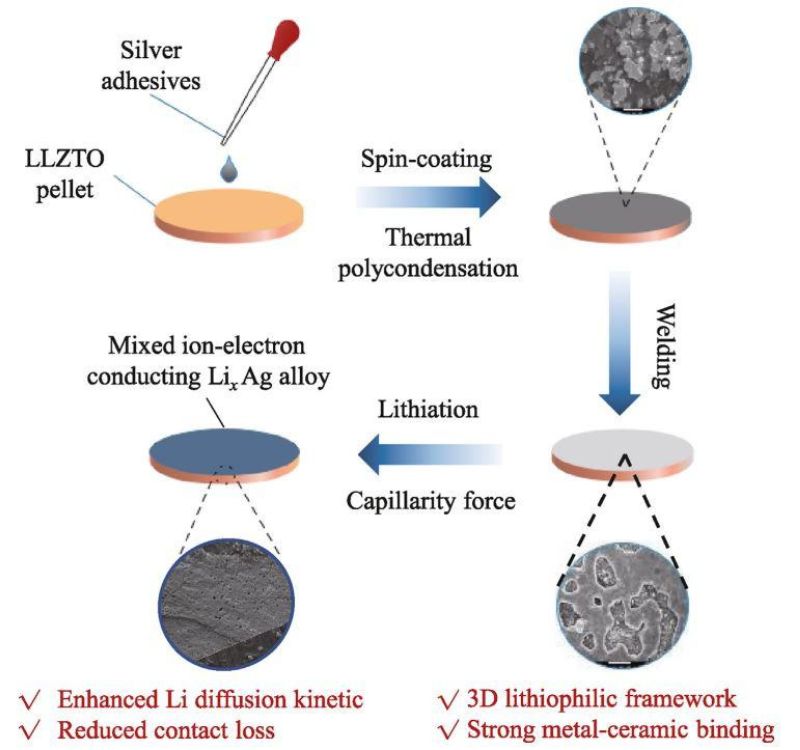
The synthesis of LixAg. Image courtesy of Cheng et al.
The architecture achieves a critical current density of 1.2 mA/cm^2 and stable cycling performance exceeding 1,200 hours at 0.2 mA/cm^2, with interfacial resistance 2.5 Ω·cm^2. Full cells incorporating LiFePO₄ cathodes retained over 94% of their initial capacity after 120 cycles. And, structural analysis confirmed the formation of a uniform, lithiophilic 3D Ag framework that maintains tight contact with the LLZTO and supports the formation of a solid-solution LixAg alloy.
POSTECH’s Quasi-Conversion Reaction
Overcharging is considered a major reason for battery degradation. Researchers from POSTECH have identified a new mechanism called “quasi-conversion reaction” that could be a large contributor as well.
In this process, surface oxygen reacts with lithium to form lithium oxide (Li2O), which decomposes the electrolyte through exothermic reactions that produce gases and a resistive surface layer. Their study identifies a reduction-driven mechanism that initiates significant structural decay at low discharge voltages. They discovered that in NMC622, surface reconstruction of cathodes from the layered to rocksalt phase occurs during charging above 4.3 V and also during discharging below 3.0 V.
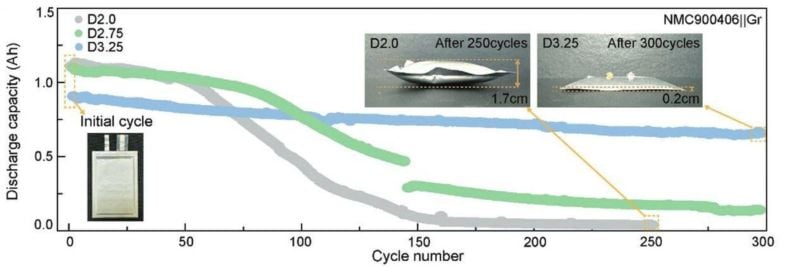
Comparing degradation at different discharge voltages. Image courtesy of Jeon et al.
Density functional theory revealed that surface oxygen, especially when coordinated with Ni or Co but not Mn, becomes unstable and can be reduced at voltages between 2.0 and 3.0 V. This initiates surface densification and lithium oxide formation, which reacts with carbonate electrolytes to trigger decomposition. Resulting byproducts form a resistive cathode-electrolyte interphase, which increases overpotentials and hinders charge transfer.
Full-cell tests using Ni-rich NMC900406 confirmed dramatic performance loss and gas generation under low-voltage cycling. The findings showed that the quasi-conversion reaction is more pronounced in cathodes with over 90% nickel content, where batteries retained only 3.8% capacity after 250 cycles under deep discharge conditions. In contrast, batteries cycled with higher discharge cut-off voltages preserved 73.4% capacity after 300 cycles. The study concludes that elevating the discharge cut-off voltage to 3.25 V suppresses this degradation and allows a 19-fold improvement in cycle life.
Major Findings in the Battery World
These findings invite a broader reevaluation of how battery systems are cycled in applications that prioritize long service life. Future battery management algorithms may evolve to prioritize partial discharge routines tailored to specific cathode chemistries. Hopefully, such approaches could support more predictive maintenance and extend the operational lifespan of high-energy storage systems.