Facebook
 Google
 GitHub
 Linkedin
Using AI To Predict Battery Performance
An AI-driven electrochemical design tool pinpoints promising electrolyte materials for high-performance batteries.
California-based startup Aionics has expanded into high-performance battery electrolytes used in electric vertical take-off and landing aircraft.
The company’s materials informatics platform employs machine learning and quantum mechanical simulations to review billions of electrolyte formulations and select the most promising candidates. The models can screen all known materials and formulations for favorable performance metrics and identify critical properties like flammability, temperature range, and salt solubility.
Combining atomistic simulations and experimental data, Aionics’s models use a SMILES string (simplified molecular-input line-entry system) as the input, based on a textual representation of a molecule structure. In addition to known formulations, the platform can predict novel candidates with a valid SMILES string but unknown properties.
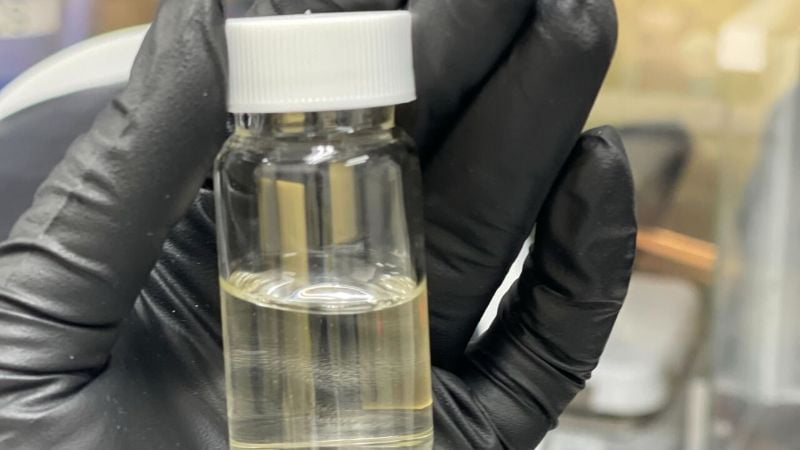
This AI-guided electrolyte formulation resulted from millions of hours of simulations, with dozens of models analyzing billions of potential molecules. Image used courtesy of Aionics
AI-Predicted Material Selection
Aionics released its molecular property prediction models on Google Cloud in late 2024. These models allow battery engineers and researchers to predict electrolyte properties across six parameters: boiling, melting, flash points, dipole moment, and oxidative and reductive stability (highest occupied and lowest unoccupied molecular orbitals, respectively). Users can deploy Aionics’s models on large datasets, such as the ZINC database of commercially available molecules.
Aionics’s graph neural network (GNN) models can process any known or unknown molecule. GNNs can learn directly from molecular structures represented as graphs, spotting complex patterns and learning the structure-property relationships in large datasets more efficiently than conventional feature-based models.
In 2023, Aionics signed a licensing agreement with Carnegie Mellon University for intellectual property developed in a Department of Energy ARPA-E program, transitioning the university’s computational design tools from research to industry practice.
A Proven Platform and Industry Support
Aionics has completed several case studies backing its technology. In one example, it partnered with a battery cell manufacturer that came to the company after spending over a year sampling more than 80 electrolyte formulations for the highest-performing candidates. The Aionics platform sped up the process and predicted battery degradation from electrolyte components and their concentrations. The customer then applied these predictive models to hundreds of potential formulations, achieving the desired performance metrics with a 10x reduction in cost and time.
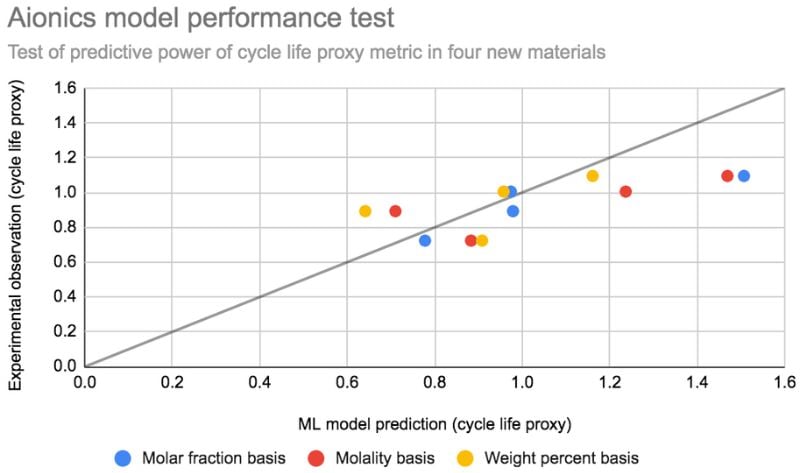
Cycle life predictions from an Aionics machine learning model. Image used courtesy of Aionics
In another case study, Aionics worked with a battery manufacturer to analyze electrolyte formulations offering an optimal cycle life. After training the model to predict electrolyte components and concentrations, the platform reviewed thousands of high-performing candidates and selected an electrolyte with 10x higher accuracy than guesswork.
Stanford University and the University of Michigan battery scientists founded Aionics in 2020. Aionics Co-Founder Venkat Viswanathan, a University of Michigan associate professor, recently made a major generative AI breakthrough last year, introducing a Molecular Insight Transformer trained on two billion SMILES molecule representations. The final model will expand that target to nearly 50 billion molecules with 5 billion parameters.
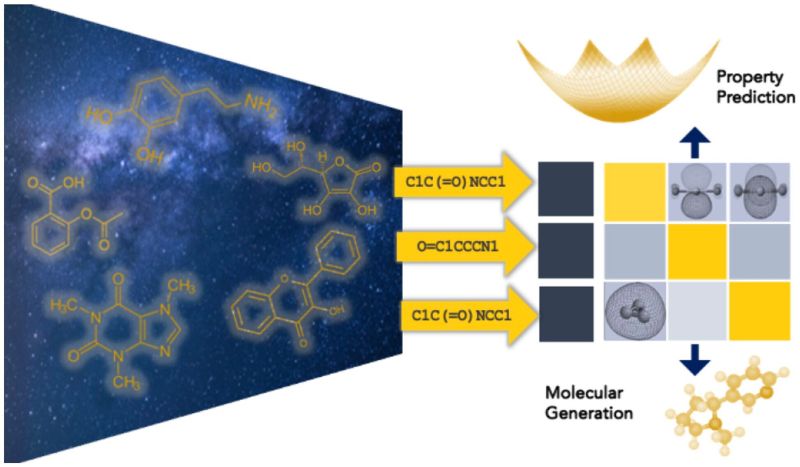
Foundational models screen promising molecules for battery electrolytes. Image used courtesy of the University of Michigan/Aionics
Since its founding, Aionics has attracted several backers, including Trousdale Ventures, UP Partners, the University of Michigan’s MINTS program, and Avila VC—all participants in its recent oversubscribed round. The company has also landed a few early customers, including a joint development partnership with Porsche subsidiary Cellforce Group to design next-generation EV batteries. Iron-air battery developer Form Energy also uses the platform to build machine-learning models that identify performance-boosting chemical features. Japanese chemical giant Showa Denko regularly employs Aionics’s API to predict novel material properties.
Last month, the company announced it entered another joint development agreement with a leading electric aviation manufacturer, marking its expansion into the eVTOL space.