Facebook
 Google
 GitHub
 Linkedin
Research Tackles the Dendrite Dilemma in Lithium Batteries
Faster charging rates have raised concerns about battery safety and longevity, so researchers are focusing on the chemical composition of batteries to optimize charging speed while maintaining high safety levels.
With the demand for instant power rising, fast-charging batteries pave the way for a future where energy is readily available. However, as batteries charge faster, concerns over battery integrity and safety are rising.
Tata Institute of Fundamental Research Hyderabad (TIFRH) researchers have modified the battery’s chemical structure to suppress dendrite growth. TIFRH’s research aims to provide a solution to optimizing battery charging speed and safety.

Dendrite growth in a battery. Image used courtesy of University of California Davis (By Jiandi Wan)
Navigating Through Lithium Challenges
A traditional lithium-ion battery consists of an anode, cathode, separator, electrolyte, and two current collectors. The electrolyte transports positively charged lithium ions between the anode (generally graphite material) and cathode via the separator. This ion movement generates free electrons in the anode, inducing a positive charge at the current collector.
A notable challenge to conventional lithium-ion (Li-ion) batteries is slow charging speeds, which impedes their widespread adoption, particularly in electric vehicle technology. Despite graphite's long-standing dominance in the anode market due to its affordability and electrochemical prowess, the material experiences inherently slow intercalation of the Li+ ions, acting as a bottleneck towards faster charging speeds.
As a result, lithium metal batteries (LMBs) have emerged as a promising solution for significantly faster charging times. Unlike Li-ion batteries, which use graphite anodes, LMBs’ anodes are made from lithium metal, which offers a greater specific capacity than graphite.
However, the integration of lithium metal anodes introduces a problem of dendrite formation. Dendrites are material protrusions that develop during the charging process due to uneven lithium deposition on the anode surface, exacerbated by high-current charging conditions. Dendrite formate poses severe safety risks, such as short circuits, by puncturing the separator and creating an uncontrolled current flow. Dendrite formation has been one of the biggest obstacles to commercializing LMBs.
Battling Dendrites
The TIFRH team has modified a standard LMB battery's separator membrane by coating it with a readily available graphite derivative powder, graphitic fluorocarbon, to suppress dendrite growth. By modifying the separator membrane's chemistry, the team could ensure more uniform lithium deposition, even at high fluxes, effectively mitigating the issues concerning dendrite formation. Ultimately, the team’s method offers promising prospects for enhancing the energy density (10x), safety, and longevity of LMBs.
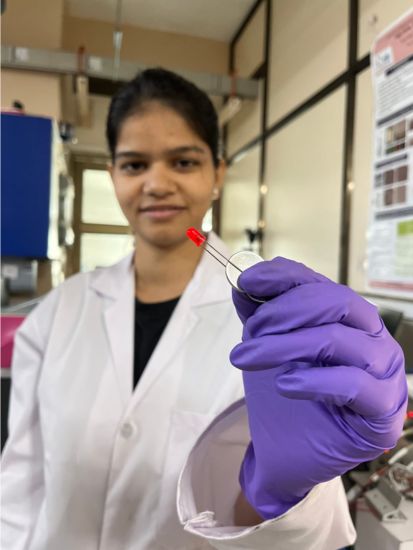
TIFRH research powering an LED with its modified battery. Image used courtesy of TIFRH
The research team maintains that their method's uniqueness lies in its simplicity and scalability. By addressing the dendrite formation challenge in a way that’s scalable and easy to integrate into the existing manufacturing processes, the research team hopes that LMBs can find their way into commercial adoption.
Advancing Battery Science
The TIFRH breakthrough hopes to address some of the most notable challenges facing LMB advancement by suppressing dendrite growth through a scalable and cost-effective approach. While the immediate impacts of such a development include improved battery performance and safety, the team also recognizes potential prospects in industrial settings. While the research recognizes challenges still exist in their solution, particularly at high current densities, the team’s next steps are to learn more about these shortcomings by exploring the role of interfaces in enhancing battery performance from a fundamental perspective.