Facebook
 Google
 GitHub
 Linkedin
Faster, Smarter EV Design with AI
Donut Lab and Qt have integrated hardware with artificial intelligence to accelerate electric vehicle development.
The electric vehicle industry is experiencing meteoric growth as global demand for sustainable transportation increases. However, challenges such as prolonged development cycles, high error rates, and inefficiencies in integrating complex hardware and software systems continue to hinder progress. Traditional design processes are manual, resulting in delays, limited scalability, and difficulty maintaining safety standards.
With rapidly evolving customer requirements, engineers require development platforms to enhance efficiency while maintaining compatibility across diverse components and systems. In collaboration with Qt, Donut Lab unveiled a platform enhancement to tackle these challenges and accelerate development and system integration in the EV space.

Donut Lab’s platform, the Brain. Image used courtesy of Donut Lab
The Status Quo
In EVs, the vehicle control unit (VCU) is an electronic module that functions as the brain of the electrical system. It incorporates electronic components such as microcontrollers, analog-to-digital converters, memory, and communication interfaces (such as CAN, SPI, Ethernet, and Bluetooth). The VCU’s main role is to manage and coordinate among the hardware subsystems, such as motor drives and battery packs.
While the VCU is a collection of hardware, its internal software enables precise control and coordination of the EV's functions. Additionally, as artificial intelligence becomes more prominent in space, the software is expected to perform predictive maintenance and enhance overall vehicle safety by monitoring the subsystems’ sensors. For example, the VCU might monitor the battery’s thermal sensor to prevent thermal runaway.
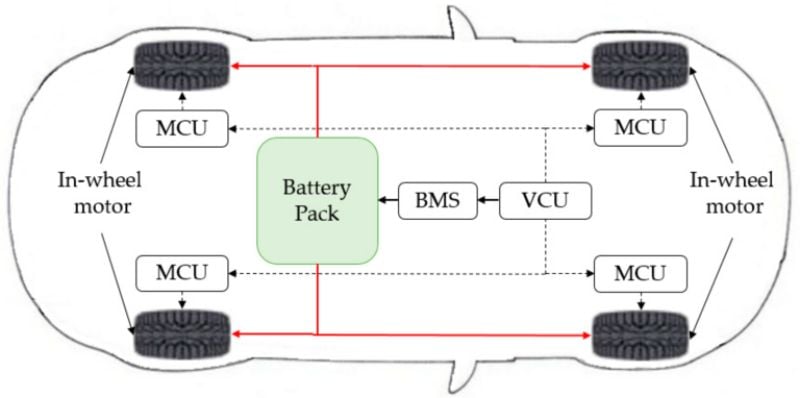
VCU’s functionality in an EV. Image courtesy of Wang et al.
However, developing such comprehensive software is a fundamental yet highly demanding process. Achieving a fully functional and reliable system often requires significant time and development efforts. In particular, the software must ensure interoperability with hardware, which necessitates exhaustive validation through simulations and hardware-in-the-loop testing.
Donut Lab and Qt Accelerates AI Software Development
Donut Lab collaborated with the software company Qt to integrate a new software layer into its already existing Donut Platform.
Launched in November, Donut Lab's platform features a comprehensive collection of ready-to-use EV components, including motors, batteries, and onboard computers. The system's pre-configured design eliminates manual integration requirements to facilitate vehicle development. Now, with the Qt collaboration, the platform will soon incorporate an advanced software layer featuring AI to optimize vehicle design, testing, and validation processes. The aim is to accelerate software development by a factor of ten through a no-code environment, where graphical user interfaces replace traditional coding.

A donut-shaped EV component. Image courtesy of Donut Lab
The new software layer will be able to integrate physical components and interact with third-party technologies, including human-machine interface (HMI) systems developed in collaboration with Qt’s Accelerate solution. This integration will automate the creation of vehicle-specific HMIs that can dynamically adapt to the vehicle's configuration without manual intervention. The platform will also support real-time data analysis for parameters like motor performance and battery efficiency.
Sustainable Transportation is the Future
By addressing technical challenges such as integrating bottlenecks and scalability limitations, Donut Labs believes that its recent collaboration can set the stage for more agile and adaptable design processes. These advancements could also influence the pace of innovation across the EV industry and afford the industry a smoother transition to sustainable transportation solutions.