Facebook
 Google
 GitHub
 Linkedin
Why Modeling and Simulation Are So Important for Battery Management System Design
Several engineers have been using modelling and simulation already for quite some time, but now these methods have become almost mandatory. Bodo’s Power Systems spoke with Danielle Chu, Product Manager at MathWorks, about the impact of modelling and simulation on the daily work of battery management systems designers, but also about e. g. development time, functional safety or compliance.
This article is published by EEPower as part of an exclusive digital content partnership with Bodo’s Power Systems.
Why have modeling and simulation become almost mandatory for efficient design processes in battery management system designs?
A short look at an example will allow us to highlight the importance and the benefits of modeling and simulation, and a BMS (battery management system) is an excellent example, because it is of critical importance to monitor and manage the battery pack’s performance and health. Without an effective BMS, several negative outcomes can arise. For example, overcharging can lead to excessive heat generation, potentially causing thermal runaway, which may result in fires or explosion. Traditional BMS development methods often struggle with lengthy prototyping and high material expenses. However, modeling and simulation can accelerate development and reduce costs.
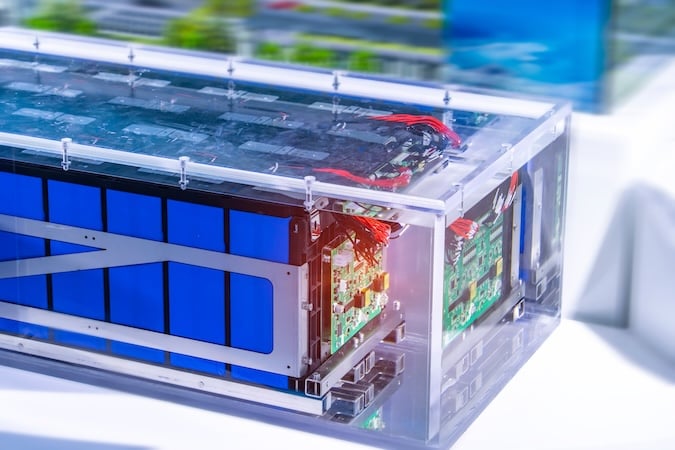
Image used courtesy of Adobe Stock
What does this really mean for the every day life of an engineer who designs a BMS for a vehicle?
Engineers use simulation tools for system-level multi-domain modeling to understand component interactions and evaluate design choices – for example, how different battery pack configurations affect vehicle range and energy consumption. Companies like Altigreen Propulsion Labs built a system-level simulation model of the vehicle, used it to test how different components work together, and validated designs earlier in the development cycle. Simulations let them test concepts quickly and easily iterate to refine the BMS design.

Image used courtesy of Bodo’s Power Systems [PDF]
Furthermore, engineers use simulation to develop and test different BMS algorithms with the battery plant model. One functionality of BMS is cell balancing which ensures all cells in a battery pack have the same state of charge (SOC). Without balancing, some cells may degrade faster than others, reducing the capacity of the battery pack and driving range. Engineers at Green Tiger Mobility simulated real-world conditions and selected the appropriate balancing resistor for cell balancing and determined discharge currents involved. They mentioned that the simulation streamlined battery pack development and robust BMS design, resulting in time and cost savings.
Do you also have an example that shows how modeling and simulation can shorten the development time, may be also by providing some figures of merit?
This is an important issue because the electric vehicle market demands faster development time to keep pace with technological advancements and consumer expectations. Therefore, engineers use simulation software that allows early validation, easy debugging, rapid prototyping and testing of components and systems in a virtual environment to reduce the time needed for physical prototypes. For example, a company named Exponent Energy accelerated product prototyping through code generation from models rather than debugging C code for the application and drivers. Engineers were able to complete the 400 V fast charger in a mere 10 days, despite none of them being firmware experts. They accelerated the development, testing, and verification of the entire solution by at least five times.
Engineers may spend more time upfront on the simulations, but the testing on actual hardware will be likely more successful and quicker. At the end, the development cycle is shorter, and cost is reduced.
In which way does desktop simulation support the engineers who need to verify the functional aspects of e.g. a BMS design?
Engineers simulate the battery plant model, environment, and BMS algorithms on a desktop computer using behavioral models. Desktop simulation enables engineers to verify functional aspects of the BMS design and identify potential issues early, which reduces the development time and cost. Some specific benefits include the logic validation, benchmarking against the requirements, setting control parameters, exploring different design choices, fault simulation, assuring the passing of functional safety and compliance standards as well as an overall simulation in the entire vehicle system.
Let’s dive deeper into these simulation aspects…
Engineers use open-loop desktop simulation to validate the logic of BMS algorithms before deploying them in real-world applications. A typical aspect is checking whether the cell balancing algorithm is activated when the cell voltages are unbalanced; do the meet the thresholds? Is the charging control logic implemented correctly? When reaching the thresholds, will the BMS actively reduce or stop the charging current to protect the battery from damage?
Furthermore, a BMS design needs to meet a set of requirements like accuracy of state of charge (SOC) estimation under various conditions, overcharging and overheating protection etc. Engineers can test the BMS algorithms using closed-loop desktop simulation with the battery plant model to make sure the BMS is designed to meet all the performance requirements.
At some point of the design process engineers need to tune control parameters in the BMS algorithms – i.e. the extended Kalman filter covariance for SOC estimation. Desktop simulations provide quick feedback for tuning BMS algorithm parameters.
But engineers also use desktop simulation to explore different design choices and evaluate trade-offs between them before committing to a hardware prototype. For example, they can evaluate different balancing configurations like active balancing vs. passive balancing, or for determining the optimal resistor value for passive balancing.
What about the functional safety and compliance aspects?
EV batteries can be hazardous if they fail. Fault simulation helps identify potential safety risks and develop strategies in the BMS to detect, respond and mitigate them more effectively. For example, engineers can inject non-intrusive faults inside the battery, such as open circuits due to defect welds and disconnection, short circuits, and thermal runaway. Understanding and addressing potential faults early in the design phase can help reduce costs associated with recalls, repairs, and warranty claims.
Electric vehicles must meet functional safety and compliance standards, such as ISO 26262. Software like Simulink supports automatic code generation ensuring that what is tested in the model is what runs on the hardware. The generated code can be configured to comply with automotive coding standards, such as MISRA C, which aligns with ISO 26262.
We should always keep in mind that the BMS is just one part in an electric vehicle; there are also traction motors, cooling systems etc. Engineers run vehicle-level simulations to study how different components of the EV, such as the battery, the electric motor, power electronics and the BMS interact with each other. It helps in identifying integration issues early in the development process, reducing the risk of costly redesigns. On top of that, engineers can simulate different driving scenarios to optimize energy efficiency and the vehicle’s range.
How can engineers use cell characterization to fit a battery model to experimental data?
Cell characterization is a crucial step in developing accurate battery models that reflect real-world performance. By following a structured approach to data collection, model selection, parameter fitting, and validation, engineers can create highly accurate models that enhance the design of BMS. However, for successful cell characterization, engineers should follow a structured five-step method. This is important to ensure that the battery models reflect the experimental data correctly – from data collection via battery model selection and parameter fitting to validation and iterative refinement.
You mentioned five steps, please explain this briefly…
For data collection engineers need to decide what tests to conduct in the battery test lab, and then they need to collect the data on voltage, current, temperature and state of charge (SOC) during charge and discharge cycles. For testing, typically, current profiles need to excite the battery system adequately so that there is enough information for identifying the battery model parameters. These are typically made of pulsed current profiles. An example can be HPPC (hybrid pulsed power characterization) profiles.
When it comes to battery model selection, engineers choose an appropriate battery model that can be parameterized to fit the experimental data. The choice of the battery model affects the complexity and accuracy of the simulation, so it must align with the intended application and available data. Common models include battery equivalent circuit models, electrochemical models, and data driven models. The battery equivalent circuit model is often employed for BMS designs because of its simplicity, high fidelity, and computational efficiency.
Another important step is parameter fitting: Using techniques such as curve fitting, optimization algorithms or machine learning, engineers adjust the model parameters to minimize the difference between the model’s predictions and the experimental data. Precise parameter fitting ensures that the model can accurately predict battery behavior under a wide range of conditions.
Next, engineers validate the fitted model by comparing its predictions against additional sets of experimental data – maybe a drive cycle current profile – not used in the fitting process.
The last step is iterative refinement: Based on validation results, engineers may iteratively refine the model by adjusting parameters or incorporating additional data to improve accuracy.
This article originally appeared in Bodo’s Power Systems [PDF] magazine.
Related Content