Facebook
 Google
 GitHub
 Linkedin
Closing the Gap: ICF Report Urges Strategic Grid Action Now
An ICF report advises utilities to prioritize location-specific planning and grid-enhancing technologies while grid expansions catch up to demand.
Grid upgrades are increasing in the U.S., but not nearly fast enough to meet demand, according to a report by energy-efficiency analysts, ICF. The report projects that demand will increase by 21% in 2030 and 39% by 2035, driven by data centers, industrial electrification, and electric vehicles.
New generation and transmission infrastructure are also expanding, but the growth rate doesn’t come close to meeting the projected energy demand. To fill the gap, ICF states that utilities should deploy grid-enhancing technologies and demand-side flexibility now. At the same time, energy leaders should understand the big picture while focusing on location-specific needs.

How can grid upgrades keep up with energy demand? Image used courtesy of Adobe Stock
Capacity vs. Peak Demand Mismatch
The ICF report points out that grid infrastructure can take years to construct and come online, whereas the surge of data centers and other high-demand industries needs power immediately. The U.S. will add 445 GW of capacity through 2030, but only 68 GW will be operational by 2026. Renewable energy intermittency reduces the value of these additions during periods of stress. On a peak basis, the 445 GW will contribute only 191 GW of dependable capacity.
What’s more, infrastructure improvements are not occurring evenly throughout the country. The areas most needing more capacity aren’t always the places where expansions are happening. This pressure varies significantly by location.
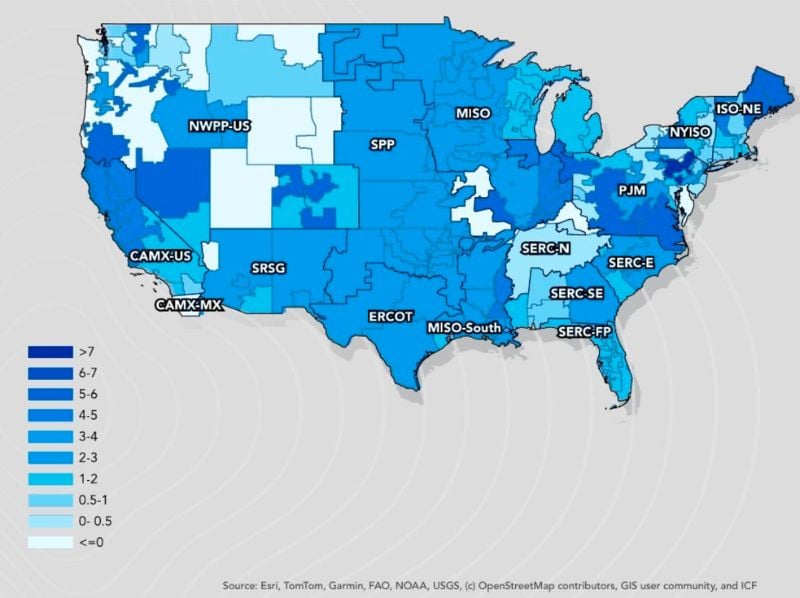
Energy demand growth by 2035, by region. Image used courtesy of ICF
For example, ERCOT and PJM have zero spare capacity beyond next year. SERC and NYISO capacity could fall below minimum reliability levels by 2030. Total demand in PJM will spike by 43% by 2035, while NYISO will see a 14% increase.
Infrastructure Expansions and Supply-Chain Bottlenecks
To keep up, annual installation rates must double recent levels to meet demand, according to ICF. At least 260 GW of early-stage projects need to begin construction in the next two to three years. Solar leads the buildout with 177 GW planned by 2030. Battery storage will add 120 GW by 2030 to mitigate solar intermittency. Utility-scale natural gas will contribute 77 GW by 2030 to maintain reserve margins.
At the same time, transmission lines should expand to move this power to heavy-load areas. Investor-owned utilities will spend $178 billion on transmission lines between 2025 and 2028. This is up from $115 billion spent from 2021 to 2024. The Department of Energy plans to build 7,500 miles of new lines to expand long-distance capacity 16% by 2030.
However, five core bottlenecks are delaying these projects: long interconnection timelines, lack of local distribution capacity, siting issues, equipment backlogs, and labor shortages.
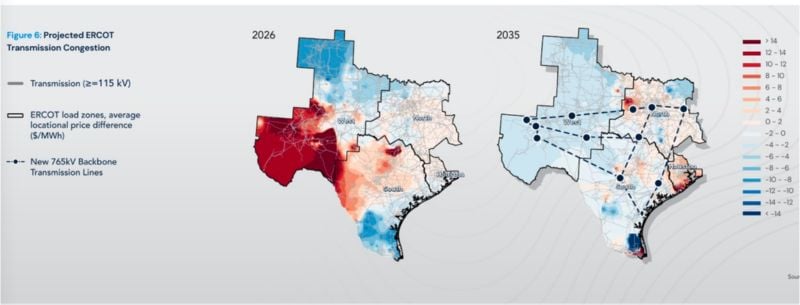
Transmission congestion zones. Image used courtesy of ICF
Grid Optimization and Demand Flexibility
The grid expansions will not completely solve the problem, the ICF report advises. Utilities can also maximize their existing capacity with grid-enhancing technologies (GETs) and demand-side management (DSM).
GETs include dynamic line ratings, advanced conductors, and topology optimization. Conditional firm service—allowing new projects to connect to the grid if the utility can make temporary cuts during peak times—is a stopgap measure. These agreements enable large loads to connect without delay while network upgrades are built.
DSM programs can deploy within 90 days of approval. They reduce pressure during the most constrained hours. At one utility in the Southwest, a DSM program delivered 130 MW of peak reduction. This cut equaled 3% of that utility's total peak demand.
Another utility implemented a smart thermostat program design that increased customer load reduction from 0.6 kW to 0.85 kW during the weakest event hour. Customer opt-outs fell from 33% to 26% under the redesigned program. This consistent performance allows planners to integrate demand flexibility directly into grid operations.
Forward-Looking Ideas
The ICF report concludes with recommendations for four key energy organizations.
- Utilities and grid planners: Planning should be location- and time-specific. Consider resource adequacy, transmission and distribution capacity, and demand-side management.
- Developers and investors: New projects should locate where the grid has the generation, storage, and capacity to deliver sufficient energy. Timing, flexibility, and onsite generation can help avoid serious delays.
- Utility program leaders: Think about how targeted, measurable customer programs can help manage peak demand and increase grid reliability as new resources are added.
- State and federal agencies: State leaders should coordinate economic development, permitting, regulations, and infrastructure planning. Federal agencies can explore improvements in financing, permitting, supply chains, and workforce development.
Meeting future energy needs can be more efficient if stakeholders at all levels work together, keeping the big picture in mind while also focusing on each area’s unique needs.
The report can be downloaded from ICF’s website.