Facebook
 Google
 GitHub
 Linkedin
Gridlock to Grid Growth: HV Transmission for a Renewable Future
Constructing high-voltage transmission lines would upgrade the U.S. national grid to accommodate renewable energy sources.
The global transition toward renewable energy faces a significant hurdle due to outdated transmission infrastructure. Existing power grids, designed for centralized fossil fuel generation, struggle to accommodate widely distributed renewable sources. This mismatch has led to grid congestion, energy inefficiencies, and slower adoption rates.
Recognizing these challenges, the industry has been investing heavily in grid modernization. From building new lines to speeding up permitting, the efforts could remove obstacles to renewable energy expansion.
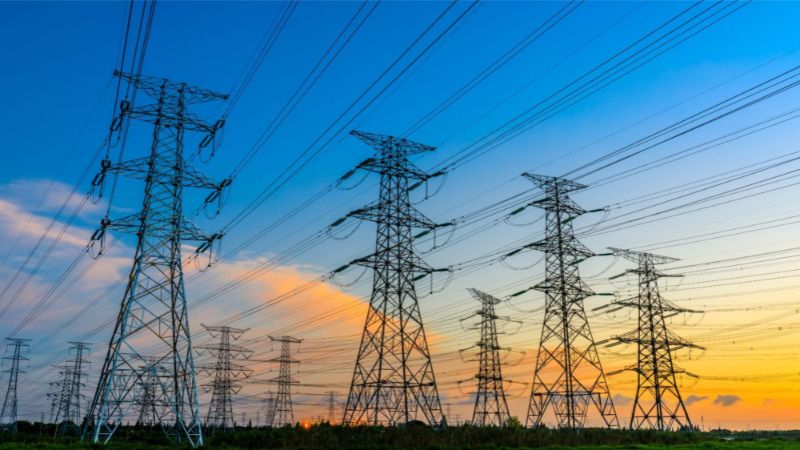
Power transmission. Image used courtesy of Adobe Stock
Avangrid's High-Voltage Transmission Solution
Transmission lines distribute electrical power from renewable generation sources, often in remote locations. High-voltage transmission lines are needed to efficiently carry large quantities of electricity over long distances. However, building a new transmission line requires significant investment and coordination between regulatory commissions, utility operators, and landowners.
Avangrid will develop a 1200 MW transmission line to connect renewable energy from Northern Maine to the New England power grid. This system will enhance grid reliability by reducing congestion, promoting energy efficiency, and reducing emissions. Overall, the project aims to build over 1000 miles of new transmission lines across the U.S., supporting an additional 7100 MW of clean energy integration into the grid.
The Department of Energy (DOE) funded the $425 million project.
Overcoming Grid Violations
Midcontinent Independent System Operator (MISO) has released their Long-Range Transmission Plan (LRTP) Tranche 2.1 Portfolio to address the issues of thermal and voltage violations in MISO’s Midwest Subregion. Thermal violations occur when power lines operate above their maximum heat threshold, while voltage violations involve deviations from optimal voltage levels.

High-voltage transmission lines infrastructure. Image used courtesy of Huang et al.
The company has introduced a $21.8 billion grid upgrade with a 765-kV transmission system for large-scale power transfers. The 24 projects under this plan are slated to come online between 2032 and 2034, aiming to reduce grid congestion and improve reliability.
The Bureaucratic Challenge of Renewable Expansion
Despite global efforts, the pace of renewable integration is hindered by lengthy permitting processes and inadequate power lines. According to the International Energy Agency (IEA), securing permits for large-scale renewable projects can rival the time needed to construct them. The IEA estimates that 15 million miles of power lines and 1,500 GW of energy storage will be required globally by 2030.
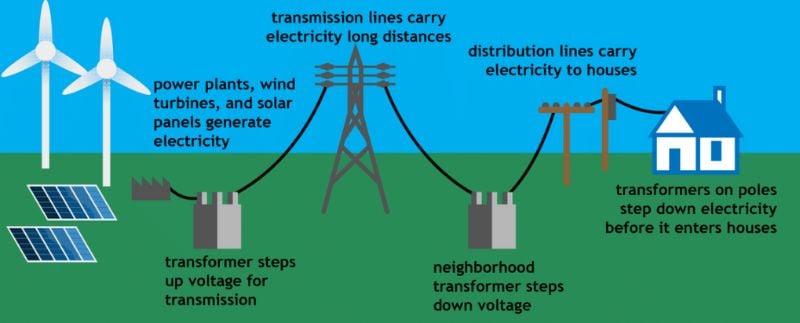
Energy distribution system involving renewables. Image used courtesy of Citizens Utility Board
In an opinion piece, the Yale School of Environment contends that governments must accelerate approval processes and build robust transmission networks. The piece points to Germany as a shining example, where reforms have nearly doubled the installation of renewable energy sources.
Without tackling these delays and scaling grid infrastructure, analysts warn that solar and wind growth will stall due to insufficient grid capacity to distribute power effectively.
A Blueprint for Grid Expansion
The National Renewable Energy Laboratory published its National Transmission Planning Study in response to the urgent need to expand and modernize the U.S. power grid.
Led by the DOE, this multiyear study used advanced modeling techniques to examine nearly 100 future scenarios through 2050. The study employed methods such as interlinked models and nodal analysis to provide detailed insights into transmission expansion needs. The research reveals that doubling the size of the current transmission system could lead to cost savings of $270-490 billion and reduce carbon dioxide emissions by 10-11 billion metric tons by 2050.
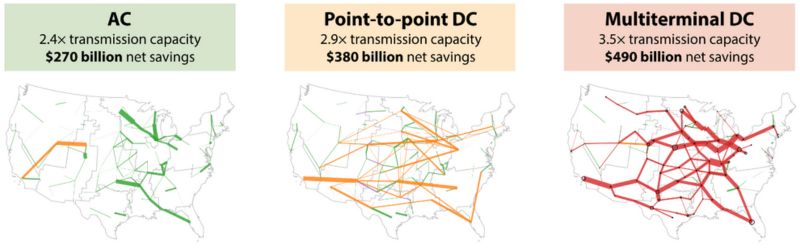
Savings grow proportionally with the extent of transmission expansion. Image courtesy of NREL
The study also predicts that new transmission infrastructure will span the U.S., with the largest growth in the central wind belt, where long-distance lines will be most necessary. High-voltage DC lines could assist in cross-regional power distribution.
Future Outlook
As the U.S. embarks on an ambitious grid modernization path, the implications extend far beyond energy distribution. Expanding transmission infrastructure could catalyze economic growth in rural areas, create job markets in clean energy, and unlock technological advancements in grid management and energy storage. With many in the industry investing time and money into grid modernization, the country could be a global model for others facing similar energy transition challenges.