Facebook
 Google
 GitHub
 Linkedin
Briefs: Mobile EV Charging, Battery Testing, Anodes, and MOSFETs
Alpine Energy, CATL, Graphite One, Polar Semiconductor, and Nexperia are developing products and facilities for vehicle-to-vehicle charging, energy storage system testing, anode materials, and power MOSFETs.
The electric vehicle, battery, and semiconductor industries are developing novel solutions and joining forces to meet next-generation energy needs. In Australia, Alpine Energy has introduced a vehicle-to-vehicle charging system designed to assist energy-drained EVs wherever they are. In China, the world’s largest and most comprehensive battery energy storage testing facility has opened.
Meanwhile, Graphite One is developing a plant to produce graphite-based anode materials in Ohio, and Polar Semiconductor and Nexperia are teaming up for power MOSFET manufacture in Minnesota.
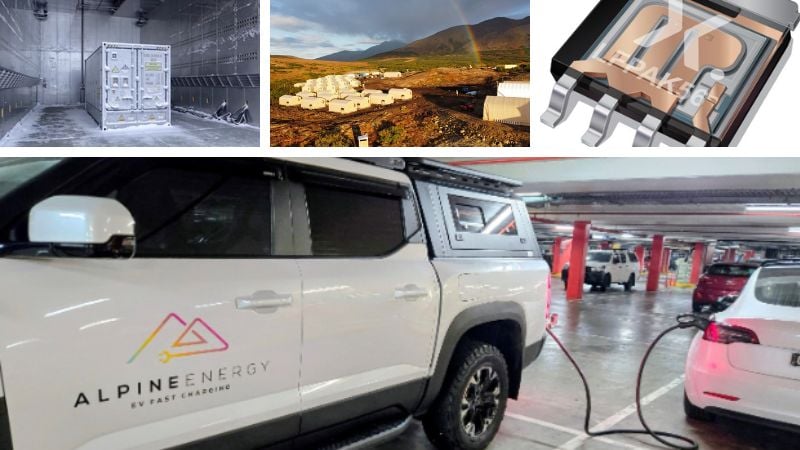
EVs, batteries, storage, and semiconductors.
EV to the Rescue? Vehicle-to-Vehicle Charging Emerges in Australia
If your electric vehicle is stranded along an Australian highway, an unusual solution may be on its way: another EV that can hook up to your vehicle and deliver a rapid charge to get you going again.
Alpine Energy, a charging technology designer, has introduced the MGEN M40, the world’s first vehicle-to-vehicle DC-to-DC EV fast charging system. The mobile-charging EV can be driven to the stranded or hard-to-reach vehicle and charged without a grid connection or a permanent charging station. Alpine claims the MGEN M40 can be used during emergencies or natural disasters, such as floods or bushfires.
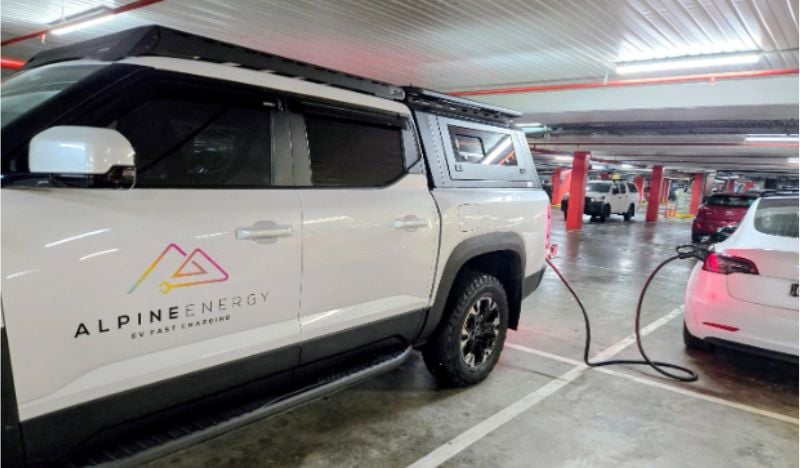
V2V charging. Image used courtesy of Alpine Energy
The V2V prototype can deliver up to 40 kW of DC output, which translates to about 65 km of driving range per 15 minutes of charging. The device uses OCPP-compliant telemetry and 4G/LTE connectivity. Alpine Energy worked with Ampernext to adapt its battery-coupled DC-DC charging technology. Other development partners include EXOR Oceana.
World’s Largest Full-System Energy Storage Facility Opens
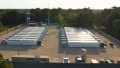
China battery giant CATL has established the world’s largest one-stop testing and validation facility for energy storage systems. The Xiamen Energy Storage Validation Research Institute (ESVL) testing facility focuses on testing systems under real-world operating conditions. It can conduct component testing, full-system verification, and assessments for safety, grid-support capability, and long-term reliability.
The station-level grid integration laboratory includes a 35 kV/100 MVA grid simulator and a real-time simulator that is 14 times larger than the National Laboratory of the Rockies’ 13.8 kv/7 MVA platform. It can text about 10 large-scale energy storage units simultaneously while simulating 1,000-node grid topologies. It covers a frequency range of 15 to 60 Hz.
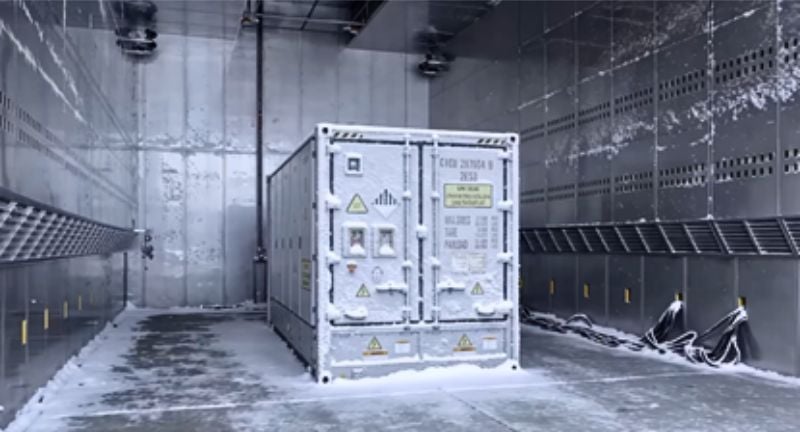
The ESVL’s Environmental Reliability Laboratory. Image used courtesy of CATL
ESVL can also validate grid-forming capabilities and multi-unit coordination under grid conditions, which CATL states will improve and shorten the safety commissioning process. The facility has several discrete labs.
- The High-Voltage Safety Laboratory aims to assist in investigating the causes of battery storage system fires and explosions. It can test lightning pulses, power frequency and DC withstand voltage, and partial discharge.
- The Thermal Safety and Combustion Laboratory is a 100,000 m2 indoor combustion facility with a 20 MW calorimeter. It can conduct explosion testing on up to nine energy storage containers and provide data for evaluating safety spacing, system iteration, and deployment planning.
- The Environmental Reliability Laboratory is used to verify full-system energy storage units under temperatures from -50°C to 100°C and altitudes up to 7,200 meters.
- The Electromagnetic Compatibility Laboratory has space for a 40-foot container. It uses a 65-ton turntable and 5 MW power supply to test EMC in an anechoic chamber under simulated real-life conditions.
Graphite One Plans to Make Active Anode Material in Ohio Factory
Graphite One has secured a site in Ohio to manufacture its Active Anode Materials, which use both artificial and natural graphite sourced from Alaska. The company intends to create a North American supply chain for the essential battery material.
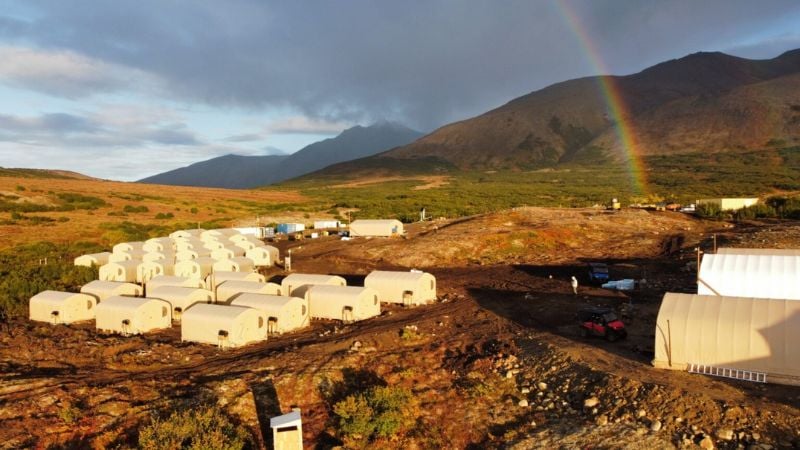
Graphite Creek in Alaska. Image used courtesy of Graphite One
The project will take two phases. Phase One, a finishing and blending facility, is targeted for completion in Q4 2027. It will produce 10,000 tonnes annually, including 4,000 tonnes of energy storage material, 3,000 tonnes of fast-charging material, and 3,000 tonnes of high-energy-density material. Phase Two, anticipated for completion in Q3 2028, will expand graphitization capacity to 25,000 tonnes annually.
Graphite One’s chief markets have been the electric vehicle and battery industries.
Polar Semiconductor and Nexperia Team Up on MOSFET Manufacturing
Polar Semiconductor and Nexperia will collaborate to manufacture next-generation power MOSFETs in Polar’s Minnesota-based wafer fabrication facility. The companies aim to create a stable supply chain to meet the growing needs of AI infrastructure, industrial electrification, automotive, and robotics.
In the partnership, Nexperia will develop an extensive portfolio of power MOSFETs in various voltage classes and package types.
Polar Semiconductor’s U.S. facility is a high-volume wafer manufacturing foundry. The company is IATF 16948 certified.
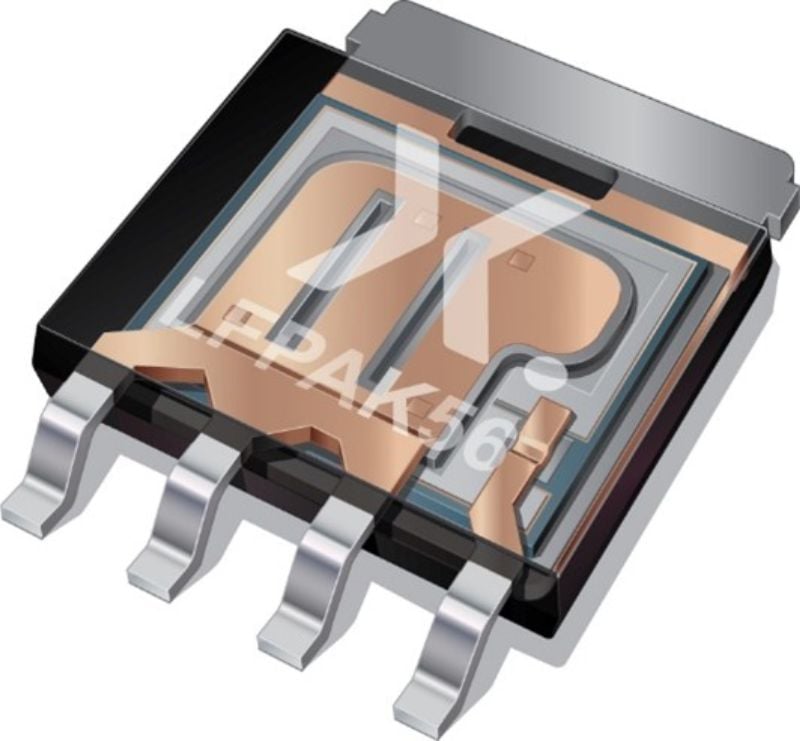
An example of Nexperia LFPPak. Image used courtesy of Nexperia
Netherlands-based Nexperia has developed numerous high-voltage semiconductor products and has innovated advanced packaging solutions such as the LFPAK and CCPak copper-clips and the MLPAK packaging, all focused on electrical performance, thermal efficiency, and ruggedness.