Facebook
 Google
 GitHub
 Linkedin
Innovation Surge Sweeps Grid Tech
Grid technology inventions target high-tech solutions for infrastructure, renewable energy, and electric vehicles.
New grid technologies have grown seven times in the past two decades, according to an analysis by the International Energy Agency (IEA). The trend reflects a healthy and rapidly evolving market with growing interest in technologies like electric vehicle chargers, fault detection software, and inverter and storage controls.
The IEA found that grid-related international patent families grew an average of 30% annually from 2009 to 2013, more than double the 12% growth rate of low-carbon energy technologies. While clean energy advancements in solar photovoltaics, wind turbines, EVs, and batteries have garnered attention, grid innovation has proved just as competitive.
Europe, Japan, and the U.S. historically led this growth, maintaining stable contributions today. However, China has slowly emerged as a major player. It claimed a 25% share in 2022, surpassing the European Union to dominate global grid patent applications.
This wave of innovation coincides with a pressing need to upgrade aging grid infrastructure, as global net-zero policies demand a 20% increase in electricity usage over the next decade compared to the last. The IEA estimates that about 31 million miles of transmission and distribution lines will need replacement by 2050. This comes after five decades of significant grid expansion—93% at the distribution level. Much of this growth has occurred in emerging and developing economies, driven by programs to expand electricity access through solar mini-grids and standalone systems.
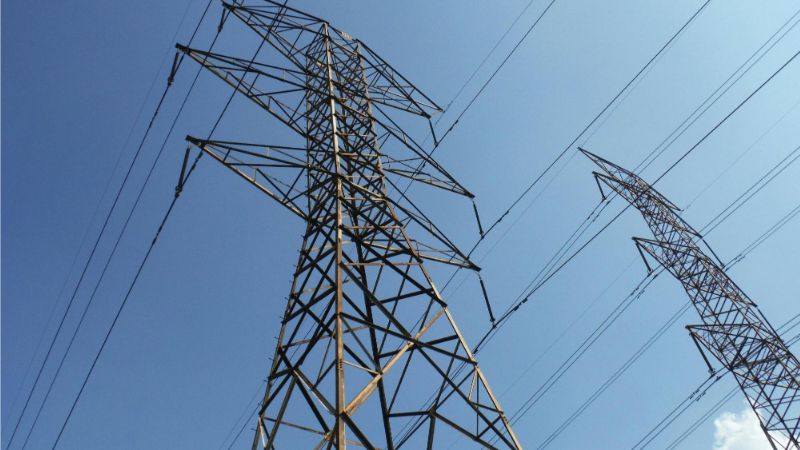
A transmission tower. Image used courtesy of Pexels/by Miguel Á. Padriñán
Grid Patent Trends
Smart grid-related patent families have remained stable over the last few decades, accounting for 70% of all grid patents. Since 2009, physical patents involving a smart grid component have stabilized to claim a 42% share as digital and software technologies complement traditional hardware components.
In addition to software advancements, there were 50% more physical patents with related smart grid technologies from 2010 to 2022 than in the previous decade.
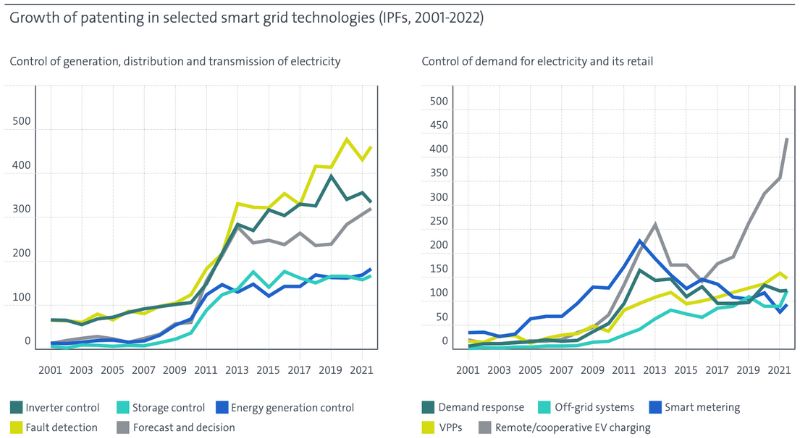
Smart grid patent trends from 2001 to 2022. (Note: “IPFs” stands for international patent families.) Image used courtesy of the IEA
As generation, distribution, and transmission grids have expanded globally, so too have control solutions targeting grid-scale assets. Fault detection is leading recent growth, alongside inverter controls, forecast and decision technology, and generation and storage controls.
The early 2010s marked a turning point: inventions for controlling storage systems skyrocketed by 800% between 2009 and 2013, while those for demand-response and grid forecasting surged by 700%. Patents for inverter controls also rose by 300%, reflecting the growing adoption of inverter-based resources like solar photovoltaic panels and batteries.
Other categories charting steady growth include virtual power plants and demand-response software to manage instantaneous EV charging peaks when solar and wind are unavailable.
In stationary storage technologies, the U.S. and European Union dominate in patent applications for redox flow batteries. Sodium-ion technologies have seen an average annual growth of 33.5% between 2005 and 2022, primarily led by Japanese and Chinese applicants. Molten metal batteries are experiencing a decline, partly due to a recent reduction in concentrating solar power development since 2010-2020.
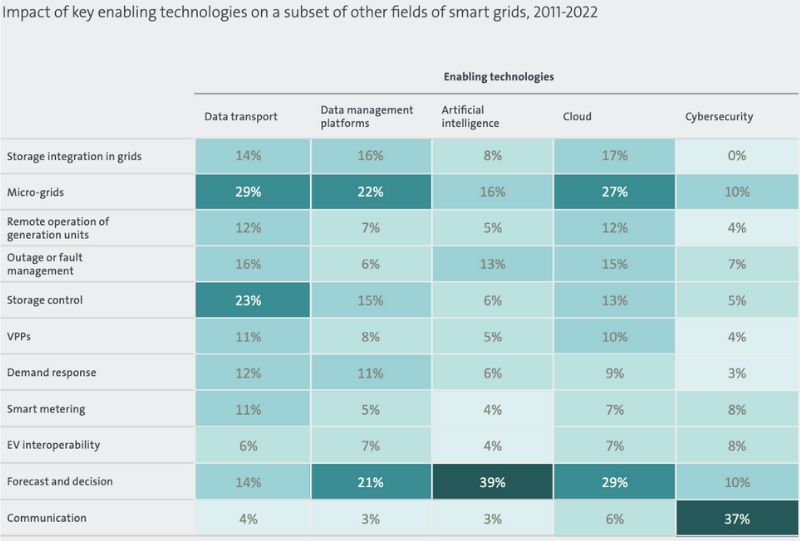
Top enabling technologies for smart grid applications. Image used courtesy of IEA
Artificial intelligence patents targeting grid applications have grown by over 500% from 2017 to 2022, making it the most active growth area in this field. AI algorithms can digest large volumes of data to predict demand patterns, forecast solar and wind production, and address transmission limitations. Utilities are also rolling out self-healing grids to quickly isolate faults and prevent outages from escalating.
One hot AI subsector is forecast and decision software, which uses predictive algorithms to forecast energy market prices, consumption, and generation. AI is also increasingly used to streamline microgrid operations, maintenance, and grid-storage integration.
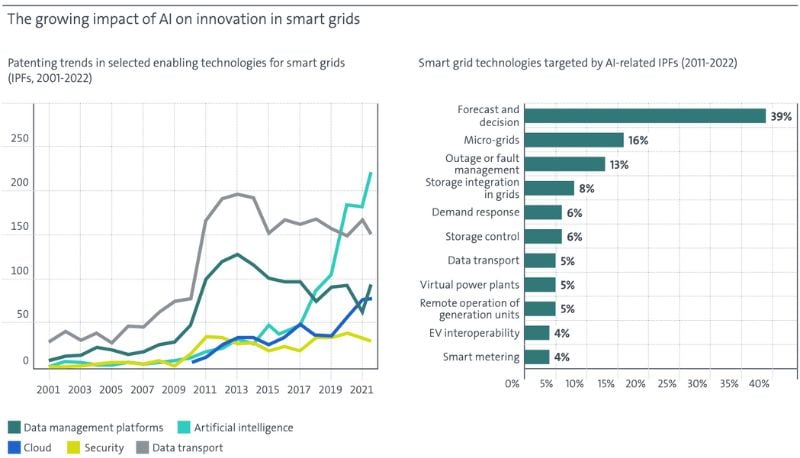
Growth in AI patents targeting smart grid applications. Image used courtesy of the IEA
Grid Equipment and EV Players Lead Patent Activity
A significant portion of patent activity is concentrated among the industry’s top 15 corporations, which accounted for roughly one-third of all grid-related international patent families from 2011 to 2022. Leading the pack are companies focusing on both smart and physical grid technologies, including Germany’s Siemens, Switzerland’s ABB, and U.S.-based General Electric. The report also lists Japanese firms such as Panasonic, Hitachi, Mitsubishi Electric, Toyota, and Toshiba, which stand out for their specialization in smart grid solutions.
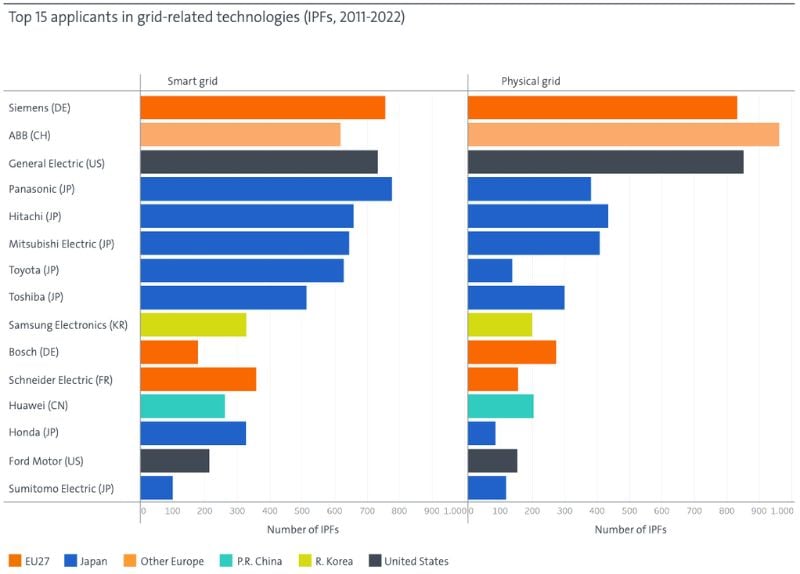
Top grid tech patent applicants. Image used courtesy of the IEA
The IEA notes a trend among original equipment manufacturers (OEMs) in the automotive market, who have prioritized interoperability and smart charging to support their EV rollouts. OEMs like Toyota, Honda, and Ford ramped up their patent activities after 2017, while contributions from other equipment suppliers tended to decline.
Related Content