Facebook
 Google
 GitHub
 Linkedin
Can Better Engineering Fix Solar and Storage Risks?
A Solar Risk Assessment report identifies faults in solar and battery storage and explains how engineers can address them early.
Solar photovoltaic (PV) and battery storage systems continue to face persistent technical risks, but many are preventable through better design, data, and quality control. The 2025 Solar Risk Assessment from kWh Analytics outlines several major failure points and engineering strategies.
From hail damage and battery fires to underperforming PV assets, the report covers how and why many failures occur and which design assumptions no longer hold up in real-world deployments.
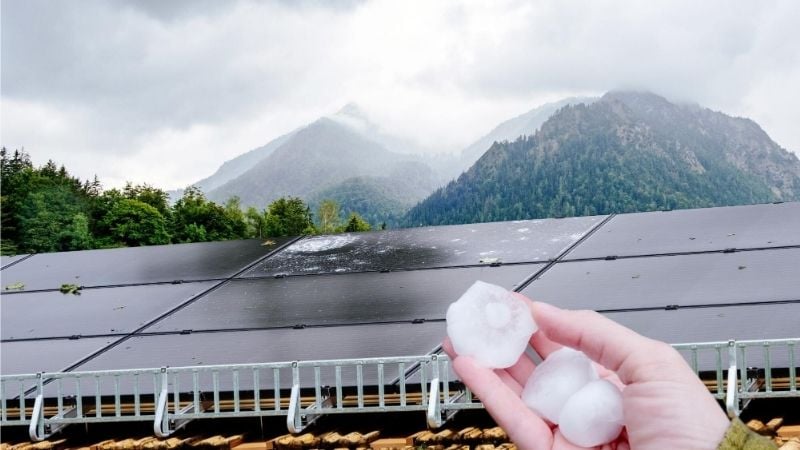
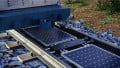
Solar panels damaged by hail. Image used courtesy of Adobe Stock
Hail Is the Top Physical Threat
According to kWh Analytics' report, more than 70% of solar asset losses stem from hail, despite it causing only 6% of incidents.
Testing data from GroundWork Renewables, combined with kWh Analytics' hail stow model, reveals where traditional modeling falls short. Many physics-based models overestimate the benefit of hail stow (tilting solar modules during storms) by up to 48% for 3-inch hailstones. That's because they assume hail impacts are elastic collisions, where the pre-collision kinetic energy of the objects equals the kinetic energy of the objects after they've collided. However, real-world hailstone impacts are largely inelastic, converting energy into rotation and deformation, especially at angled impacts.
For example, a 2 mm glass module under a 75° stow angle has an estimated 36% failure probability against 3-inch hail at 40 miles per hour, assuming elastic collision. Accounting for inelasticity, that chance rises to 84%.
While stow certainly helps, it doesn't provide the scope of benefits the industry had expected, the report notes. Still, hail-resilient modules are gaining industry adoption, such as 3.2 mm/2 mm glass/glass modules. In GroundWork's preliminary tests, this new architecture withstands 1.7 times more impact energy than 3.2 mm glass/polymer designs.
Underperforming PV Sites + AI Considerations
Across 34,000 system-months analyzed between 2015 and 2023, solar PV assets across the U.S. are underperforming against P50 estimations by 8.6%. (P50s serve as the baseline for loan agreements and financial models.) The Southwest had the best site performance. The South showed the worst, primarily due to regional curtailments.
Monthly operating reports lacked the detail to pinpoint the root cause of underperformance, but possible contributors include over-optimistic availability assumptions, inflated P50 values for financing, and underestimated losses from extreme weather, curtailment, shading, sub-hourly clipping, and DC issues.
kWh Analytics also found that without domain-specific training, out-of-the-box artificial intelligence models, like GPT-4o-mini, misclassified 15-25% of solar loss events in common and frequent categories, including communication, curtailment, and preventative maintenance. It also struggled with weather and damage loss categories, misclassifying them up to 50% of the time.
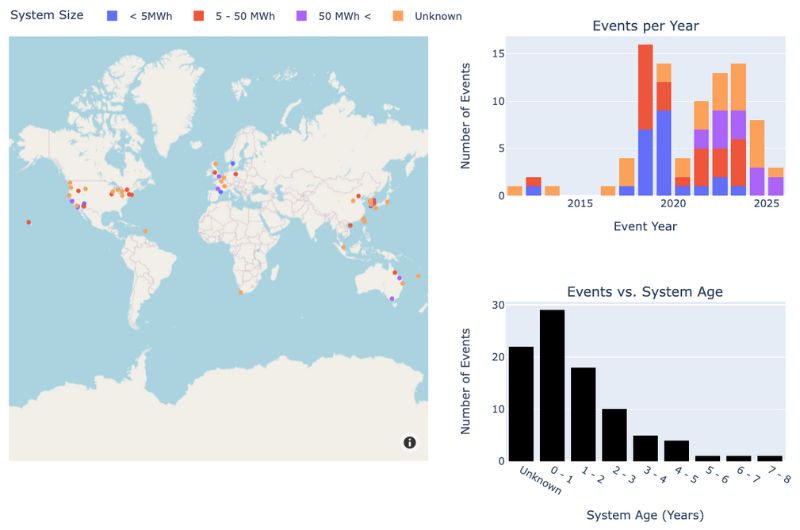
Stationary energy storage failure events. Image used courtesy of EPRI
However, fine-tuning the same model on 8,000 data points increased the F1 score (a measure of accuracy for classification problems) from 87% to 98%, significantly reducing errors.
Domain-specific training and regular updates are critical requirements for AI tools. Engineers using AI for diagnostics should prioritize data quality, model validation, and continuous updating with fresh data and training to maintain reliability through changing system conditions.
Battery Storage Failures Happen Early
Global grid-scale battery energy storage system (BESS) deployment has surged from 11 GWh to over 300 GWh in just six years, with 78% of the total deployed in the past two years. Battery fires have drawn media attention, but the overall rate of incidents has dropped by 98% since 2018.
The report cites EPRI's data, which found 72% of BESS failures occur within the first two years of installation. Few systems are older than five years. In several incidents, monitoring and communications were offline, allowing coolant leaks and other faults to escalate into full-blown failures.
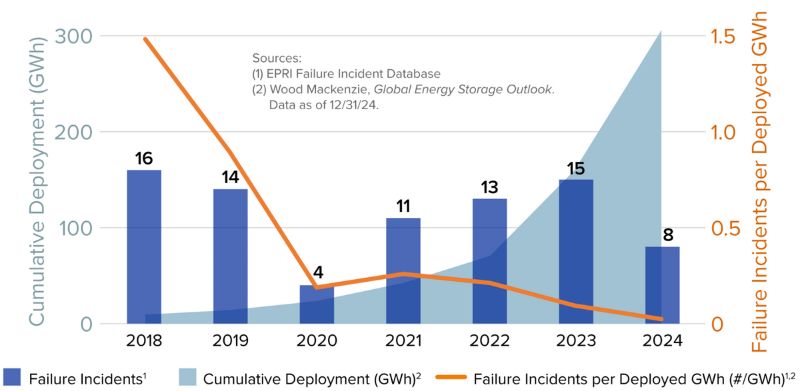
Worldwide grid-scale storage deployment and failures. Image used courtesy of EPRI
The integration, assembly, and construction phase is a critical opportunity to address failures in balance-of-system components. Integration failures are growing primarily due to poor build quality in balance-of-system parts, such as coolant systems, AC or DC wiring, or water suppression piping.
EPRI cites factory acceptance testing, component design studies, and integrated product testing as key opportunities to prevent balance-of-system failures. EPRI has also recommended system-level failure analysis, particularly for interfaces between components.
The report also cited Clean Energy Associates' 330 factory inspections performed at global BESS manufacturing sites, covering 29 GWh of lithium-ion battery systems. Among the audited BESS units, quality issues in the fire suppression system were represented in 28%. Those issues included incorrectly wired alarm systems, non-responsive smoke detectors, and malfunctioning fire suppression actuators.
Auxiliary circuit panel defects were found in about one-fifth of the inspected units, including exposed wiring and improperly installed circuit breakers. Thermal issues were identified in 15%, typically apparent through faulty temperature sensors, coolant leaks from poorly secured pipes, or circuit board malfunctions. This could increase the risk of overheating and thermal runaway.
Fire suppression and thermal management are typically easy to address before or during factory testing, where quality issues can be spotted early through production audits, factory acceptance tests, and during commissioning.