Facebook
 Google
 GitHub
 Linkedin
No Fire, No Explosion: Safety Standards for EV Batteries
China has just enacted the world’s strictest fire prevention standards for lithium-ion EV batteries.
Lithium-ion batteries, including those used in electric vehicles, pose fire dangers primarily due to their sensitivity to overheating, physical damage, electrical faults, and improper charging. The main risk is thermal runaway, a rapid, self-sustaining reaction where heat generation inside the battery exceeds its ability to dissipate that heat. Scientists and battery developers continue to search for safer technologies, but as yet, no safety standards exist for lithium-ion batteries.
China intends to change that. It has developed a mandatory national standard for the safety of traction batteries used in electric vehicles. Called GB 38031-2025, the standard requires that lithium-ion EV batteries cannot catch fire or explode during a thermal runaway event, even after damage and severe internal failures. The standard will take effect on July 1, 2026, for new vehicles, with a 12-month transition period for existing vehicles required to demonstrate compliance by July 1, 2027.
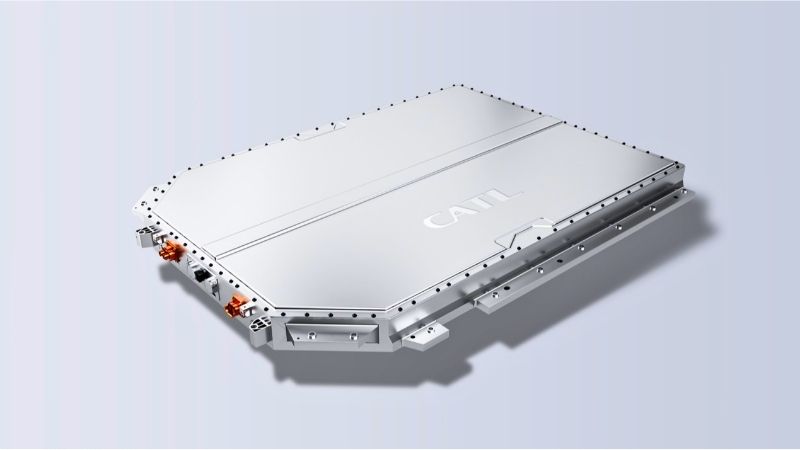
The Qilin battery. Image used courtesy of CATL
Why Lithium-Ion Batteries Fail
Lithium-ion batteries, including those used in electric vehicles, pose fire dangers primarily due to their sensitivity to overheating, physical damage, electrical faults, and improper charging. This can lead to thermal runaway and extremely high temperatures (over 600°C), causing the battery to catch fire or even explode within minutes.
When lithium-ion batteries fail—whether from overcharging, using incorrect chargers, exposure to extreme temperatures, or physical damage—they can emit toxic, flammable, and explosive gases. Fires from these batteries are intense, difficult to extinguish, and can reignite even after appearing to be out. In EVs, the high voltage, energy density, and large size of the pack increase these risks, and damaged batteries can pose electric shock hazards to emergency responders as well as the danger of delayed or repeated ignition.
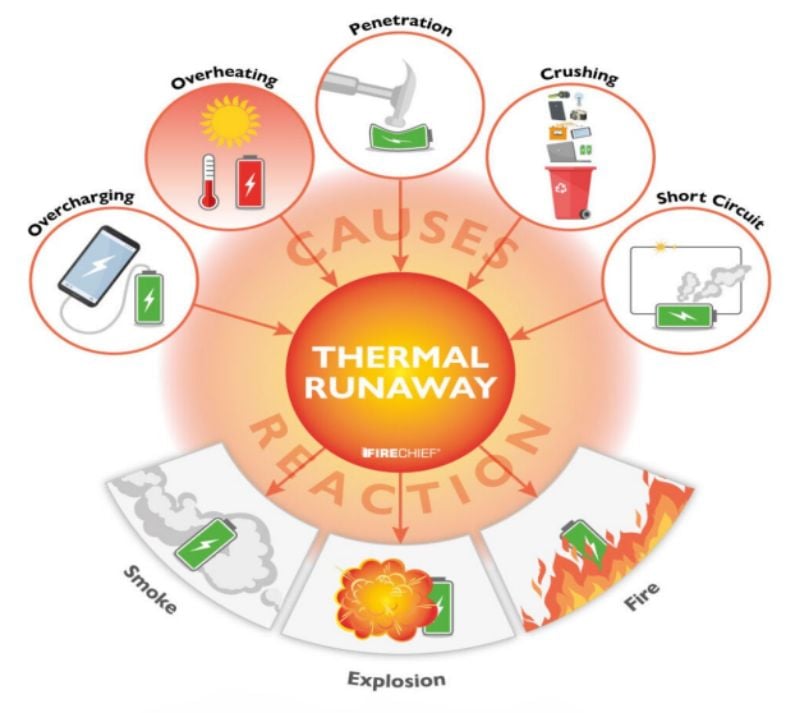
Triggers for thermal runaway. Image used courtesy of the Department of Homeland Security
While lithium-ion batteries are generally safe when used, charged, stored correctly, and protected by a battery management system, mishandling or defects can lead to fires that spread rapidly and are challenging to control.
The State of Safety Standards
The U.S. has no equivalent to China’s GB 38031-2025 standard. However, the U.S. is moving toward stricter EV battery safety regulations that share some similarities. The National Highway Traffic Safety Administration has proposed Federal Motor Vehicle Safety Standard (FMVSS) No. 305a, which would expand on the current FMVSS 305. FMVSS 305a introduces new performance and risk mitigation requirements for rechargeable energy storage systems in both light and heavy vehicles.
Europe also does not have a direct equivalent to China’s GB 38031-2025. However, the European Union has enacted comprehensive regulations and harmonized safety standards for batteries, including those used in EVs. IEC 62660 is an international standard adopted in Europe, covering the safety and performance of secondary lithium-ion cells used for propulsion in electric road vehicles. The standard addresses mechanical, electrical, and thermal abuse, but does not mandate the same outcome-focused criteria as China’s GB 38031-2025.
China’s GB 38031-2025 Key Features and Requirements
The most significant update in China’s standard is the elevation of the “no fire, no explosion” requirement to a mandatory level. Batteries must not catch fire or explode during or after an internal thermal runaway event, a stricter criterion than the previous standard, which only required a 5-minute delay before fire or explosion and mandated warning signals. In addition, any smoke emitted during such an event must not endanger vehicle occupants. The standard applies specifically to traction batteries for electric vehicles, not to auxiliary or non-propulsion batteries.
Expanded and Enhanced Testing
The batteries in China must be tested by an accredited third party, such as the China Automotive Technology and Research Center (CATARC), before receiving certification. Tests include:
- Thermal Propagation Test: Batteries must undergo rigorous thermal diffusion testing, with clarified temperature requirements, observation times, and vehicle conditions. The battery must remain safe (no fire/explosion) even during thermal runaway.
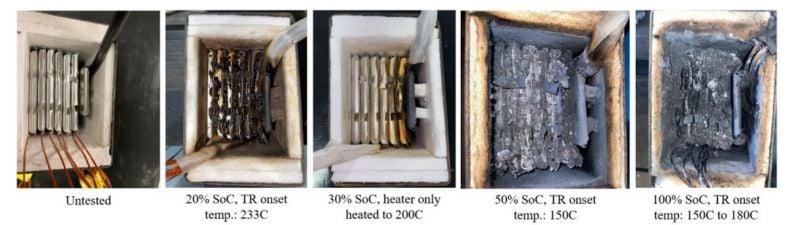
Thermal propagation test. Image used courtesy of Federal Aviation Administration
- Bottom Impact Test: A new test simulates impacts to the battery’s underside, reflecting the trend of integrating batteries into the vehicle structure (cell-to-body designs).
- Post Fast-Charging Safety Test: After enduring 300 rapid charging cycles, batteries are subjected to an external short-circuit test, and must not catch fire or explode.
- Comprehensive Testing: The standard includes 7 single-cell tests and 17 battery pack/system-level tests, covering scenarios such as mechanical shock, electrical abuse, and environmental stress.
Battery registration and China Compulsory Certification remain prerequisites for importing and selling batteries in China. The standard introduces a structured approach: when components at the pack level are changed, specific sub-tests must be repeated to ensure ongoing compliance.
Meeting the Challenge
The new standard’s no fire, no explosion mandate after thermal runaway events will force manufacturers to significantly enhance the safety of cells and packs. This will require tighter control over material purity and manufacturing tolerances, as even minor defects can lead to catastrophic failures at scale. This, in turn, requires an upgrade in quality assurance processes to detect and eliminate impurities and defects throughout the entire production chain, from raw materials to finished cells. In addition, implementing more comprehensive and rigorous testing protocols, including new tests for bottom impact and post-fast-charging safety, will increase the complexity and cost of compliance.
Table 1. Key challenges
| Challenge Area | Description |
| Safety & Quality Control | Zero-tolerance for fire/explosion, micron-level precision, impurity detection |
| Production Scale & Precision | High-volume, high-speed, low-defect manufacturing; automation and real-time monitoring |
| Material Supply & Chemistry | Raw material shortages, rapid chemistry innovation, ethical sourcing |
| Cost & Investment | Increased expenditures for testing, QA, and compliance |
| Value Chain Coordination | Cross-team alignment, module/pack redesign, communication gaps |
| Regulatory & Data Compliance | Interpreting new rules, lifecycle traceability, global regulatory harmonization |
Industry Leaders
As of May 2025, Contemporary Amperex Technology Co., Limited (CATL) is the first and, so far, the only company publicly confirmed to have met China’s new GB 38031-2025 battery safety standard. CATL’s Qilin battery cells and packs successfully passed all required certification tests, including CATARC’s thermal runaway, bottom impact, and post-fast-charging safety tests.
Several automakers, such as Zeekr, Lotus, Neta, Avatar, Li Auto, and Aito, already use the Qilin battery, which employs CATL’s third-generation cell-to-pack technology.
Other battery manufacturers may be close to meeting the new standards. BYD was involved in drafting the standards, and, as one of China’s largest battery and EV manufacturers, is widely expected to be close to compliance, although there is no public confirmation. Other battery manufacturers like Gotion High-Tech are reportedly working on meeting the new requirements. However, CATL remains the only company officially recognized as having achieved certification under the new standard.
GB 38031-2025 sets a global benchmark for EV battery safety, mandating zero fire or explosion risk even in severe failure scenarios. It introduces stringent testing protocols, including new bottom impact and post-fast-charging safety tests. It is expected to significantly enhance the safety and reliability of electric vehicles in China and around the world.