Facebook
 Google
 GitHub
 Linkedin
How Will AI Transform Smart Grids in 2025?
The increasing decentralization of energy production demands sophisticated technology solutions to integrate diverse power sources and manage dynamic load requirements without compromising stability.
As renewable energy sources proliferate and traditional power grids struggle to adapt, utilities face complex operational challenges ranging from intermittent power generation to cybersecurity vulnerabilities. The increasing decentralization of energy production demands sophisticated technological solutions that cohesively integrate diverse power sources and manage dynamic load requirements without compromising grid stability.
In 2024, artificial intelligence stepped into this energy landscape as a promising solution, and 2025 will bring more of the same. AI has the potential to integrate renewables into modern electric grids, and 2025 is poised to push this technology even further.
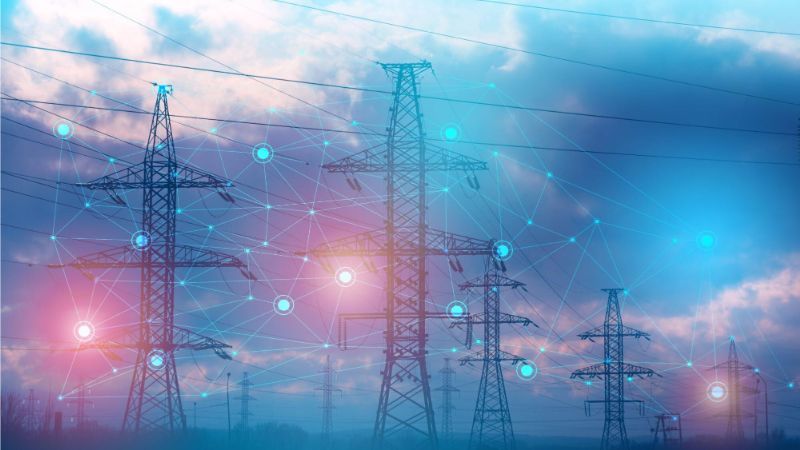
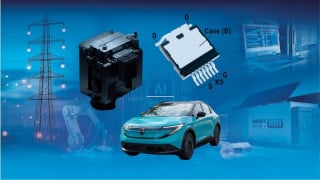
AI-enhanced power grid. Image used courtesy of Adobe Stock
AI Protects Smart Grids from Cyber Threats
The digital transformation of energy systems has led to smart grids that combine advanced Internet of Things (IoT) technologies with traditional infrastructure to optimize energy distribution, integrate renewables, and enhance sustainability. However, introducing IoT technology makes these grids vulnerable to cyber threats like false data injection attacks (FDIAs), where adversaries manipulate operational data, risking blackouts and system integrity.
To tackle this challenge, researchers from Heilongjiang University developed a cyber-physical digital twin fortified with recurrent neural networks (RNNs). An RNN is an artificial neural network designed to predict and detect anomalies in sequential data. The novel system leverages RNNs’ memory capabilities to detect dynamic anomalies by analyzing historical and real-time data, transforming FDIA detection into a binary ordering task.

The structure of RNN. Image used courtesy of Wikimedia Commons
Validated through IEEE test environments, this model offered high levels of accuracy. By blending machine learning (ML) with simulation tools, the solution reinforces grid security while enabling proactive threat mitigation.
Schneider Electric’s Distributed Grid Solutions
Traditional grids, designed for one-way power flow, struggle with integrating renewable energy sources because of unpredictable voltage fluctuations, frequency variations, unsynchronized grid operation, and grid regulation. Moreover, operational inefficiencies are common due to the inherent intermittency of distributed renewable energy resources like solar panels.
However, in 2024, Schneider Electric introduced AI-powered solutions to these grid management challenges. Central to the solution are the EcoStruxure ADMS and DERMS (distributed energy resource management system) platforms, which leverage real-time monitoring and predictive analytics to optimize grid operations. DERMS can track and address undervoltage, overvoltage, thermal overload, and unwanted reverse power flows while optimizing renewable energy generation output.
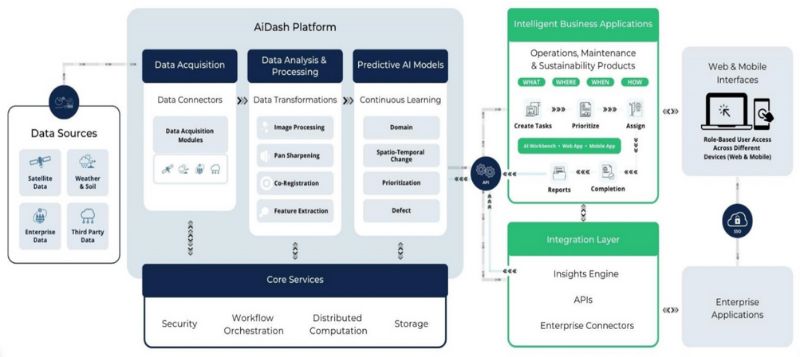
Features and integration of AiDash platform. Image used courtesy of AiDASH
Meanwhile, the AI-driven AiDash platform uses satellite imagery and machine learning to assess resilience and prepare for extreme weather events proactively. AiDash offers an enterprise-grade security platform with advanced access management, data encryption, and comprehensive audit capabilities. Leveraging proprietary geospatial and AI/ML technologies, Schneider Electrics’ models continuously evolve through intelligent processing of diverse data points.
2025’s Take on Electric Grids
As AI technology evolves, it will become essential in managing electric grids. In 2025, we expect to see AI technologies help energy systems become more flexible, secure, and efficient. By predicting problems and responding quickly, AI will help optimize distributed energy sources to meet the overall power demands without compromising the grid’s operation, leading to more reliable and adaptive power networks in 2025 and beyond.