Facebook
 Google
 GitHub
 Linkedin
Can CSP Scale to Meet Solar Demand?
Concentrating solar-thermal power technologies are a reliable alternative to conventional solar systems, but can they overcome barriers to wider development?
Concentrating solar-thermal power (CSP) technologies represent a compelling alternative to industry-dominant solar photovoltaic (PV) systems. With increased efficiency and built-in energy storage, they cover energy demand in periods of low sunlight. However, cost remains a critical barrier to scaling up CSP deployment in the U.S.
That’s why the Department of Energy’s (DOE) Solar Energy Technologies Office will award $30 million for up to 16 research, development, and demonstration projects to reduce the cost of large-scale CSP deployment. Projects will receive $750,000 to $10 million each to pursue advancements in concentrating solar collectors, supercritical carbon dioxide (sCO2) turbomachinery, and solar-thermal receivers and reactors.
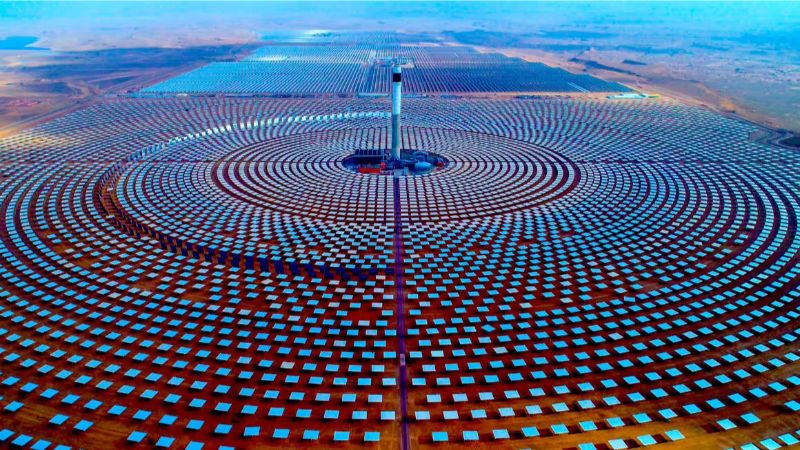
The 500 MW NOOR CSP project in Morocco. Image used courtesy of NREL
As a relatively nascent field, CSP costs are not yet competitive with utility-scale PV systems. The most expensive components of CSP plants are the power block housing the turbine generator, energy storage, the field of mirrors, the focal point receiver, site preparation, operations, and maintenance. The primary opportunity to improve performance is the efficiency of thermal-to-electric conversion.
With this funding round, the DOE seeks projects proposing new materials and equipment to reduce the levelized cost of electricity (LCOE) of next-generation CSP plants by 50%. For a 100 MW system with 14 hours of thermal storage, this cost would fall from today’s $.09 per kWh baseline (with 37% net power-cycle efficiency) to $.05 by 2030 (with 40–55% efficiency).
Video used courtesy of DOE
How Do CSP Plants Work?
CSP plants employ mirrors to track the sun and concentrate rays onto receivers. Then, a heat-transfer process raises the temperature to spin a turbine generator, producing electricity. CSP incorporates thermal energy storage (TES), adding dispatchability for plants to ramp power on demand.
Most CSP plants follow two common configurations: Solar towers with heliostats centered around a receiver and parabolic trough systems with curved collectors that direct sunlight toward linear tube receivers. Existing plants’ rated output ranges from 50 to 200 MW. In addition to generating electricity, CSP technology can provide heat for industrial applications like food and mineral processing, chemical production, and water desalination.
The National Renewable Energy Laboratory’s SolarPACES database counts 100 commercial CSP plants operating worldwide today, totaling 6.6 GW of capacity. Another 1.5 GW is under construction. The U.S. accounts for about 1.5 GW, but continued technology optimization could cut costs to unlock 25 to 160 GW by 2050.
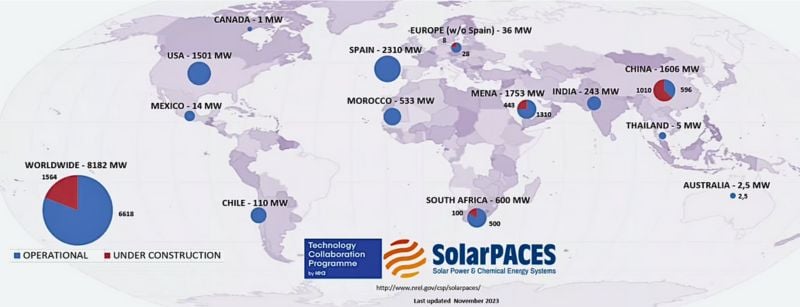
Map of CSP plants worldwide. Image used courtesy of NREL
Many of today’s commercial plants store energy with molten salt, a mixture of potassium and sodium nitrates. Conventional power blocks (where heat is converted to electricity) use a steam Rankine power cycle heated to solar salt’s 1,049°F temperature limit. However, researchers are exploring new materials, such as particles and air, with equipment optimized to move the particles and form an air curtain in the receiver for improved performance. Solid-to-sCO2 heat exchangers can also help transfer hotter particles into thermal energy for the power cycle’s fluid.
While steam Rankine turbines have been the dominant technology historically, the sCO2 Brayton power cycle is an emerging alternative that can be combined with next-generation systems’ higher operating temperature (above 1,292°F), enabling a thermal-to-electric efficiency exceeding 50%.
Opportunities to Improve Solar-Thermal Collectors
Solar collectors (mirrors) track the sun’s movement and concentrate radiation onto solar-thermal receivers. A material inside the receiver is then heated to convert the solar flux light energy into thermal energy, which then spins a turbine and generates electricity.
Collectors are typically the most expensive subsystem in solar-thermal plants, representing up to 40% of the total. The DOE’s new funding program targets novel heliostat designs, line-focusing collectors, and other systems to reduce the installed cost of solar collectors to $50 per square meter and demonstrate high efficiency over a 30-year lifespan.
A significant share of industrial heat applications require temperatures under 572°F, which can be applied to commercial solar collectors. However, they must be competitive with process steam generated by natural gas. Research into low-temperature industrial process heat could reduce the levelized cost of heat (LCOH) to $.02 per kilowatt-hour thermal (kWhth).
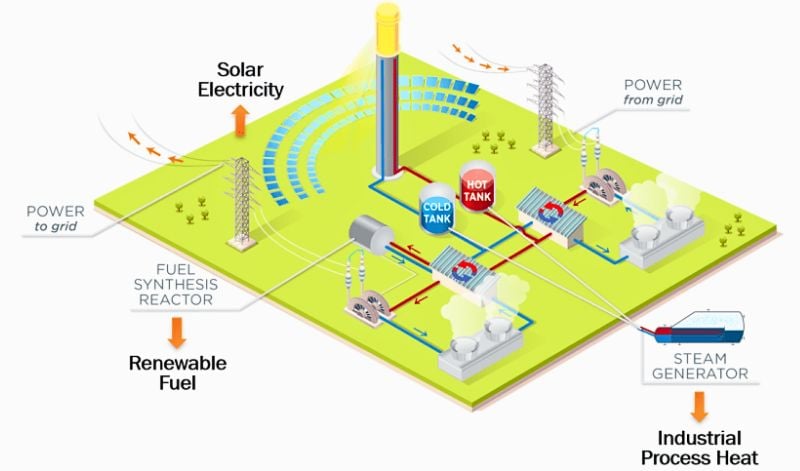
Concentrating solar-thermal power applications. Image used courtesy of the DOE
Solar-Thermal Receivers and Reactors
The new DOE funding will also support novel receivers and reactors to convert concentrated sunlight into high-temperature thermal energy.
CSP systems harness the sun to heat fluid in the receiver. Current CSP plants use tubular receivers containing a heat transfer fluid, but advanced iterations could employ sand-like particles not bound by salt temperature limits. Newer systems operating with solid particles can also bring storage costs down.
The FOA targets receiver subsystems with a megawatts-thermal (MWth) capacity of 10 MWth and a 1,382 °F outlet temperature compatible with a 10 MW sCO2 power cycle. The program also seeks a 1 MWth reactor design integrating solar-thermal energy for industrial chemical, mineral, or cement production.
Ideally, next-generation systems would meet the DOE’s 90% optical-to-thermal efficiency goal, a metric depending on the system’s target temperature and the illumination intensity on the receiver.
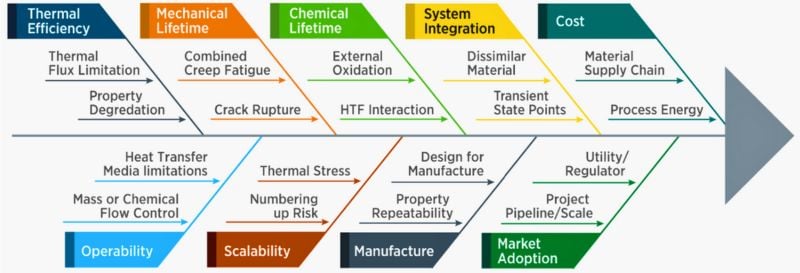
Barriers to receiver technology innovation. Image used courtesy of DOE (Page 31, Figure 7)
The FOA also focuses on projects developing advanced solar reactors, wherein thermal energy sets off a chemical reaction to generate fuel or chemicals. The program targets efficiency comparable to receivers but with a lower cost: $300 per kWth for integrated reactor systems or $15 per kWhth for integrated TES subsystems.
Supercritical CO2 Turbomachinery
Using sCO2 as a working fluid in turbomachinery with Brayton power cycles could support the DOE’s $.05 per kWh LCOE goal. sCO2 technologies can support dispatchable power generation and TES, boosting CSP plants’ conversion efficiency with higher temperatures. Supercritical turbines are also smaller, unlocking more cost savings.
The DOE targets scaled-up, sCO2-based power cycles that are more efficient than conventional steam cycles. The program aims to advance turbine and compressor technology for heat engine and heat pump cycles to reduce costs for CSP plants coupled with TES.
CSP technologies can deliver thermal energy above 1,382°F, and the efficiency of sCO2-based heat engine cycles rises as the working fluid temperature increases within the Carnot limit. With this, a recompression closed Brayton cycle (RCBC) for sCO2 can offer more than 50% efficiency.
sCO2 cycles can retain high efficiency at small scales under 10 MW, serving combined heat and power applications and standalone systems varying in size. Since the working fluid is compatible with dry cooling integration, these cycles can also save on water consumption.
The DOE’s FOA specifies that scaling up domestic CSP could involve developing the RCBC at less than $900 per kW (including turbomachinery, recuperators, and air coolers) and a cycle efficiency exceeding 50% for next-generation systems with peak temperatures above 1,328°F. To that end, the DOE seeks integrated sCO2 RCBC turbomachinery with under $300 per kW of total installed capital and a gross expander efficiency of 70%.