Facebook
 Google
 GitHub
 Linkedin
Engineers Repurpose Oil Wells as Solar Storage
Plans are underway in California to convert abandoned oil wells into energy storage for solar farms.
California’s Kern County will soon be home to a novel long-duration solar power storage solution using depleted oil well reservoirs.
The geological thermal power storage (GeoTES) project is among the state’s latest renewable energy storage solutions investments. It is the first attempt of its kind and aims to store solar power in a natural geologic reservoir. The National Renewable Energy Laboratory (NREL) is heading the project.
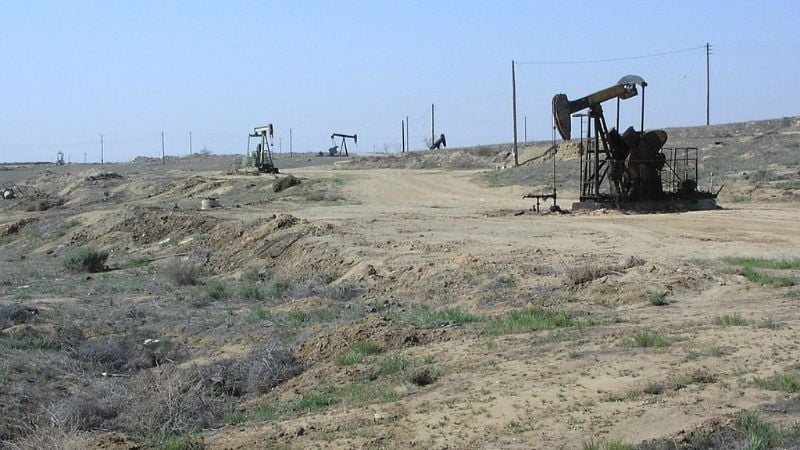
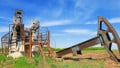
Kern County, California, oil field. Image used courtesy of Wikimedia Commons
Kern County’s Solar Energy Storage Solution
Fluctuating production rates may cause renewable energy, such as solar power, to fall short of demand or result in power waste. For California to achieve its goal of becoming net zero by 2045, it must prioritize energy storage. According to Governor Gavin Newsom, the state’s grid-connected storage has grown 1,250% since 2019, meaning it is about 20% toward reaching the 52 GW it needs.
An uptick in clean energy adoption has been on the horizon for a long time. However, while many engineers are developing novel concepts, GeoTES is a breakthrough long-duration storage solution that inadvertently solves Kern County’s fossil fuel reliance issue.
What Makes Kern County Special?
Kern County has an abundance of sunlight and abandoned oil wells. It is home to 75.6 % of all the wells in the state, 68.4% of which are orphan or idle. While some ran dry, others were forgotten as new opportunities appeared and local regulations strengthened. In 2022, the Governor restricted permits near businesses, housing, and public facilities.
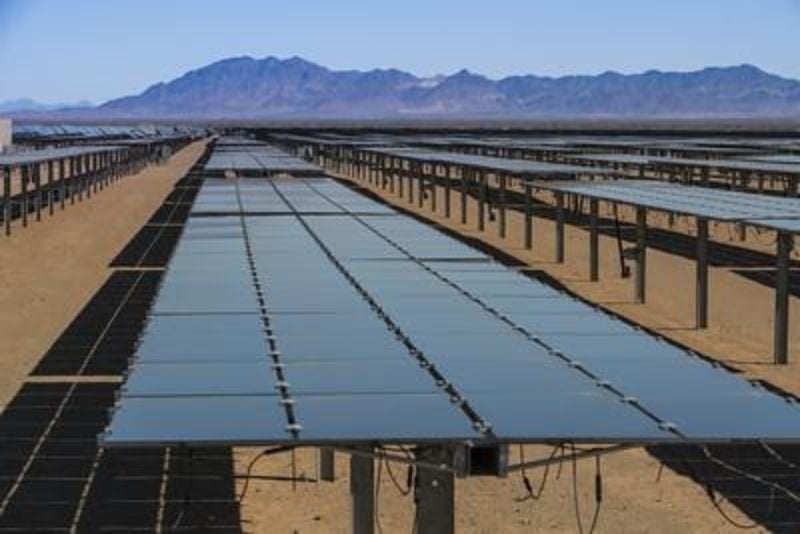
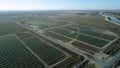
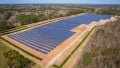
Camino Solar Project in Kern County. Image used courtesy of Bureau of Land Management
Notably, Kern County also has many highly skilled workers who are unemployed. GeoTES relies on oil well operators’ data and infrastructure to manage reservoirs so the workforce left behind can seamlessly transition into geothermal roles. The project’s operators mutually benefit, as former oilfield workers offer crucial expertise.
How the Project Is Engineered and Implemented
GeoTES didn’t require any technological, scientific, or mechanical breakthroughs. Rather, engineers applied existing equipment and proven techniques in a novel way. They pumped superheated water stored in the oilfield’s depleted reservoirs through a geothermal ground loop and to a turbine. While similar geothermal and turbine power applications exist, none were specially designed for solar energy and natural geologic reservoirs.
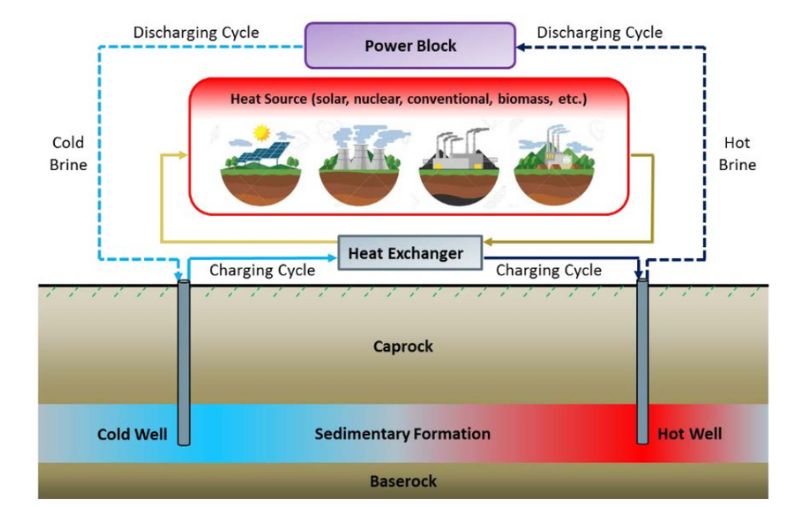
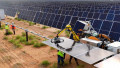
GeoTES processes. Image used courtesy of NREL
On the ground, parabolic mirrors gather solar power, heating the silicon oil flowing through an aboveground loop to 700 degrees Fahrenheit. Engineers pump comparably cold groundwater to the surface, heat it with the oil, and then send it back down. The system constantly circulates, actively heating the water during the day. When electricity is needed, an extraction well brings the heated groundwater to the surface to spin a turbine, producing power.
How Engineers Are Overcoming Obstacles
The first issue GeoTES engineers had to overcome was knowledge. They needed to know the depth, porosity, thermal conductivity, and formation thickness to determine whether the depleted reservoirs could contain heat and resist groundwater contamination. Luckily, many oil well operators in Kern County kept detailed records because they used steam injection to extract crude oil.
Other issues include corrosion and mineral scaling—the accumulation of mineral crystals on surfaces. Over time, these processes can cause significant structural damage, potentially resulting in the pump’s failure and preventing further solar energy storage. The project’s engineers must track the reservoirs’ mineralogy and temperature levels with geochemical modeling techniques to ensure their equipment remains intact and operational.
How This Project Can Serve Energy Engineers
Power engineers can use Kern County’s GeoTES to inform their future endeavors. The project’s team produced a working long-duration energy storage solution without researching and developing a breakthrough technology. Their inventive workarounds to common geothermal issues should inspire others’ work.