Facebook
 Google
 GitHub
 Linkedin
Can Railway Solar Panels Power Cities?
A Swiss company will install solar panels in the space between train tracks.
More than 386,102 square miles of untapped land sits on global railways, including 100,386 square miles in Europe alone. Switzerland is one of the region’s most popular rail travel hubs, with riders averaging over 70 trips annually across the 3,300-mile public trail network, according to Switzerland’s Federal Office of Transport. That’s more than any other European nation.
Are railways an untapped site for solar panels? Video used courtesy of Sun-Ways
A Swiss startup plans to leverage this untapped surface area for solar photovoltaic (PV) power production at a railway in Neuchâtel, western Switzerland. Sun-Ways has secured the Federal Office of Transport’s approval to install a 328-foot solar system on an active railway line. The project will install 48 solar panels with 380 W of capacity each, totaling 18 kW of installed power and 16 MWh of annual production.
The pilot project, scheduled for spring 2025, will fit standard-sized solar modules between rails. Each unit will rest on sleepers—the crossties between sets of train tracks—to ensure sufficient spacing. Sun-Ways’s mechanical installation process uses a special train that only needs a few hours to install a 3,280-foot-long solar panel set.
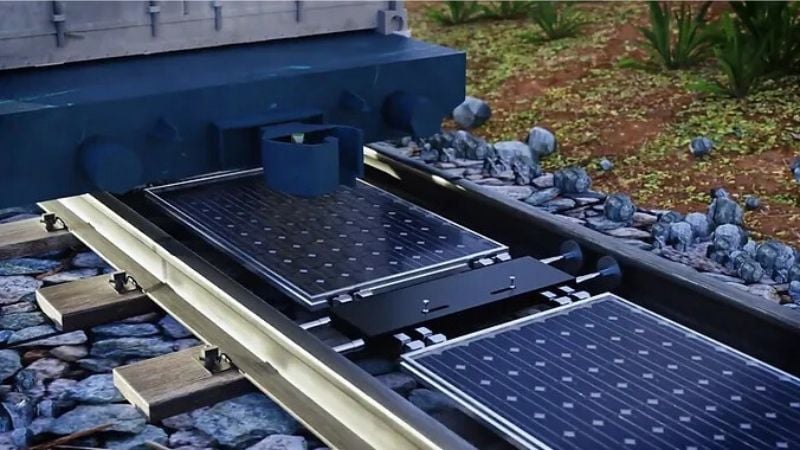
Sun-Ways’ solar railway design. Image used courtesy of Sun-Ways
Tapping Train Tracks for Solar Power
Sun-Ways claims Swiss railway networks could produce 1 TWh of solar power annually, or about 1.7% of the nation’s total electricity consumption last year. That’s enough capacity to power 300,000 households.
The Swiss Federal Office of Transport recently greenlit the $685,920 project after a 10-month review of independent assessments from the School of Engineering and Management Vaud and engineering consultancy GESTE.
Swiss rail equipment manufacturer Scheuchzer Ltd. developed a special machine to install up to 984 feet of solar panels per hour, or nearly 500 modules daily. Public transport operator transN will host the project, while local utility Viteos and electrical installer DG-Rail will oversee grid connection work to provide current to the distribution network.
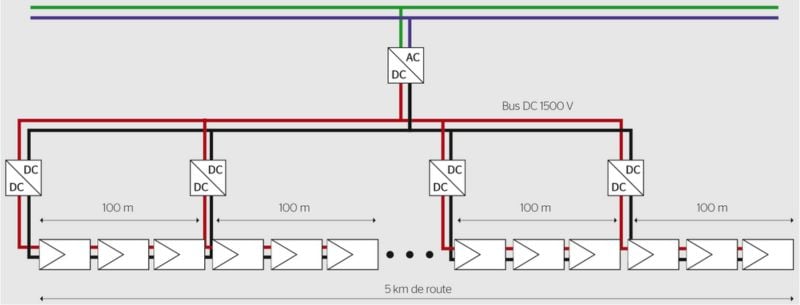
This image from an article co-authored by Sun-Ways CEO Joseph Scuderi shows the architecture of a linear solar installation between rails. Image used courtesy of Sun-Ways (Figure 3)
Sun-Ways envisions three possibilities for using the project’s output. It could reinject the electric current into the railway system’s low-voltage network to power stations, switches, signals, and other infrastructure. It could also reinject the current directly into the power grid via the distribution network operator or a traction energy network that powers the locomotives. However, this option requires additional technical assessments.
Ideally, Sun-Ways’s final solution would avoid installing ground inverters, allowing substations to recover the injected current.
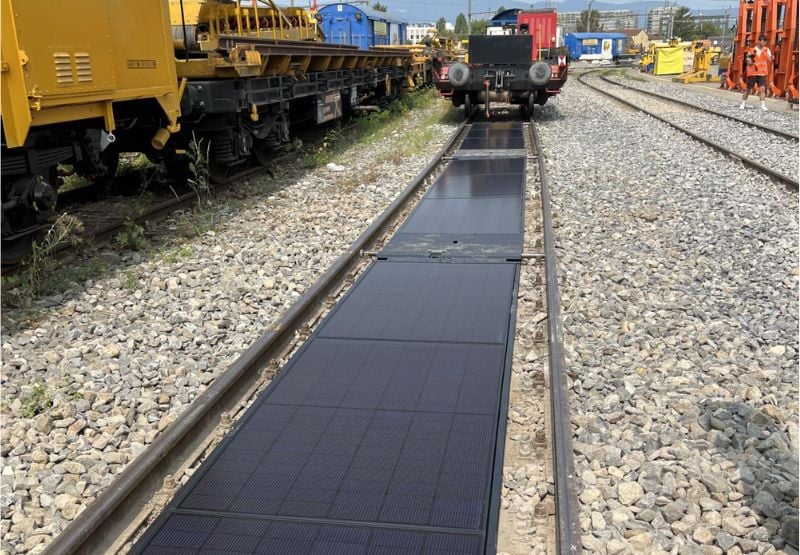
Sun-Ways installation. Image used courtesy of Sun-Ways
Removable Solar Panel Design
Sun-Ways’s attachment system can be removed quickly, allowing maintenance teams to conduct work like grinding rails and tamping the ballast under sleepers that hold the rails in place. The solar panels will also include an anti-reflective filter to avoid glare.
The panels feature cylindrical brushes to clean off debris and avoid performance issues. The system can withstand winds up to 149 miles per hour (mph), and current prototypes have validated stability when trains pass over at up to 93 mph. The railway section for the pilot project allows a maximum speed of 43 mph.
The project will use standard 3-by-5-foot PV modules with a Sun-Ways device installed between the rails at a 4.7-foot gauge. Specific dimensions may vary depending on the individual track’s gauge.
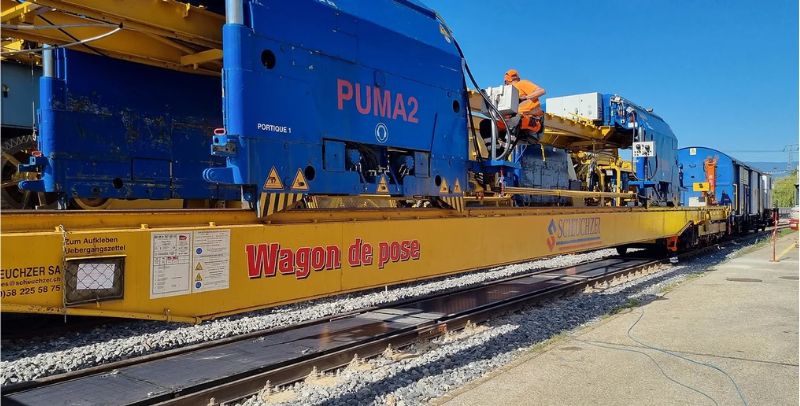
Sun-Ways partnered with Scheuchzer to develop an installation procedure for its rail-based solar system. Image used courtesy of Sun-Ways
This will be Sun-Ways’s first full-scale pilot in Switzerland. The company is in talks with SNCF, a state-owned railway company in France, on another potential project. It’s also engaging prospective partners in the U.S., China, Australia, and Thailand.