Facebook
 Google
 GitHub
 Linkedin
Hail No! Preventing Storm Damage to Solar Farms
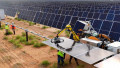
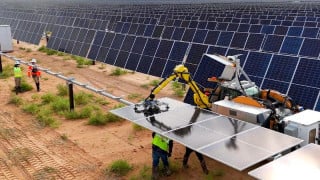
Terrasmart employs high-tilt stow angles to protect solar panels from hail damage.
Terrasmart, a leading provider of utility-scale single-axis solar photovoltaic trackers, has introduced a new hail protection functionality that automatically stows panels in an optimum position to avoid direct impact.
The feature—available in TerraTrak 1P and 2P—directs Terrasmart’s cloud-based control and monitoring software to reposition arrays 60 minutes before hail hits. The timing can be customized to operators’ requirements.
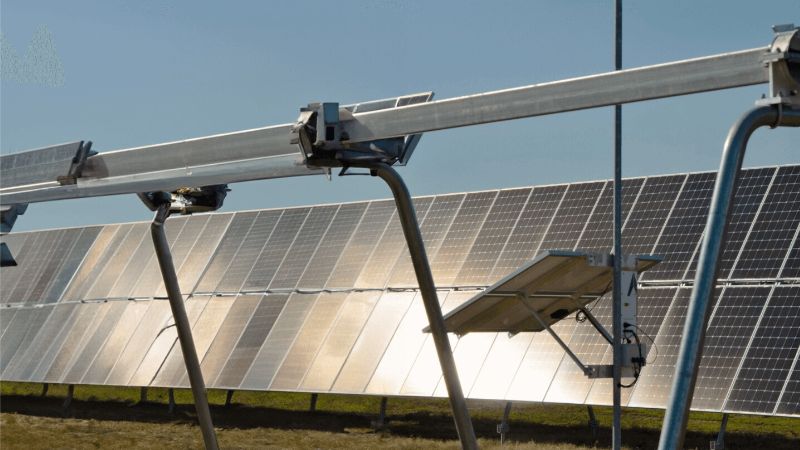
Terrasmart’s high-tilt angle. Image used courtesy of Terrasmart
Solar Panel Weather Destruction
Although only 2% of insurance claims filed by solar projects are hail-related, the damage is particularly costly. Insurance underwriter GCube found hail comprises 54% of insured losses on solar systems, averaging $58.4 million per claim. These risks are compounded by an increase in destructive thunderstorms across the U.S. Year-to-date preliminary data from the National Oceanic and Atmospheric Administration (NOAA) counts 5,122 severe hail reports through August 2024, most of which involve hailstones 1-2 inches in diameter.
Last year saw more than 10,000 severe hail events nationwide. Some of the hardest-hit states also have a growing pipeline of solar projects. Texas, which experienced nearly 2,000 hailstorms, is the nation’s second-largest solar power producer. According to the Energy Information Administration, developers plan to add nearly 24 GW of capacity to the state by late 2025. Kansas and Colorado each counted more than 750 events in 2023. The former’s utility-scale solar generation has grown tenfold since 2018, while the latter ranks 11th among states in grid-scale generating capacity, with 1.2 GW installed and another 1.7 GW scheduled to come online in 2024.
Tailoring Tilt for Hail Resilience
Terrasmart’s stow feature triggers a high-tilt angle to reduce the modules’ exposed surface area. Without manual intervention, the mechanism automatically moves trackers away from the wind’s direction by stowing at a 50° angle for TerraTrak 1P and 60° for 2P. Activation is tied to weather forecasts from AccuWeather.
The capability expands upon TerraTrak’s built-in wind and snow protection features, proven in locations with 150-mile-per-hour (mph) winds, 100 pounds-per-square-foot snow loads, and 60-inch-deep frost. The system monitors wind and snow conditions through on-site weather stations and stows assets when needed.
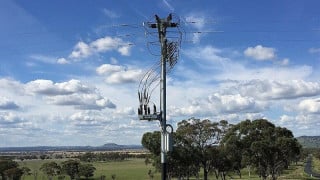
The stations’ sensors send data to the network controller and activate stowing based on wind speed, gust, and direction, ambient temperature, and snow depth. Terrasmart’s PeakYield software then adjusts each tracker row.
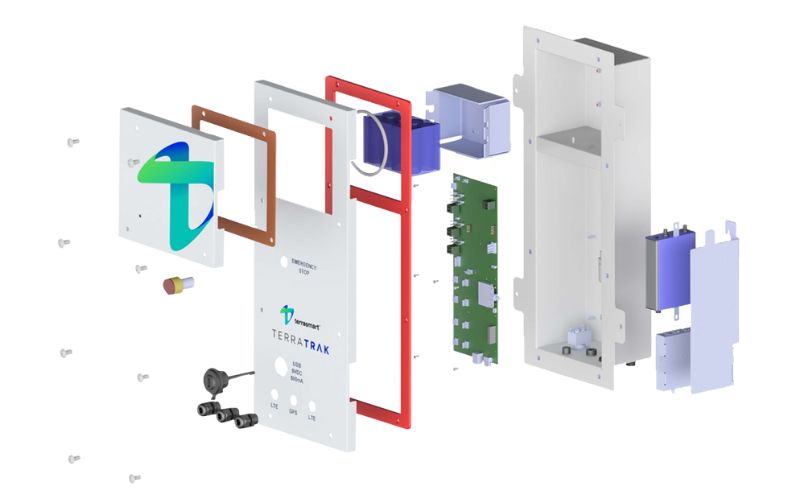
Sensor and communication system. Image used courtesy of Terrasmart
Before developing the hail feature, Terrasmart’s engineers worked with consulting partners to determine performance needs in high wind conditions, finding that balancing stiffness, wing length, and damping is crucial. With dampers ensuring system stability in strong winds, a high-tilt strategy could align wind and hail stow positions for better protection.
Hail Protection Protocols
Terrasmart cited VDE Americas’ data indicating that stowing solar panels at an angle of at least 50° minimizes financial risks by tens of millions of dollars compared to a 0° tilt configuration.
Defensive stow protocols significantly mitigate hail damage for single-axis trackers by reducing direct glass impacts. While horizontally oriented modules (flat or 0°) are subject to direct blows, a strategy of rotating modules to a tracker’s maximum angle (50° to 70°) can control indirect or glancing blows associated with kinetic energy from falling hail.
Higher tilts can offer superior protection against particularly large hailstones. According to NOAA, severe thunderstorm-induced hail typically ranges from 1 inch in diameter (quarter size) to 1.75 inches (a golf ball), falling in 25 to 40 mph winds. Hail can tumble up to 72 mph in strong supercells and reach 2 to 4 inches in diameter. About 14% of last year’s severe hailstorms produced stones close to the size of a tennis ball.
A VDE Americas case study tested module impact with 3.5-inch ice balls, finding that a steep 75° stow reduces damage probability by 87% compared to a 60° position.
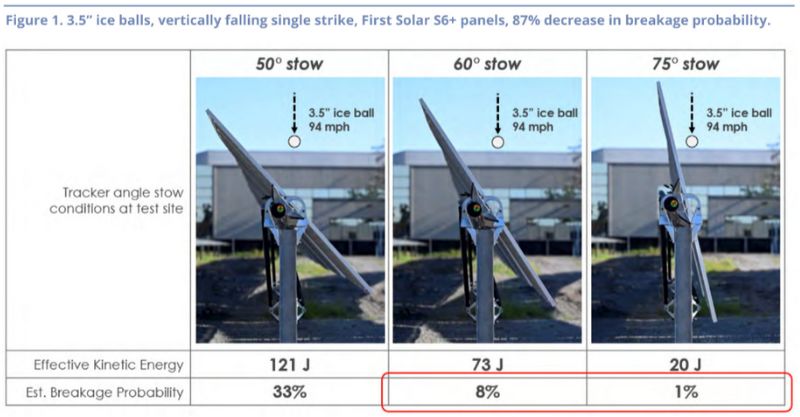
Tests show that a high-tilt stow position significantly reduces damage risks. Image used courtesy of VDE Americas (Page 10)
Hail-resistant materials are another solution. For example, modules with 3.2-mm heat-tempered front glass are more resilient than 2-mm heat-strengthened glass. Some manufacturers are offering new glass structures with enhanced durability. LONGi recently debuted a dual-glass bifacial panel combining fully tempered glass with a standard structure to withstand 2-inch hailstones.