Facebook
 Google
 GitHub
 Linkedin
Achieving Grid Resilience With Building-Level Renewable Generation
Commercial buildings with on-site microgrids help relieve grid congestion and aid in load balancing.
Buildings, both commercial and residential, consume about 37% of total energy in the U.S., according to the Energy Information Administration’s latest figures. Commercial structures make up over 17% of energy consumption and contribute significantly to greenhouse gas emissions.
How do building-level microgrids benefit the grid? Video used courtesy of Wattsmart Batteries
What if these same commercial buildings could serve as miniature power plants, generating energy for their own needs and feeding the excess back into the grid for general use? This idea is gaining traction, especially in urbanized areas.
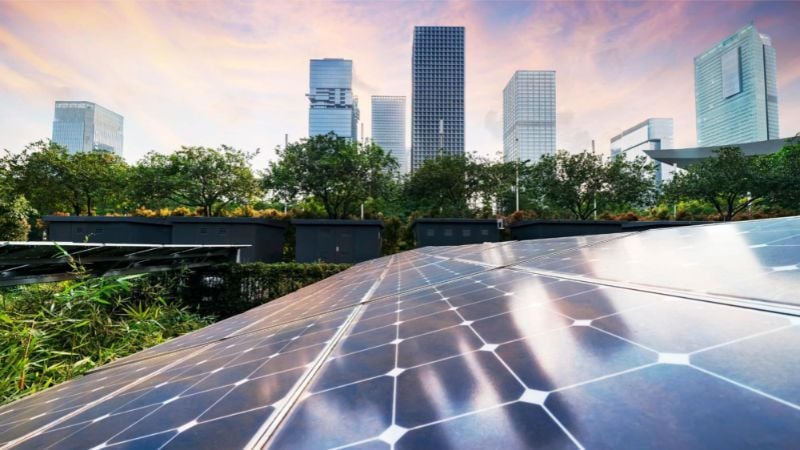
Solar panels on an urban building. Image used courtesy of Adobe Stock
Generating and Storing Energy
Solar microgrids have become more popular with businesses seeking to reduce energy costs, meet emissions goals, and provide backup power. Property owners could save as much as 30% on their electricity bills. Building-level microgrids can compensate for missing revenues from vacant or underused buildings. Building vacancy rates are high, reaching about 20% in many urban areas.
Building-level generation also reduces costs for local utilities. About 5% to 6% of electricity is lost in transmission, so on-site generation could save energy and millions of dollars.
Solar power comprises almost all microgrids, but rooftop wind turbines, geothermal heating, and hydrogen fuel cell systems are also possible.
Renewable energy can produce more energy than needed. When a lack of sunlight or wind reduces generation, the microgrid owner can store the excess energy in battery energy storage systems for backup power. Storage batteries like the Tesla Powerwall are commercially available and can be scaled to meet the needs of all building sizes. This stored energy can keep vital systems running in emergencies and power outages.
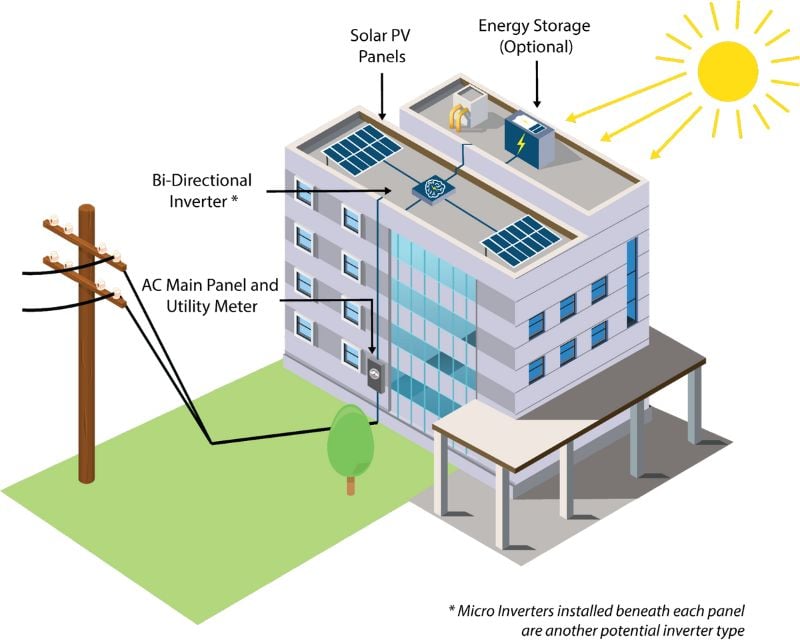
Building-level solar and storage. Image used courtesy of Massachusetts Clean Energy Center
Microgrids operating in island mode can produce 100% of their electricity needs for at least a short time. However, most are grid-connected and rely on conventional energy to fill production gaps.
Buildings with grid-connected microgrids can also send excess energy to the grid through an inverter to further reduce costs. The building then becomes a mini-power plant, helping to supply energy to the community. When several microgrid-equipped buildings are grid-connected, the effect can be significant.
Relying on Building ‘Power Plants’
Artificial intelligence data centers, electric vehicles, increases in heating and air conditioning, and other electrification are increasing energy demand and straining local grids. At the same time, grids are integrating more renewable energy resources, which naturally fluctuate in energy production.
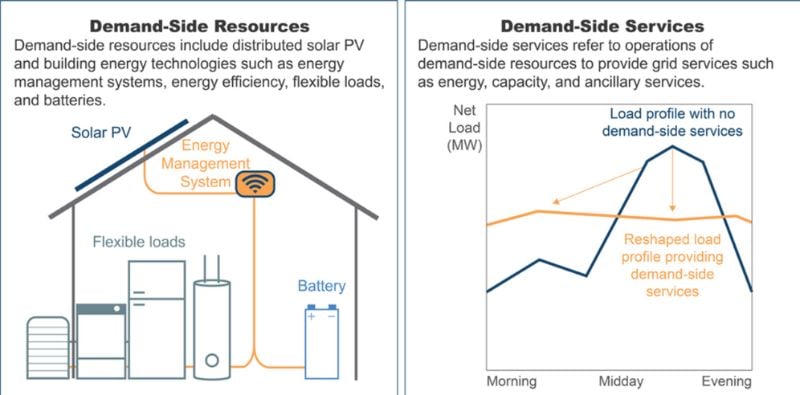
Demand-side resources. Image used courtesy of National Renewable Energy Laboratory
To manage supply and demand, many utilities are implementing demand-side management programs. These programs offer dynamic pricing schedules that enable users to schedule electricity use, such as EV charging, during off-peak hours. The program allows utilities to better plan for peak demand and prevent congestion, curtailment, and possible outages through load-shifting strategies.
Utilities also provide credits when buildings send energy back to the grid. The building-level microgrids then become “power plants,” which utilities can manage as distributed energy resources.
Solutions and Challenges
Several challenges in building-level microgrids persist, including variations in regulations, standards, and policies among utilities and municipalities. Local governments typically require inspections and permit applications.
Yet, utilities continue to develop incentives for on-site generation or storage to boost grid resilience. Using commercial buildings as mini-power plants will likely continue, especially as businesses seek to reduce costs and maximize their resources.