Facebook
 Google
 GitHub
 Linkedin
Microgrids, Macrotrends: Local Generation Feeds the Grid
Microgrids can benefit users and aid the power grid when optimized by AI and management software.
As solar panels and energy storage systems have become cheaper and more available, many companies are creating building-level microgrids as power backup or co-generation. These microgrids can add resilience during extreme weather and outages and reduce energy costs.
Microgrids are becoming a significant distributed energy resource (DER) at the grid level. Innovations in microgrid technology, such as artificial intelligence, are making these energy sources more efficient and robust.
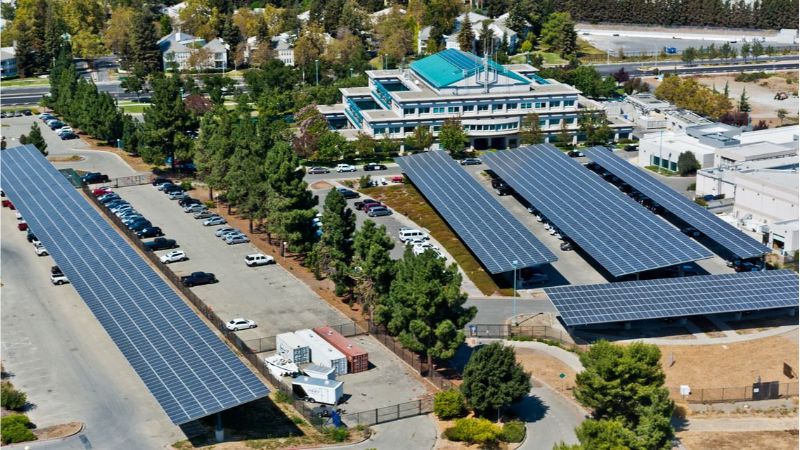
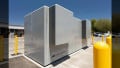
A solar microgrid. Image used courtesy of City of Fremont
Business Microgrids
Microgrids can benefit most types of companies. Large tracts of land are not needed since solar panels and equipment operate more efficiently than in the past. Two Toyota car dealerships in New York illustrate this fact.
Sunrise Toyota and Sunrise Toyota North on Long Island are working with Sprocket Power Microgrids to install grid-connected solar and energy storage systems. The project is anticipated to reduce electricity bills by 90%.
The installation will also use electric vehicle chargers from Kempower. Toyota makes the bZ4X EV and several plug-in hybrids, including the Prius.
Sprocket Power’s microgrids use cloud-based technology for management. The system accounts for weather and local grid conditions, including pricing variations.
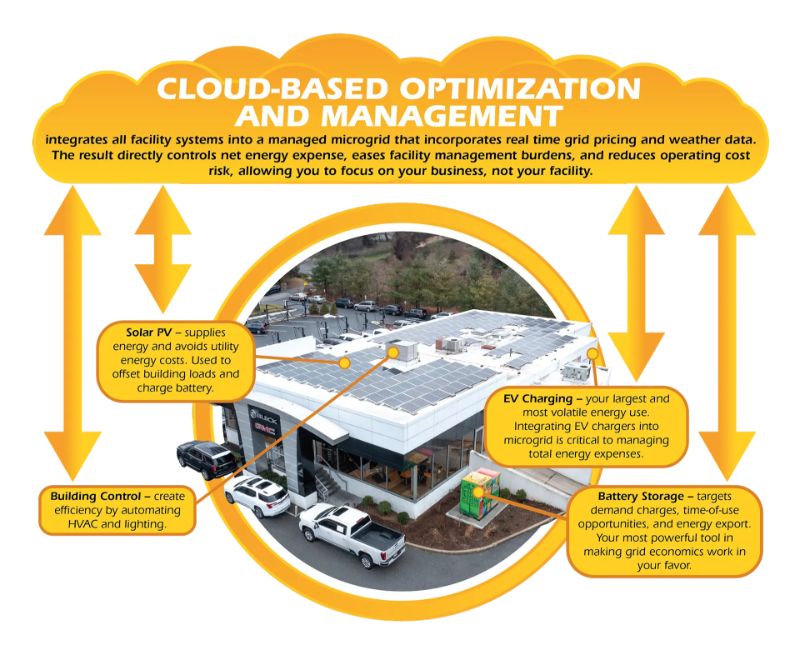
Cloud-based microgrid management. Image used courtesy of Sprocket Power
Charging infrastructure for electrified fleets can be integrated into solar microgrids. In December, Duke Energy and Entrada established fleet charging for Daimler trucks in a North Carolina microgrid.
Managing Grid-Connected Microgrids
As a DER, grid-connected microgrids can provide resilience during high demand or stress. However, integrating and managing these assets needs specialized tools.
To smoothly integrate and control microgrids, OATI created GridMind, a software management platform for businesses with microgrids. GridMind can optimize the available energy resources, including storage batteries, generators, inverters, and other equipment. It can function as a virtual power plant in grid services programs when paired with DER management software.
Since every business has unique microgrid needs, OATI uses a digital twin simulator to help plan operations. The simulator can test various conditions in the GridMind system to anticipate the impacts.
Artificial Intelligence and Microgrids
Artificial intelligence improves microgrid use at the local and grid levels. An AI-enhanced microgrid can be more efficient and adaptable to outside impacts and grid conditions. In DER management, AI algorithms can quickly adapt microgrid use to smooth out power fluctuations and optimize energy use.
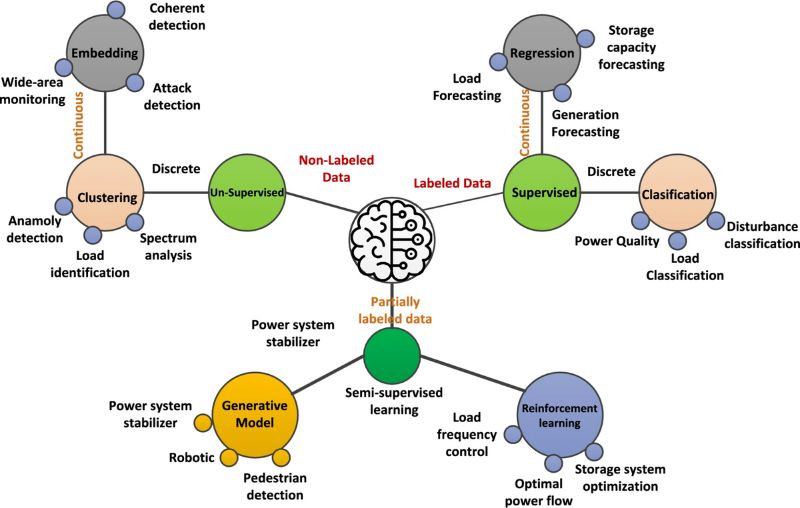
AI domains in a microgrid system. Image used courtesy of Singh et al.
AI can also predict maintenance needs by collecting sensor data from all integrated devices, such as inverters, generators, and transformers. The AI can monitor and assess temperature, current, voltage, and vibration. A study by Frost & Sullivan found that AI predictive maintenance can decrease unexpected outages by 50-70% within microgrids.
An AI-enhanced microgrid or DER management platform can also predict weather patterns and energy consumption based on previous trends and meteorological information, which it can gather and analyze in real time. This information is crucial for renewable energy microgrids; weather and seasonal changes can sharply impact solar and wind generation.
Microgrids, like other DERs, expose the grid to cyber attacks. Each integrated device offers a potential entry point for bad actors. AI-based cybersecurity can monitor the devices and their interactions within the network, detecting any abnormal activity and identifying weak areas.
Microgrid Trends
As AI grows in popularity, it will become a key component of microgrids. A decentralized power grid needs smart management to coordinate energy sources, optimize energy flow, and balance renewable loads.