
 Facebook
 Google
 GitHub
 Linkedin
With Steady Progress, Fusion Tech Inches Closer to Feasibility
In 2025, nuclear fusion technology scaled up, improved efficiency, and attracted billions of dollars in funding. But is it enough to move from lab to commercialization?
Nuclear fusion spent the second half of 2025 creeping a little closer to the grid and a little further from the “only 30 years away” punchline, with progress shifting from one-off physics tricks toward engineering, materials, and money. Lots of money.
Making electricity from fusing two hydrogen atoms sounds simple—it’s how the sun and the stars produce their prodigious energy. But achieving nuclear fusion on Earth is fiendishly difficult.
Rather than a single defining breakthrough, the past year was characterized by incremental yet significant steps that, collectively, strengthened the case for fusion as a plausible mid-century energy technology.

Concept of nuclear fusion. Image used courtesy of Adobe Stock
Pushing Fusion Limits
The National Ignition Facility (NIF) has been pushing beyond its historic 2022 breakeven demonstration by repeating and refining ignition-scale experiments. In an October 1, 2025, shot, NIF delivered about 2.07 MJ of laser energy to a capsule that released 3.5 MJ, a target gain of around 1.74. That’s its highest reported energy yield to date, and a sign that ignition is becoming a reproducible regime instead of an accident of alignment.
What matters is that NIF’s team and collaborators are starting to systematize the experiment cycle. One group trained machine-learning models to predict which experimental setups would achieve ignition, cutting the number of expensive “dead-end” shots, while others used AI-guided simulations to explore target designs and laser configurations, sharpening the path toward an economical inertial fusion energy driver rather than a laboratory curiosity.
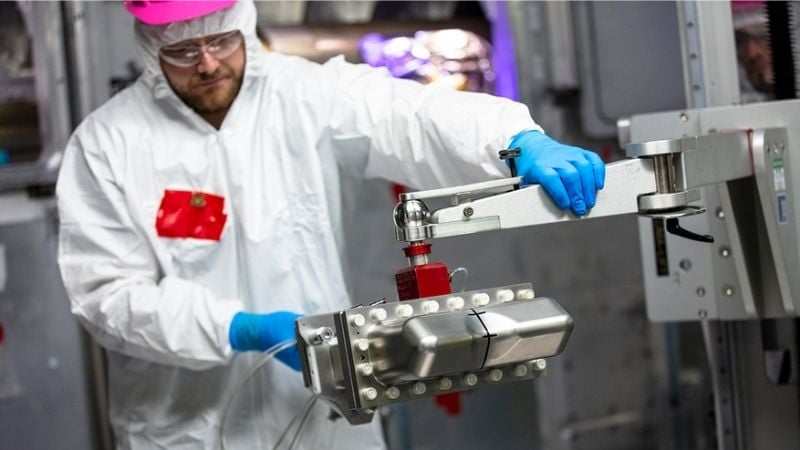
A scientist adjusts the equipment that safely contains material samples for fusion ignition irradiation environments. Image used courtesy of the National Ignition Facility/Jason Laurea
From Big to Industrial Lasers
If inertial confinement fusion can ever power cities and data centers, the laser hardware has to become smaller, faster, cheaper, and completely reliable.
In December 2025, Lawrence Livermore National Laboratory (LLNL) and Germany’s Fraunhofer Institute for Laser Technology announced ICONIC-FL, a cooperative program to design next-generation high-repetition-rate fusion lasers with industrial manufacturability in mind.
The partnership is essentially a division of labor between a lab that has already demonstrated ignition and an institute that lives in the world of mass-produced laser systems. The group is cross-validating laser-driver simulations, exploring architectures suitable for fusion power plants, and explicitly framing the 2020s as a “decisive decade” in which the laser technology must make the leap from bespoke optics to factory-scale hardware. They hope the LLNL’s new LIFT initiative will act as a hub for industry collaborations.
Tokamaks, Stellarators, and Smarter Magnets
On the magnetic-confinement side, the year’s second half was less about spectacular single shots and more about keeping hot plasmas where they belong.
In October, researchers reported the first successful use of three-dimensional magnetic coils on a spherical tokamak to actively suppress edge-localized modes and independently control upper and lower divertors, a key step toward longer, more stable discharges.
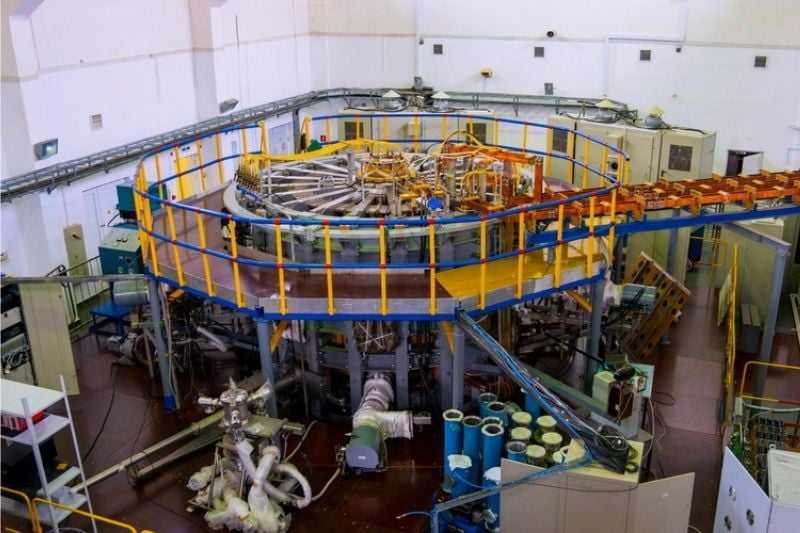
The Kazakhstan tokamak. Image used courtesy National Nuclear Center of the Republic of Kazakhstan
At the same time, materials scientists working with facilities such as Kazakhstan’s unique high-heat-flux installations and U.S. university labs focused on candidate metals and composites that can survive inside plasma in conditions up to 10 times the temperature at the sun’s core without eroding or contaminating the plasma.
This combined push on 3D field control and advanced wall materials is quietly shifting magnetic fusion from impressive but fragile physics experiments toward devices that could, in principle, operate at high duty cycles without destroying themselves.
Materials: From Diamonds to Ultrawide Bandgap
The most interesting fusion developments often focused on esoteric materials rather than on reactors themselves. Experimental work at SLAC and UC San Diego probed how gold and diamond behave under laser-driven fusion’s extreme pressures and temperatures, overturning long-standing theoretical models and giving designers better data on how fuel capsules deform, crack, and mix.
In November, a Texas Tech University team reported the first practical ultrawide-bandgap semiconductor detector for 14.1 MeV deuterium-tritium fusion neutrons, with around 5% detection efficiency. Built from hexagonal boron nitride, these compact, radiation-hard detectors promise better, battery-operated neutron diagnostics inside harsh fusion environments, and they build on earlier h-BN work that achieved record-high 60% efficiency for thermal neutrons.

The hexagonal h-BN semiconductor neutron detector. Image used courtesy of Texas Tech University
In parallel, chemists and materials scientists highlighted how high-temperature superconductors, radiation-tolerant steels, and innovative coolants are becoming the true bottlenecks—and potentially the enablers—of commercial fusion designs.
Private Fusion: From Hype to Hardware
Commonwealth Fusion Systems (CFS) closed an $863 million Series B2 funding round in August 2025 to finish its SPARC and advance its ARC power plant plans in Virginia, bringing total funding close to $3 billion. This consolidates CFS as one of the first likely grid-scale private fusion providers, with enough capital to move beyond experiments into full plant engineering.
Helion Energy continued testing its Polaris prototype and broke ground on Orion, a 50 MW commercial plant in Malaga, Washington, aimed at supplying Microsoft data centers by 2028. The total raised is now over $1 billion, including a $425 million round in 2025. This sets one of the most aggressive commercialization timelines in the industry and anchors fusion directly to data-center demand via a power purchase agreement.
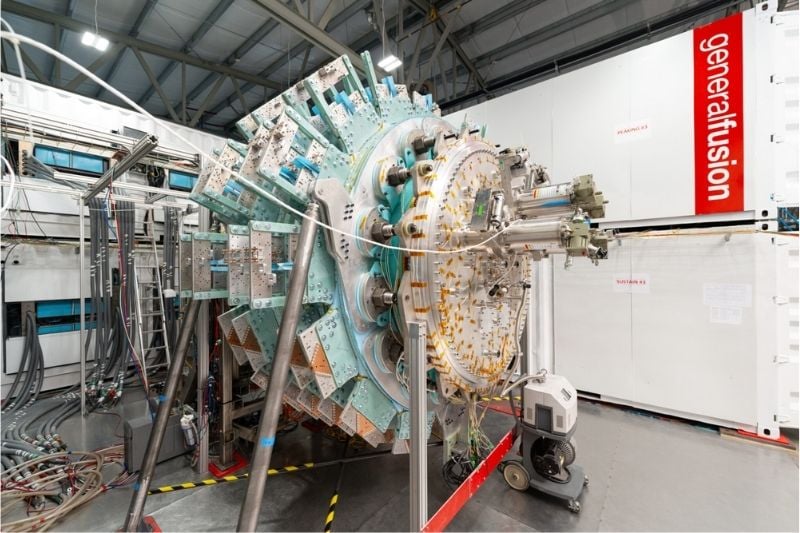
Magnetized target fusion technology. Image used courtesy of General Fusion
General Fusion in Canada, Realta in Wisconsin, and Helical Fusion in Japan all raised tens of millions of dollars to advance toward demonstration devices and validate novel approaches, such as magnetized-target fusion and compact, lower-temperature concepts. These moves keep the technology portfolio diverse, with multiple fusion paths that might fit different grid niches or industrial applications.
Across the sector, a Q3 2025 analysis estimated that cumulative private fusion investment had hit around $10 billion, with nearly $1.7 billion committed in 2025 alone (excluding China). A separate supply-chain survey found that spending by fusion companies on components and services jumped 73% from 2023 to 2024, to roughly $434 million, reflecting the shift from simulations to hardware procurement and plant-site work.
Engineering the Ecosystem: Supply Chains and Fuel
Even if any one reactor concept works, fusion will fail commercially without a supporting ecosystem of specialty manufacturers, fuel suppliers, and regulators. In 2025, the Fusion Industry Association and partners mapped a rapidly expanding supply chain of magnet makers, cryogenic specialists, precision machine shops, and neutron-diagnostics vendors. However, the association also flagged looming bottlenecks in areas such as high-temperature superconducting tape and tritium-breeding technologies.
Concurrently, materials research focused on components that can tolerate extreme heat and neutron flux without unacceptable erosion or plasma contamination. Studies using specialized facilities in Kazakhstan and elsewhere assessed candidate alloys and composites under conditions approaching or exceeding those in envisaged power plants, while broader reviews emphasized high-temperature superconductors, radiation-resistant steels, and advanced coolants as decisive enablers for both tokamak and stellarator concepts.
On the fuel side, a team led by Texas A&M researchers grabbed attention in mid-2025 with an electrochemistry-based process for safer, cheaper extraction of lithium-6, a key ingredient for tritium breeding in many fusion designs. The work, which began as a cross-disciplinary idea bridging batteries and fusion engineering, underscores how fusion’s constraints are reshaping seemingly distant fields like resource extraction and chemical processing.

Microcapsules of fusible material. Image used courtesy of Texas A&M/LLNL
Policy, Timelines, and the Reality Check
By mid-2025, mainstream outlets were beginning to treat commercial fusion in the 2030s as a live possibility rather than science-fiction flavor text. Fusion is now framed as “closer than you think,” while critics also point out how unprepared regulators, grid planners, and climate policy frameworks are for a technology that might dump large amounts of dispatchable, non-fission nuclear energy onto the system within a single decade.
Analysts looking at the same funding and technical milestones delivered a more sober verdict: the fusion industry is now past the “toy problem” stage and deep into the gritty work of cost curves, component lifetime, tritium accounting, and licensing. Still, the gap between a prototype and a reliable, bankable power plant remains daunting.
The second half of 2025 did not bring the long-promised “fusion power to the grid” moment—in fact, it’s still not clear that the technology will ever be ready for prime time. The past year did, however, mark a clear inflection from individual laboratory successes toward a messy, industrial, and increasingly well-funded race to turn fusion into infrastructure—a shift that may matter more, in the long run, than any single experimental record.











Warm fusion is an illusion. I follow all efforts on this dream since after WW2. I can not understand how high level scientists do not understand that such energy source has in any way the under 1 the efficiency. On the other hand, the more important problem of humans is the next (2035+/-3) dramatic process when more than 80% of population will vanish.