
 Facebook
 Google
 GitHub
 Linkedin
Amid Skepticism, Cold Fusion Experiments Heat Up Again
A Canadian study has reignited interest in creating cold fusion, a form of nuclear energy achieved at room temperature.
Cold fusion is heating up again as a hope for an endless supply of energy generation. Cold fusion is a theoretical nuclear reaction occurring at or near room temperature—radically different from conventional fusion, which requires million-degree temperatures.
The idea, if proven, would mean virtually limitless, clean energy, using materials as simple as hydrogen and palladium. But proving that cold fusion even exists has been elusive for more than three decades.
However, University of British Columbia (UBC) researchers have reexamined the possibility of a cold fusion reaction as a radical energy generation form. Will their study in Nature inspire others to explore cold fusion?
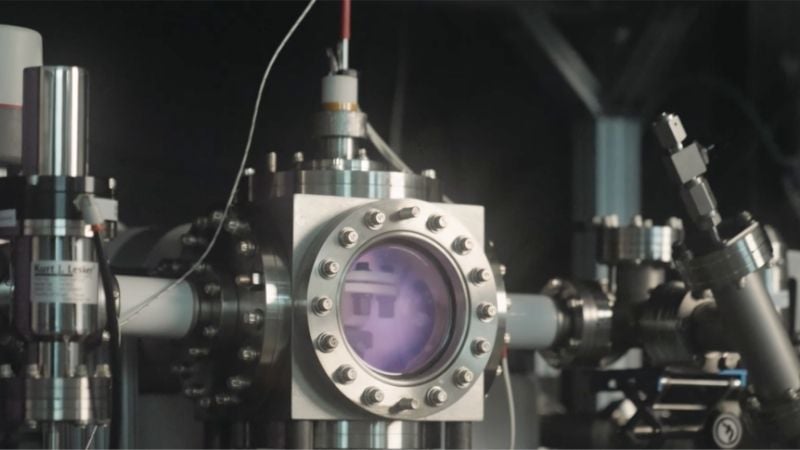
The Thunderbird electrochemical reactor. Image used courtesy of University of British Columbia
Cold Fusion Skepticism
In March 1989, electrochemists Stanley Pons and Martin Fleischmann, from the University of Utah, claimed to have produced excess heat during an experiment with heavy water and palladium, far exceeding the energy input. This suggested nuclear fusion, combining hydrogen isotopes (deuterium) to produce helium, neutrons, and energy, was happening at room temperature—a feat previously thought impossible.
Unfortunately, attempts to replicate Pons and Fleischmann’s results failed. Groups at Texas A&M and Georgia Institute of Technology initially reported positive results. Texas A&M saw excess heat, and Georgia Tech announced neutron production. However, both later retracted their claims after discovering instrument flaws (bad wiring and false positives due to detector exposure to heat).
Stanford University reported a small degree of excess heat was formed during their experiments, but standard chemical differences between heavy and light water could explain the result. Further, as Stanford did not measure radiation, peer reviews evaluated its findings as inadequate. It was later found that the researchers’ calorimetry (heat measurement) did not account for uneven mixing, heat loss, or gas evolution, which resulted in misestimating their “excess heat.”
The consensus quickly shifted—most physicists tagged cold fusion as an experimental error rather than a genuine discovery.
Hoax or Hope?
Because most of the scientific community concluded the original claims were due to mistaken measurements, not fraud, the story endured as a cautionary tale rather than deliberate intent. Pons and Fleischmann were reputable scientists; their mistake stemmed from hasty publication and lack of reproducibility, not malice or deception.

Martin Fleischmann with part of his cold fusion apparatus. Image used courtesy of Wikimedia Commons
Despite skepticism, a few researchers persisted, searching for reproducible results. Experiments focused on precise measurements of reaction products like helium, neutrons, or excess heat, especially in complex palladium-deuterium systems. Creating reproducible results remained problematic.
Scientific Consensus: 2025 Perspectives
Fission reactions that split uranium, plutonium, and other highly radioactive materials as a source for nuclear power have been around for decades. The waste products it creates are also highly radioactive and must be safely stored for 10,000 years or more before their radioactivity levels have dropped enough to be safe for humans.
Nuclear fusion is the process by which two light atomic nuclei of hydrogen isotopes combine to form a single heavier nucleus (of helium), releasing a large amount of energy in the process. This is the same nuclear reaction that powers the Sun and other stars.
Temperatures of around 100 million degrees Celsius are needed to overcome the electrostatic repulsion between positively charged hydrogen nuclei, and it is necessary to maintain high pressures to increase the chances of fusion reactions occurring. The super-heated plasma that forms is difficult to control, requiring powerful magnetic fields or inertial confinement by rapidly compressing fusion fuel using lasers or other methods.
Fusion reactions do not produce the same radioactive waste as fission. Still, even after more than seven decades of research, it has only been in the past three years that scientists at Lawrence Livermore National Laboratory achieved scientific energy breakeven—that is, the fusion reaction produced more energy than the energy input used to drive it.
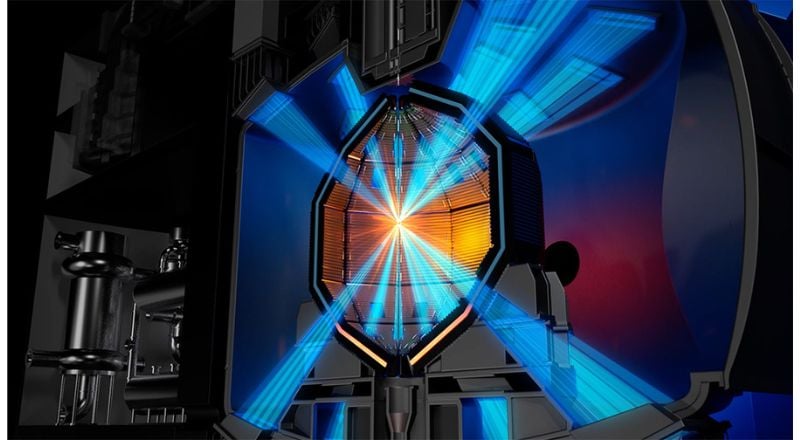
Artist’s concept of an inertial fusion energy power plant’s target chamber. Image used courtesy of Lawrence Livermore National Laboratory/Eric Smith
Today, fusion power research is a multi-billion-dollar enterprise dominated by efforts in China, the United States, and Europe. The “hot” fusion approaches—massive reactors like ITER and JET—use extreme pressures and temperatures to force hydrogen isotope nuclei together. These projects face huge engineering, cost, and scaling obstacles, but their principles are well understood and grounded in physics.
On the cold fusion front:
- No experiment has produced clear excess energy that exceeds the energy put in, at a scale useful for power generation.
- The rare results that indicate some level of cold fusion might occur are most often attributed to experimental artifacts, measurement errors, or misunderstood catalysis.
- The search continues, both to probe physical limits and refine materials science, but the consensus remains: Cold fusion is not yet a realistic solution for large-scale (or any) energy production.
Cold Fusion Study Leads to Renewed Interest
The Nature article has reignited some interest in at least the physical phenomenon of cold fusion. The UBC cold fusion experiments centered on a compact, bench-top apparatus called the Thunderbird Reactor. The research team designed their setup with three main parts: a plasma thruster, a vacuum chamber, and an electrochemical cell. Central to their experiment was a target made of palladium metal—a material known for its ability to absorb large amounts of deuterium, the isotope of hydrogen that would serve as the fusion fuel.
To initiate the process, the team used two methods to saturate the palladium with deuterium. On one side, they employed a plasma field in a plasma immersion ion implantation technique, which infused the metal with deuterium ions under controlled conditions. Simultaneously, they exposed the palladium target’s opposite side to an aqueous electrochemical cell, injecting even more deuterium into the material. This dual approach resulted in exceptionally high deuterium loading, reaching fuel densities typically associated with extreme pressure environments, but achieved at room temperature and with only a single volt of electricity.
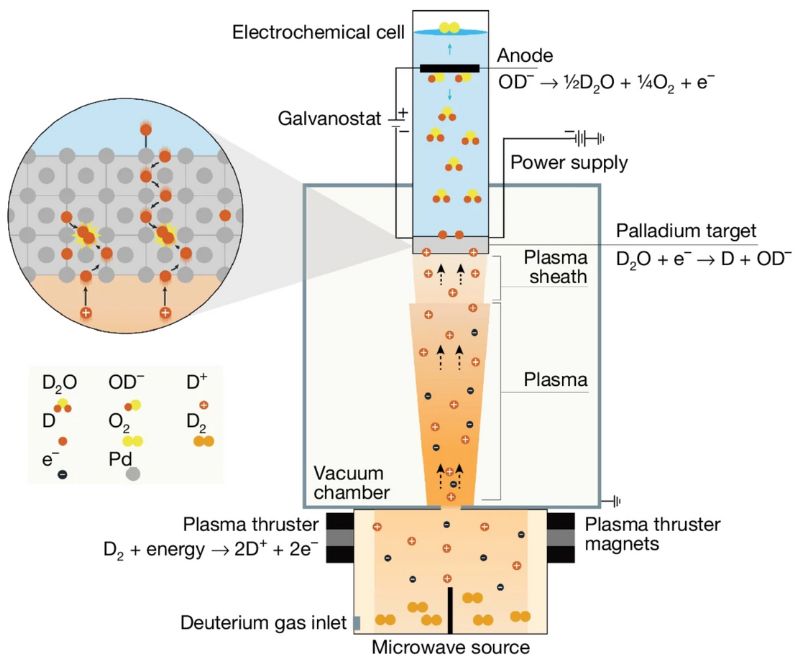
The UBC researchers’ configuration of the Thunderbird reactor. Image used courtesy of Chen et al.
After preparing the deuterium-rich palladium, the researchers bombarded the target with a deuterium beam, aiming to drive fusion reactions within the metal’s atomic lattice. Rather than focusing on indirect signs, like excess heat—an approach that plagued previous cold fusion claims with ambiguity—the UBC team relied on rigorous detection of neutron emissions, which acted as a direct indicator of fusion processes. The experiment demonstrated a notable 15% increase in measured fusion rates when electrochemical loading was combined with plasma implantation, compared to plasma alone.
The system was never intended to produce net energy. Its purpose was to prove that electrochemical loading could reliably boost fusion rates.
Is Cold Fusion Worth Pursuing?
Despite its spotty record, some researchers continue to investigate cold fusion, reframing it as “low-energy nuclear reactions” or “condensed matter nuclear science.” These are studies of nuclear reactions and processes occurring within condensed phases of matter, such as solids and liquids, as opposed to the high-energy plasma environments typical of conventional nuclear physics.
Cold fusion’s appeal lies in its immense promise: the possibility of a clean, abundant energy source. Recent experiments, such as those at the University of British Columbia, that emphasize reproducible techniques and systematic study, explicitly avoid grandiose claims of energy breakthroughs. Rather, such work seeks to illuminate novel states of matter and improvements in materials science that might have broader benefits—even if cold fusion never becomes a scalable energy solution.












“Cold Fusion ” is always a wonderful concept, and if it could ever be made to actually produce free energy the benefit would be huge. No question about that! There are always challenges, usually in containment, and so the solution has been “about ten years down the road” for the last 35 years. (Or was that “20 years down the road”).
What the actual problem is consists of two challenges, the first challenge being just how to start a stable fusion reaction. That seems to always require just a small bit more energy than is actually available. The second challenge is that it will require containing a reaction possibly producing the heat of the sun, in some sort of controlled manner. These two details seem to always require more research.