Facebook
 Google
 GitHub
 Linkedin
Enhancing xEV Powertrains With Advanced Trench Tech
Power electronics are a cornerstone of innovation in automotive, enabling superior performance and efficiency. Add SiC and they become even better.
This article is published by EEPower as part of an exclusive digital content partnership with Bodo’s Power Systems.
As the automotive market accelerates toward mainstream adoption, power electronics have emerged as a cornerstone of innovation, enabling superior performance and efficiency. At the forefront of this technological evolution are Silicon Carbide (SiC) power modules—a pivotal advancement redefining the capabilities of electric powertrains.
The growing adoption of electric vehicles depends on extending vehicle range and reducing battery costs. This can be addressed by minimizing energy losses and enhancing the compactness of power modules used in inverters. SiC power devices have garnered significant attention due to their ability to achieve lower energy losses compared to traditional silicon-based devices, positioning them as a key technology for loss reduction in power modules.
From Si-IGBT to SiC Technology
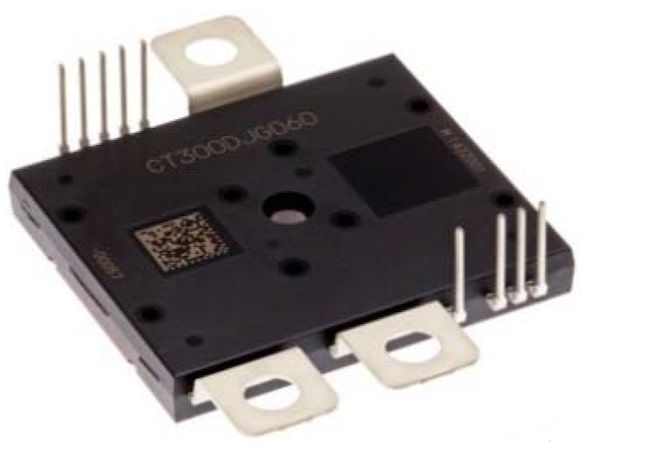
Mitsubishi Electric has powered over 33.5 million xEVs since 1997 and continues with its J3-Series of next-generation automotive power modules featuring advanced trench technology, improved thermal management, and integrated multi-functional chips to address challenges in EV powertrain design and performance. Pioneering automotive power module innovations, MELCO utilized 4th Generation IGBT technology in 1997, starting with customized modules based on case-type designs. By 2001, MELCO pioneered its first Transfer-molded Power Module (T-PM) package, setting a new standard in compact and reliable power modules. Over the years, the company launched several groundbreaking T-PM products including Direct-Lead-Bonding (DLB) technology in 2009 which eliminated the wire-bonding limitation to deliver compact and highly reliable solutions. The J1-Series 6-in-1 product, introduced in 2015, featured integrated cooling fins for compactness and high power density. To date, over 4.5 million J1A modules have been shipped with zero reported field failures. Figure 1 shows the two design concept of T-PM (Generation 2) and J1A Si-IGBT modules.
(a) Image used courtesy of Bodo’s Power Systems [PDF]

(b) Image used courtesy of Bodo’s Power Systems [PDF]

(c) Image used courtesy of Bodo’s Power Systems [PDF]
Figure 1. Automotive Si-IGBT Power Modules (pictures to be replaced) (a) 2nd Generation Transfer-molded (b) J1-Series Power modules (c) 3rd Generation Transfer-molded modules (J3-Series).
Mitsubishi Electric began developing SiC power devices in the 1990s, including SiC power modules featuring planar MOSFETs for applications in railways, industrial equipment, consumer electronics, and automotive systems. Recent advancements have focused on SiC power modules utilizing trench-gate SiC MOSFETs, which deliver lower power losses and higher output performance than conventional planar-gate designs. Currently, the company is advancing the development of its J3-Series automotive power modules, which integrates efficient Trench SiC semiconductor devices with compact, high-reliability transfer mold packaging (T-PM).

Figure 2. Structural Comparison of 2nd and 3rd Generations of T-PM Designs. Image used courtesy of Bodo’s Power Systems [PDF]
The newly developed module (J3-Series) features an optimized heat dissipation structure that significantly improves thermal performance over conventional designs. Structural comparison between 3rd Generation T-PMs (J3-Series) to previous generation is shown in Figure 2. Key changes include replacing the traditional insulation sheet with a high thermal conductivity insulator and enhancing the module’s heat transfer capabilities. For chip bonding, Ag sintering with its superior thermal conductivity and reliability was introduced, surpassing the performance of conventional lead-free solder as in 1st Generation T-PMs. One of the most notable improvements of the J3-Series lies in substituting grease with solder for the module’s base thermal interface material. This change not only enhances heat dissipation but also simplifies the mounting process by eliminating the need for springs and retaining plates—an added convenience for mounting. The lineup will include both copper (Cu) and aluminum (Al) coolers. For aluminum coolers, a newly developed pin-fin design, offering higher thermal conductivity than traditional cylindrical fins, is under consideration. These advancements are expected to reduce thermal resistance by over 30% compared to the previous aluminum-based designs, delivering superior performance and efficiency.
Advanced Trench SiC Technology
While SiC serves as the powerhouse in EV power modules, trench technology optimizes its performance. This advanced engineering technique reshapes the flow of electricity through SiC MOSFETs, significantly boosting efficiency and power density. Unlike traditional planar designs, trench technology refines current paths to minimize resistance, resulting in lower energy loss and cooler operation—especially at higher voltages. Trench designs enable SiC power modules to manage more power in smaller packages, aligning seamlessly with the compact systems in modern EVs. From enabling ultra-fast charging to enhancing motor efficiency, trench technology is essential to the next generation of EV systems.
Mitsubishi Electric began developing SiC power devices in the 1990s and introduced the first-generation SiC power MOSFETs for electric railways in 2010. By 2013, mass-production of second-generation devices began, featuring optimized cell sizes and improved carrier injection mechanisms. Currently, Mitsubishi is developing an innovative SiC MOSFET with a new gate trench structure, integrated into the J3-series SiC power modules.
Trench-type SiC-MOSFETs offer significant advantages over traditional planar designs. One major benefit is reduced on-resistance, achieved by the larger channel area created by the trench design. This reduction in on-resistance lowers conduction losses, enhancing overall efficiency. Additionally, SiC materials boast superior thermal conductivity compared to silicon, enabling trench-type SiC MOSFETs to operate at higher temperatures and handle greater power densities—key for energy-efficient, high-performance applications. Figure 3 illustrates the trench gate structures. Compared to the traditional planar gate, the trench gate structure allows for smaller unit cells and low-loss operation through higher integration.
Despite these benefits, trench-type SiC MOSFETs come with certain challenges. The high conductivity of the trench design can make short circuit handling more difficult. In addition, fabricating trench-type SiC MOSFETs is more complex, requiring precise manufacturing control, which can increase production costs. However, the efficiency gains often justify the added expense, especially in high-end automotive applications. Another challenge with the trench structure is electric field concentration at the trench bottom, which can lead to device breakdown and degradation of the gate insulation.
To support a wide range of automotive applications, it is crucial to integrate structural design methods that enhance short-circuit capability while maintaining efficiency. Mitsubishi Electric has refined its conventional trench SiC MOSFET structure to strike a balance between reducing resistance and improving short-circuit robustness. Figure 4 illustrates the developed trench SiC-MOSFET.

Figure 3. Schematic of Developed Trench SiC-MOSFET. Image used courtesy of Bodo’s Power Systems [PDF]
To mitigate the trade-off between lower resistance and enhanced short-circuit capability, Mitsubishi Electric introduced a method to adjust the sidewall P-type pillar ratio (rSP) of SP regions along the trench sidewall. These regions are optimally spaced along the trench structure, ensuring effective control over the device’s short circuit capability. Additionally, grounding the bottom P well (BPW) provides stable switching performance and addresses the challenges of field concentration at the trench bottom. These advancements significantly enhance the reliability and efficiency of trench SiC MOSFETs, making them well-suited for automotive powertrain applications.

Figure 4. Developed Trench SiC-MOSFET With the Sidewall P-type pillar structures. Image used courtesy of Bodo’s Power Systems [PDF]
Outline of J3-Series SiC Products
The J3-Series SiC lineup is shown in Figure 5. It combines advanced SiC device technology with T-PM, offering a compact, high-reliability design. These modules provide low loss, higher power density, and increased reliability. At its core, the J3-T-PM module is a versatile half-bridge unit, available with 1300 V SiC MOSFET technology, making it suitable for 800V battery architectures. The module measures 26.5 mm x 53.9 mm x 6.92 mm (resin part). By adjusting the number of power chips and parallel modules, 6in1 configurations (J3-HEXAS and J3-HEXA-L) can handle output power from 50kW to 300kW, with the potential for even higher power by paralleling additional modules, leveraging the J3-T-PM’s scalability.
SiC Technology for Automotive
Mitsubishi Electric is reinforcing its commitment to the automotive and power semiconductor sectors with a 10 billion yen investment in a new facility in Fukuoka Prefecture, Japan, set to begin operations in 2026. The plant will focus on the assembly and inspection of power semiconductor modules to meet the growing demand for energy-efficient solutions, particularly for electric vehicles, supporting global decarbonization goals.
Key to this investment is the focus on silicon carbide (SiC) technology. The company is advancing its J3-series automotive power modules, including Si and SiC variants, to ensure high-performance, scalable solutions for the evolving market.

Figure 5. Lineup of J3-Series SiC Products. Image used courtesy of Bodo’s Power Systems [PDF]
Approximately 100 billion yen has been invested in a new 8-inch SiC wafer plant in Kumamoto Prefecture, which will feature advanced energy-efficient production and automation. By 2030, SiC wafer production (6-inch and 8-inch) capacity will increase 30 times compared to FY 2022. Additionally, Mitsubishi Electric is investing 10 billion yen to consolidate its existing operations in Fukuoka, optimizing assembly and inspection processes for power semiconductors. These investments, in addition to continuous innovation in the SiC trench technology and J3-series module packages, solidify Mitsubishi Electric’s leadership in SiC design and production and support its role in advancing energy-efficient and reliable technologies for automotive powertrain applications.
This article originally appeared in Bodo’s Power Systems [PDF] magazine and is co-authored by A. Saif, K. Hussein; Mitsubishi Electric Europe B.V., Germany; S. Inokuchi, T. Osaga, K. Yoshida, T. Tokorozuki, Y. Fukui; Mitsubishi Electric Corporation, Japan.