Facebook
 Google
 GitHub
 Linkedin
Data Center Surge Drives Short-Term Energy Demand
As data center expansion skyrockets, U.S. power needs will exceed previous forecasts.
The U.S. Energy Information Administration (EIA) has revised its retail electricity sales forecast upward in its June 2025 Short-Term Energy Outlook, citing stronger-than-expected demand growth in the commercial sector.
The EIA's outlook foresees commercial electricity consumption rising 3% in 2025 and 5% in 2026, significantly higher than its earlier estimate of 2% annual demand growth. This sharp upward revision is largely attributed to the expansion of data centers, particularly in areas served by the ERCOT (Texas) and PJM Interconnection (Mid-Atlantic) independent system operators.
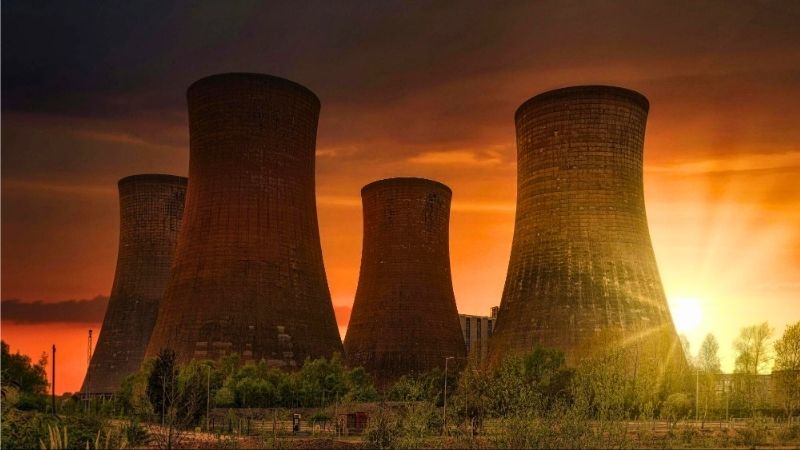
A nuclear power plant. Image used courtesy of Pexels/by Johannes Plenio
Data Center-Driven Demand
Following near-flat demand growth from the mid-2000s to the early 2020s, U.S. electricity consumption is now accelerating, with 2025 set to surpass the previous peak reached in 2024.
The main driver is data centers, particularly in ERCOT and PJM territories, which are rapidly becoming hubs for AI, cloud computing, and cryptocurrency mining. These regions are attracting new facilities due to favorable regulatory conditions, abundant land, and access to diverse power sources.
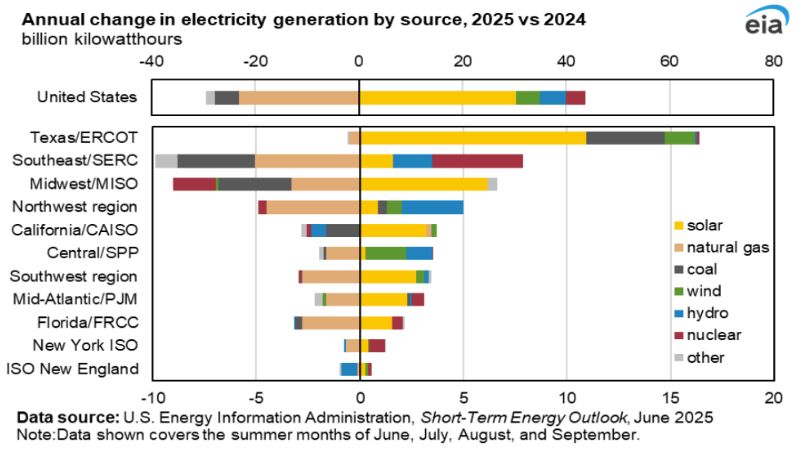
Regional comparison of electricity generation in 2024 vs. 2025. Image used courtesy of the EIA
ERCOT is on pace to lead summer-over-summer growth in power generation, due to demand from both data centers and new manufacturing sites. Texas' natural gas generation is likely to decrease this year, primarily due to increased output from new solar facilities and a smaller decline in wind generation.
PJM is also experiencing significant growth in data center-related commercial demand. Earlier this year, Reuters reported that peak demand in PJM's service area, which spans 13 states and the District of Columbia, is projected to increase from 152 GW to 184 GW by 2030, nearly all additions coming from data centers.
The EIA's short-term outlook also predicts that natural gas use will fall in the Northwest, offset by higher hydropower. This region, comprising Washington, Oregon, and California, holds half of the nation's hydropower capacity.
The Midwest will likely see a shift this summer from natural gas to solar as generation sources rebalance. The Southeast's forecast indicates nuclear generation will rebound from unplanned outages at three reactors in Tennessee last summer.
Summer Outlook: Solar Grows as Natural Gas Slips
According to the EIA, U.S. monthly electricity demand peaks during the summer (June through September) when most houses use air conditioning. This year, cooling degree days are expected to roughly match 2024 levels, indicating residential air conditioning use will remain stable.
However, increased power demand from the commercial and industrial sectors is likely to drive a 1% rise in total summer power generation—up by about 14 billion kWh (14 TWh)—over last year.
The power sources are also changing. Gas-fired generation is slated to fall by 3% this summer (23 TWh) compared to summer 2024. Rising fuel costs and expanding renewable capacity—particularly solar—are driving the decline. Coal generation is projected to dip another 2%.
Solar generation is on track to soar 33% this summer (by 30 TWh), powered by new capacity nationwide, particularly in Texas and California. Meanwhile, hydroelectric generation will rise by 6% due to improved water availability in the western U.S. Wind is forecast to grow modestly by 4%, while nuclear will jump 1%.
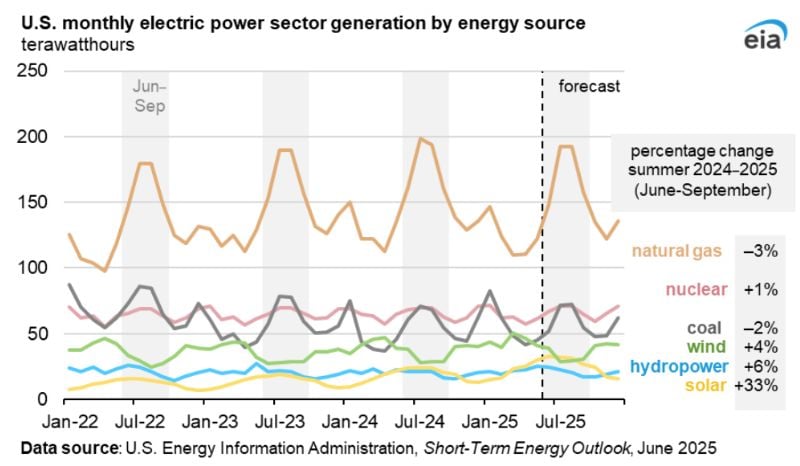
Monthly electric power generation data. Image used courtesy of the EIA
This tracks with the EIA’s earlier estimates that solar will account for over half (32.5 GW) of all new utility-scale capacity additions in 2025.
Other Energy Projections
Over the next year, EIA anticipates that natural gas, coal, and nuclear will remain relatively flat in the U.S. electricity generation mix. Natural gas currently accounts for 40% and is likely to hold steady at this level in 2026, while coal generation is expected to shrink from 16% to 15%, and nuclear from 19% to 18%. Meanwhile, renewables will grow from 23% in 2024 to 25% this year and 27% in 2026.
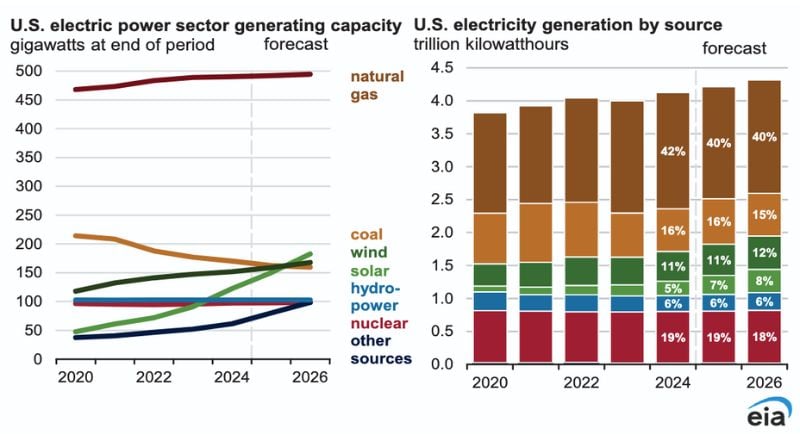
Generating capacity and output by source. Image used courtesy of the EIA
Renewable energy supply is expected to continue trending upward in 2025 and 2026, led by solar, wind, and hydropower.