Facebook
 Google
 GitHub
 Linkedin
Transforming Energy Storage: The Role of Bidirectional Charging in BESS
This article explores the role of Bidirectional functionality in enhancing Battery Energy Storage Systems' performance, reducing energy infrastructure costs, and helping to maximize renewable energy utilization, reducing reliance on fossil fuels.
This article is published by EEPower as part of an exclusive digital content partnership with Bodo’s Power Systems.
Global efforts to reduce emissions are driving the transition to electrical energy as a cleaner alternative to fossil fuels. Electricity now plays an increasingly important role in our daily lives, powering everything from electric vehicles (EVs) to transportation systems.
With the growing use of heat pumps, electricity is also making inroads in domestic heating. At the same time, grid operators are increasingly integrating renewable sources, such as wind and solar, into their energy mix. Unlike the coal and gas power stations, which can produce energy 24/7, these renewable energy sources are intermittent in nature – if the sun doesn’t shine and the wind doesn’t blow, these systems cannot generate energy.
These circumstances and trends are fuelling strong growth in the market for Battery Energy Storage Systems (BESS). Traditionally, the preserve of large-scale grid developments, the scale, flexibility, and cost of BESS are being transformed by innovations in battery and power electronics technologies. These advancements are creating opportunities and demand for an ever-growing range of applications.
Power conversion is a core function of a BESS, and Bidirectional Charging (BDC) systems represent a significant innovation in the field of power electronics. Traditional BESS power conversion systems were unidirectional, requiring separate circuits for charging (AC/DC) and discharging (DC/AC) the battery. BDC systems, however, allow electricity to flow in both directions, offering numerous benefits to the BESS developer.
What is a BESS?
The fundamental purpose of a BESS is to store electrical energy, making it available when needed, irrespective of when it was generated. Consisting of a collection of battery units, associated power electronics, control systems, and safety equipment, BESS can be characterized by its storage capacity in kWh (the amount of energy that the battery can store) and power capability in kW (the rate at which the battery can deliver or receive power).
The scale of BESS varies widely, depending on the end application, which can be classified into Front-of-the-Meter (FTM) and Behind-the-Meter (BTM), Table 1.
Table 1. BESS applications can be categorized into Front-of-the-Meter and Behind-the-Meter.
| Front-of-the-Meter | Behind-the-Meter |
| Transmission and distribution | Transport |
| Power Stations | Commercial |
| Substations | Residential |
| Utility-scale generation and storage | Industrial |
| Microgrid |
Front-Of-The-Meter (FTM)
Front-of-the-Meter (FTM) – or grid-scale – BESS supply power to electricity grids or off-site locations, and are deployed mainly by utility companies, grid operators, and renewable energy developers. FTM BESS are used in the energy industry for a variety of purposes, such as balancing the supply and demand of energy in the grid, providing ancillary services, and, increasingly, enabling the integration of renewable energy sources like wind, solar, and tidal.
Grid-scale BESS can store over 1,000 kWh of energy and can occupy large tracts of land; they are increasingly viewed as crucial components of a country’s energy supply. Fidra Energy’s Thorpe Marsh project, for example, the largest BESS project in the UK at 1,400 MW (3,100 MWh), is being developed on 55 acres of land and will ultimately have enough capacity to supply 800,000 homes during peak demand times.
Behind-The-Meter (BTM)
Behind-the-Meter (BTM) BESS provides power to on-site locations, such as residential homes or businesses, with applications including EV charging infrastructure, telecommunications networks, data centers, and residential energy storage. Capacities of commercial BTM systems range from 20 kWh to 1,000 kWh, while residential BESS are typically within the 5 kWh to 20 kWh range. The physical sizes of BTM systems range from a domestic refrigerator up to multiple shipping containers.
As this fast-growing market attracts increasing levels of investment and incentives, innovations in BESS technologies are leading to the development of flexible, scalable, and highly portable systems, creating new opportunities and enabling new applications.
Increasing Energy Densities Drive BESS Innovation
The BESS sector has undergone rapid evolution over the last 15 years, with energy densities (a key characteristic of a BESS) increasing dramatically. Higher energy densities enable more energy to be stored in a given footprint, which brings multiple advantages. Land acquisition and construction costs are reduced, and transportation of higher-capacity BESS becomes easier and more cost-effective.
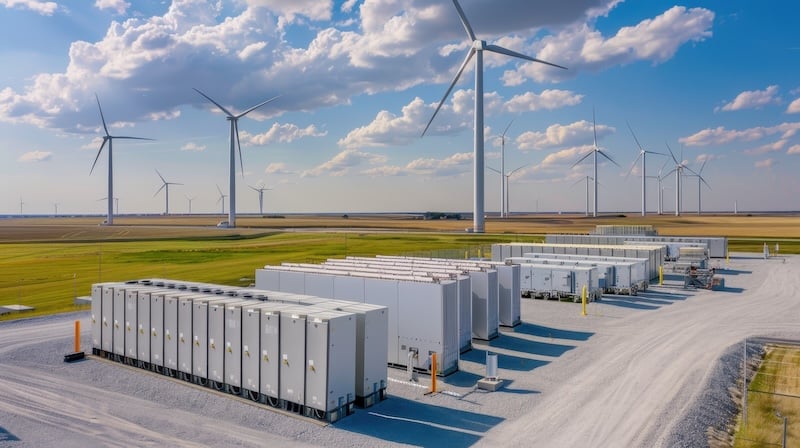
Figure 1. Containerized battery systems. Image used courtesy of Avnet Silica and Bodo’s Power Systems [PDF]
The utility-scale stationary storage installations of the early 2010s, often housed in large buildings, are giving way to containerized BESS (Figure 1), particularly in BTM systems, where applications range from mining and construction to EV charging infrastructure.
Containerized BESS are designed to be shipped out to remote areas, such as mining or construction sites, where they are used to power equipment before being returned from the field for recharging. Higher energy densities allow the mobile BESS to deliver power for longer intervals, reducing downtime and transportation costs.
BESS can also be installed at EV charging stations to smooth the impact on local grid connections at peak charging times. With space often limited around charging stations, in urban areas, for example, the physical size of the BESS is important. To understand this evolution in energy density, it is useful to consider how a BESS works briefly.
A Look Inside the BESS
The key subsystems within a BESS consist of the Battery Modules, the Battery Management System (BMS), the Energy Management System (EMS) and the Power Conversion System (PCS, Figure 2).
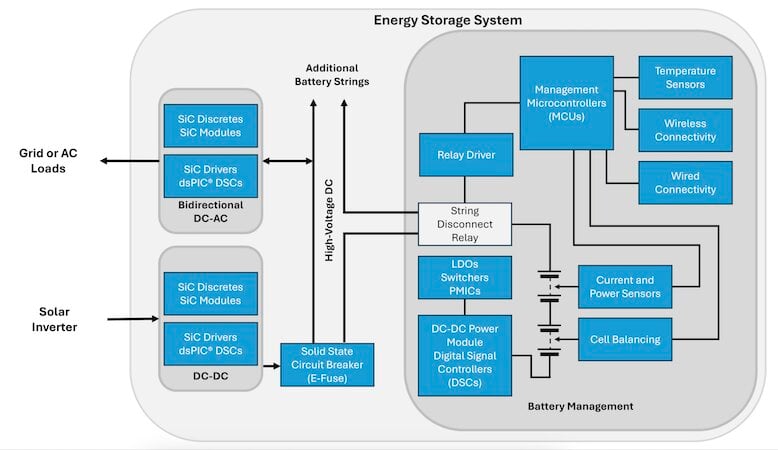
Figure 2. Battery management system breakdown. Image used courtesy of Microchip Technology and Bodo’s Power Systems [PDF]
While all of these sub-systems work in collaboration to deliver the overall efficiency and energy density of the BESS, developments in two specific areas have contributed significantly to increased energy densities.
Advancements in Battery Chemistry
As the primary energy storage units, the battery cells are at the heart of the BESS, and recent advancements in battery chemistry have focused on enhancing energy density, charging speeds, and safety. Solid-state batteries, including lithium-sulfur and lithium-air batteries, which offer higher energy densities and improved safety over liquid electrolytes, are emerging as alternatives to conventional lithium-ion technology.
The Evolution of Power Electronics
The Power Conversion System (PCS) plays a crucial role in converting the supplied power to a form that can charge the batteries and also in converting the stored energy back into a suitable output form for the grid or other loads, such as machines or EV charging stations.
Power electronics devices perform these conversions, and the field of power electronics has evolved significantly since the early 2010s. Power conversion solutions use a combination of switched semiconductors and passive components arranged in various topologies paired with control devices that turn the semiconductors on and off to achieve the desired outputs.
Silicon (Si) MOSFETs and IGBT devices were used in power conversion for many years, due to their low conduction and switching losses. In the relentless drive for increased efficiencies and power densities, the switching-speed limits of these silicon devices were eventually reached, and designers have increasingly turned to wide-bandgap technologies, such as Silicon Carbide (SiC).
Alongside these developments in semiconductor technologies, advancements in topology design and control strategies have delivered more flexible and innovative power conversion solutions. One specific development in power electronics, Bidirectional Charging (BDC), has had a transformational impact on BESS.
Bidirectional Charging – Transforming BESS
Traditional power management solutions could only transmit power in one direction, either from the AC grid to the DC battery or vice versa. This limitation obliged BESS developers to include two separate power conversion circuits in the design, which added to the overall cost, complexity, and size of the BESS.
BDC solutions, however, use a single circuit for both AC-DC and DCAC conversion, offering multiple benefits to BESS developers, including reduced space, weight, power, and cost (SWaP-C), as well as lower complexity. BDC systems are thus simpler to implement, with lower Bill-of-Material (BoM) costs, and can easily be scaled up by paralleling multiple circuits. Popular BDC topologies include buck-boost converters (Figure 3) and dual active bridge (DAB) converters (Figure 4).
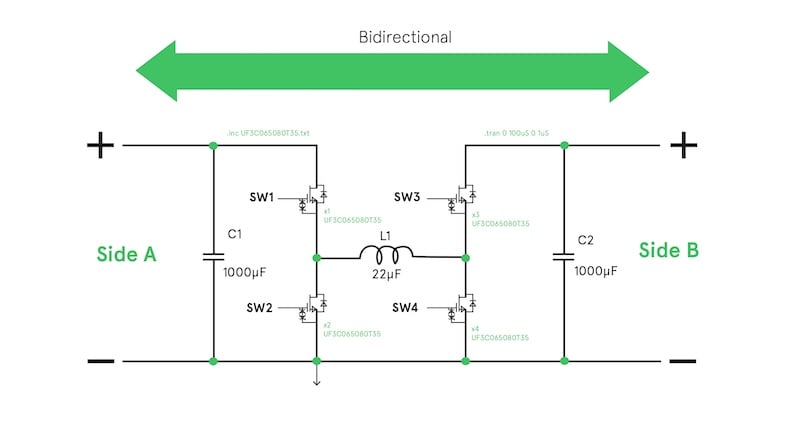
Figure 3. The buck-boost converter. Image used courtesy of Avnet Silica and Bodo’s Power Systems [PDF]
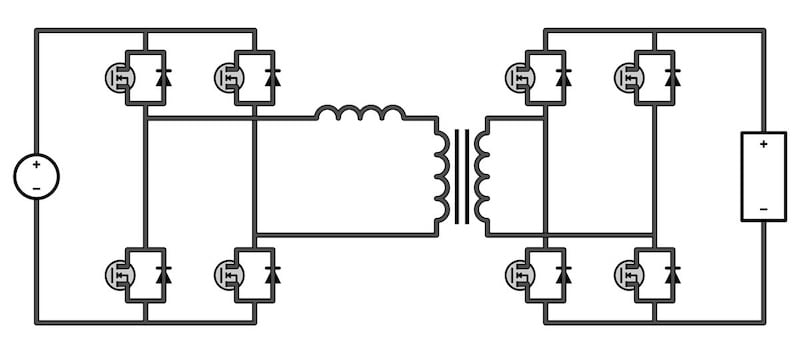
Figure 4. The dual-active bridge converter. Image used courtesy of MathWorks and Bodo’s Power Systems [PDF]
Buck-boost converters are commonly chosen for bidirectional DC/ DC conversion due to their simple design and ease of control, while DAB converters are popular where isolation is required. Other notable BDC topologies include the CLLC converter, the Phase-Shifted Full Bridge (PSFB) Converter, and the Totem-Pole PFC.
Bidirectional charging also requires sophisticated control algorithms to manage the charging and discharging cycles; modern solutions use advanced control strategies like Linear Active Disturbance Rejection Control (LADRC).
Conclusion
BESS plays an increasingly important role in our society as we integrate renewable energy and EV batteries into the energy ecosystem and support a growing range of BTM applications. The evolution of power conversion topologies has been instrumental in fulfilling the growing demand for more flexible and efficient energy storage solutions, with BDC offering significant space, weight, and cost benefits to BESS developers.
Ongoing research efforts into the efficiency of bidirectional converter topologies and control strategies will continue to enhance the overall reliability and lifespan of BESS and connected devices.
This article originally appeared in Bodo’s Power Systems [PDF] magazine.