Facebook
 Google
 GitHub
 Linkedin
Nuclear Researchers Push Fusion, Dark Matter, and the Moon
Discoveries could accelerate nuclear development on Earth, demystify the laws of physics, and send nuclear power to the moon.
Interest in nuclear energy is soaring amid efforts to meet energy demand and decarbonize the grid. Engineers and researchers are focused on the next generation of reactors, which could accelerate development, lower costs, and expand nuclear energy use.
In the latest research, scientists have used artificial intelligence to stimulate fusion reactor plasma and have discovered the potential to create dark matter particles. Meanwhile, Russia has plans to establish nuclear power on the Moon.
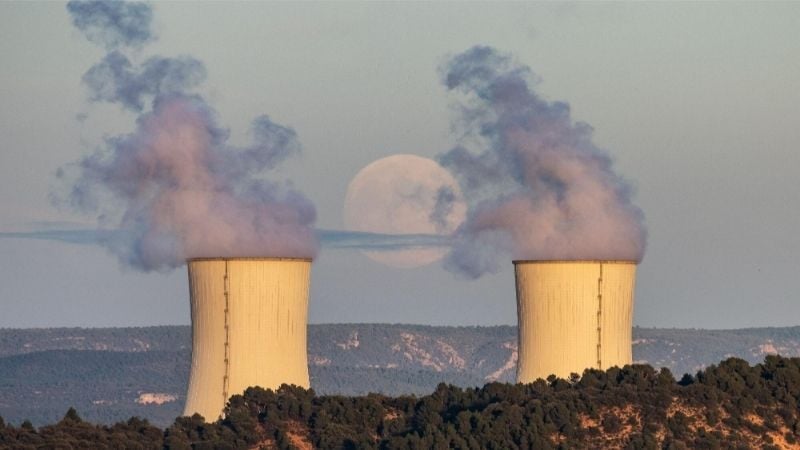
Nuclear energy is changing and expanding, maybe even to the Moon. Image used courtesy of Adobe Stock
AI Tool Could Lead to Faster Fusion
Scientists from the U.K. Atomic Energy Authority (UKAEA) and Austria have developed GyroSwin, an AI tool that can create nuclear fusion plasma simulations up to 1,000 times faster than other computational methods.
Achieving nuclear fusion requires confining plasma at very high temperatures and pressures using powerful magnets. Extreme conditions force atomic nuclei together, overcoming their natural intermolecular repulsion, enabling two elements to fuse into heavier elements. This process releases energy that can be harnessed without carbon emissions.
However, turbulence within the plasma is a major challenge because heat is transported to the plasma edges, making it difficult for the plasma to reach the temperatures required for fusion. Modeling this turbulence in fusion processes has become the main way to understand if fusion systems will encounter issues once in action.
5D gyrokinetic models are widely used to measure plasma turbulence, as they account for the three spatial dimensions and two extra dimensions describing the parallel and perpendicular particle velocities within the plasma. This process, while effective, uses a lot of supercomputing power and is slow to model. GyroSwin aims to make these simulations quicker and more accessible, shortening development times.
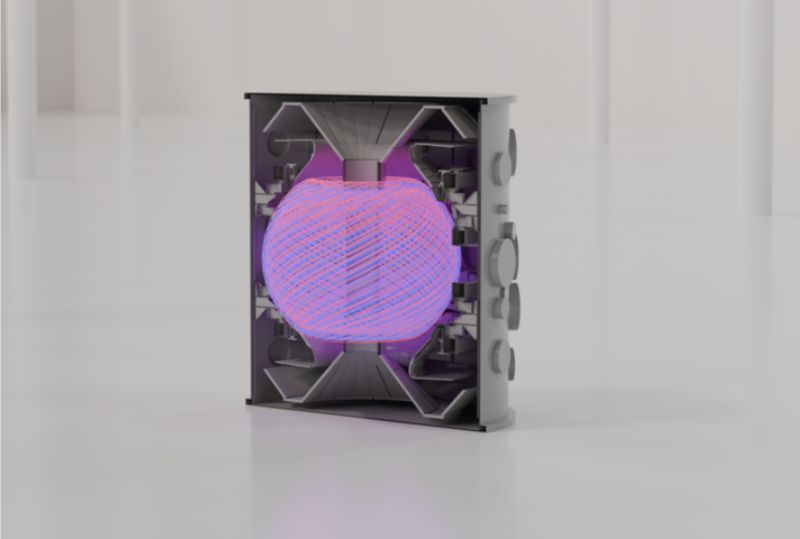
A GyroSwin model. Image used courtesy of the U.K. Atomic Energy Authority
The GyroSwin uses advanced AI algorithms to learn the 5D simulation dynamics, enabling models to run in seconds rather than hours or days. Researchers trained GyroSwin on 6 TB of data and found it highly accurate at predicting turbulence in the reactor, enabling the optimization of fusion machine designs in a much shorter time.
GyroSwin preserves physical information from a fusion plasma, such as the length scale of fluctuations and the sheared flows that can reduce turbulence, both of which are key parameters in turbulence simulations.
Next, the UKAEA will examine how the GyroSwin can apply to the next generation of power plants, including the U.K.’s Spherical Tokamak for Energy Production. Scientists believe that millions of simulations may be required to optimize the plasma design, so shorter simulation timelines should help speed up the project's development.
Can Fusion Reactors Solve Major Physics Challenges?
While nuclear fusion might be able to solve some of the world’s energy challenges, it may also be able to solve some of the greatest physics challenges as well. Physicists from the University of Cincinnati have created a theoretical model for producing axions—particles that could help to explain dark matter—inside a fusion reactor. These particles have long been theorized but never directly observed.
Dark matter has played a fundamental role in shaping the universe since the Big Bang, and scientists theorize that most of the universe's matter is dark matter. However, they have never directly detected dark matter. Dark matter does not absorb or reflect light. Still, scientists have inferred its presence in the universe by observing unusual motions in galaxies and planetary systems that suggest the presence of a large amount of matter causing a gravitational pull.
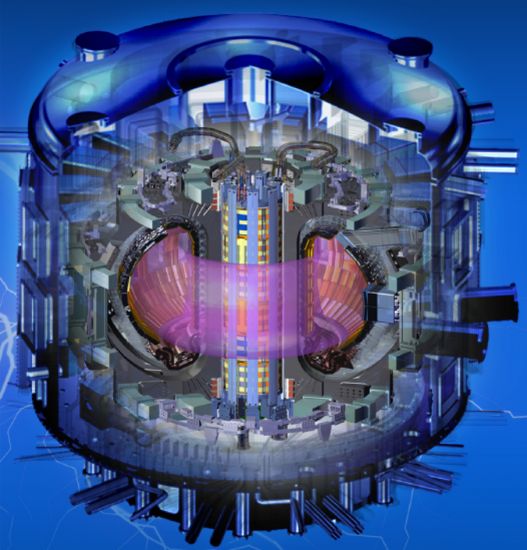
Plasma containment in a fusion reactor. Image used courtesy of Department of Energy
So, where do fusion reactors come into this great physics conundrum? Dark matter consists of neutral, ultra-light particles known as axions. This recent study examined fusion reactor designs that use heavy water—deuterium and tritium—within a lithium vessel. A reactor like this is already under development in southern France.
The researchers deduced that this design would generate a large number of neutrons alongside the high-energy output. When these neutrons interact with the materials in the fusion reactor wall, they can generate axions or axion-like particles. They also theorized that neutrons could collide with other particles in the plasma, slowing down and releasing energy in a phenomenon known as “braking radiation,” thereby creating axions.
Russia Plans Nuclear Power Plant on the Moon by 2036
Russia plans to build a nuclear fission power plant on the moon to supply its space program, including rovers, an observatory, and a joint Russian-Chinese research station.
Roscosmos, Russia's state space corporation, plans to construct the plant by 2036. The government has contracted with Lavochkin, a Russian aerospace company, and partnered with the Russian state nuclear corporation, Rosatom, and its leading nuclear research institute, the Kurchatov Institute.
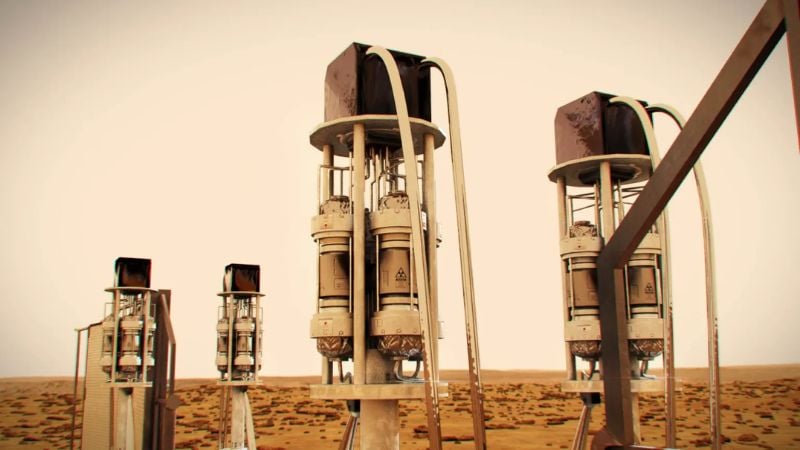
Concept of fission reactors on the Moon. Image used courtesy of NASA
Russia is not the only country planning to put a nuclear reactor on the Moon. Last year, NASA announced its plan to put a reactor on the Moon by 2030.
Russia, China, and the U.S. have a long history of space races, but this time, it’s a lunar gold rush to put energy generation capabilities on the Moon and to harvest rare earth metals, such as scandium, yttrium, and the lanthanides, as well as Helium-3, which may be in abundance on the Moon but rare on Earth.