Facebook
 Google
 GitHub
 Linkedin
Fusion Energy: The Long-Term Solution
Nuclear fusion could be a long-term solution for low-carbon, reliable energy production. But how long will it be until fusion powers the grid?
Fusion energy represents the most transformative potential nuclear technology, with recent breakthroughs generating significant excitement. In 2022, the National Ignition Facility recorded the first experiment to surpass scientific breakeven, producing more fusion energy than the laser beam delivered to the target. This milestone came after decades of research dating back to the theoretical foundations laid in the 1920s.
The fusion industry has attracted substantial private investment, with over 40 companies now in operation having secured a combined total exceeding $6 billion. Several companies have made progress in developing prototypes for grid-scale fusion generators, with some projected to be operational by 2030.
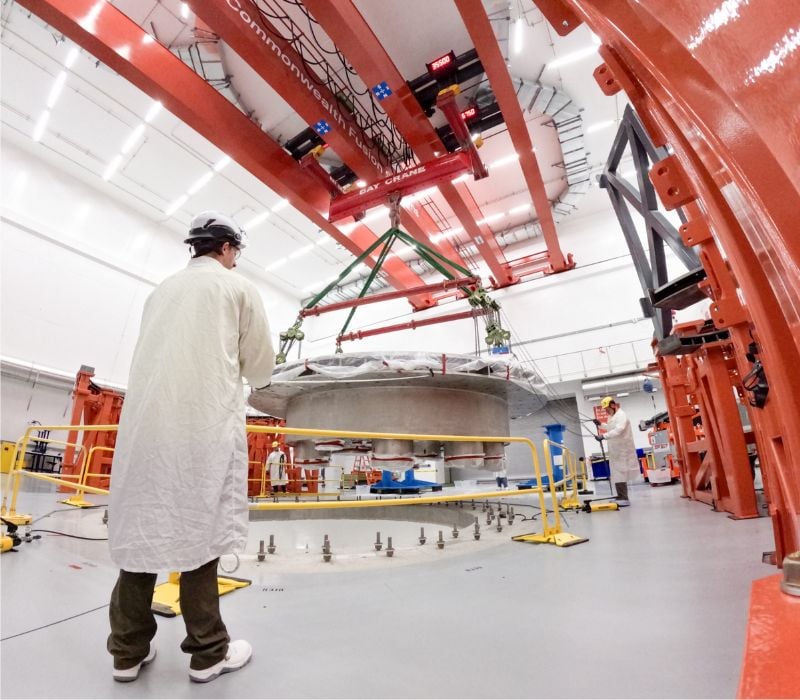
Constructing a fusion generator. Image used courtesy of Commonwealth Fusion Systems
The Fusion Power Plant Dream
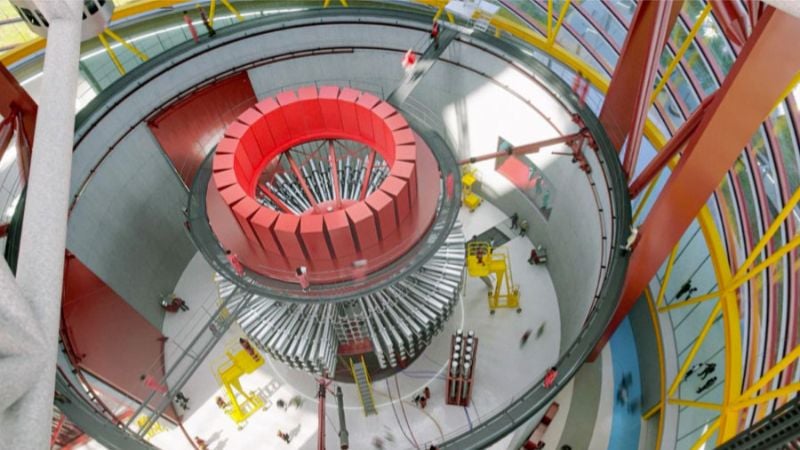
Notable companies developing fusion include Commonwealth Fusion Systems, which plans to begin operating its SPARC demonstration reactor by 2025 with the goal of achieving net-positive energy production by year-end 2025. CFS intends to build the world's first commercial fusion power plant, called ARC, in Chesterfield County, Virginia, with operations projected for the early 2030s.
Type One Energy, a U.S.-based startup, has begun the design process for the company’s first Infinity Two stellarator nuclear fusion power plant. A stellarator uses external coils to generate a twisting magnetic field that controls the hydrogen plasma inside the reaction chamber. The Tennessee Valley Authority is working with the firm on a proposed 350 MWe pilot project, aiming to generate power as early as mid-2030.

Stellarator. Image used courtesy of Type One Energy
Canada-based fusion energy company General Fusion has successfully achieved the first-ever plasma in a reactor powered by steam. This milestone was accomplished using the latest version of its prototype nuclear reactor, the Lawson Machine 26.
While current fusion energy efforts largely focus on tokamaks and stellarators, General Fusion has been advancing magnetized target fusion (MTF)—a technology developed in the 1970s at the U.S. Naval Research Laboratory to enable compact fusion reactors. Unlike other approaches relying on lasers or superconducting magnets, MTF employs steam-driven pistons to compress plasma. Electricity is first used to magnetize the fuel, and then pistons push a liquid lithium wall against the plasma, compressing it and raising its temperature. Once the plasma reaches a critical temperature, fusion occurs, releasing energy that heats the liquid lithium.
Magnetized target fusion. Image used courtesy of General Fusion
The heated lithium generates steam by passing through a heat exchanger, driving a turbine to produce electricity. Achieving plasma was a critical step in this process, as earlier attempts failed due to insufficient control over piston movements. General Fusion credits advancements in modern computing for enabling the precise control required to overcome this challenge. MTF eliminates the need for expensive components such as superconducting magnets or high-powered lasers, making it a promising pathway toward commercially viable fusion energy.
Idaho National Laboratory (INL) is developing “fusion blanket” technologies to create a critical nuclear fuel component for nuclear fusion. Nuclear fusion requires two different hydrogen isotopes—deuterium (which has one neutron and is commonly available in seawater) and tritium (which has two neutrons and is unstable and difficult to produce). When they fuse, they make a helium atom and huge amounts of energy, some of which is in the form of high-energy neutrons.

Fusion blanket. Image used courtesy of Idaho National Laboratory
Fusion blankets are typically made from materials that can withstand high-energy neutron bombardment while facilitating tritium breeding and heat extraction. Lithium is essential for breeding tritium, which is otherwise all but impossible to find. Lithium blankets can be used in solid or liquid forms, such as lithium-lead alloys or molten salts like FLiBe (a mixture of lithium fluoride and beryllium fluoride). In addition to producing tritium fuel, a fusion blanket absorbs energy from neutrons and plasma radiation, converting it into heat. This heat is transferred to a coolant system and used to generate electricity via turbines. Fusion blankets protect critical reactor components, such as superconducting magnets, from neutron radiation damage by significantly reducing neutron flux outside the plasma chamber.
The INL work is part of the Department of Energy’s $107 million funding award to six research centers called Fusion Innovative Research Engine collaboratives.
Industry experts generally maintain more conservative timelines than those suggested by some fusion startups. Most experts agree that any large-scale energy from nuclear fusion is unlikely before around 2050.
Nuclear Future
As energy demands continue to rise, driven particularly by data centers and electrification, nuclear power's role as a provider of clean, reliable base energy becomes increasingly critical. Whether through evolutionary improvements in conventional reactors, deployment of SMRs, or eventual fusion commercialization, nuclear energy appears set to play a significant role in the global energy transition. However, the exact pace and scale of this contribution remain subject to technological, economic, and political factors.