Facebook
 Google
 GitHub
 Linkedin
The Internet of Things Is Making Renewables Integration Easier
How is the IoT taking over renewable energy management?
Implementing the Internet of Things (IoT) has become commonplace in the power grid, especially with the evolution of smart grids. Smart grids rely on IoT sensors to monitor different parameters around the grid. Now, the IoT is transforming the integration, control, and management of the various renewable energy resources connected to the grid.
The IoT helps improve renewables’ efficiency and reliability once attached to the grid by providing real-time data analysis, monitoring, and automation for solar cells, wind turbines, and other distributed energy resources. However, IoT protocols impact renewables within different contexts.
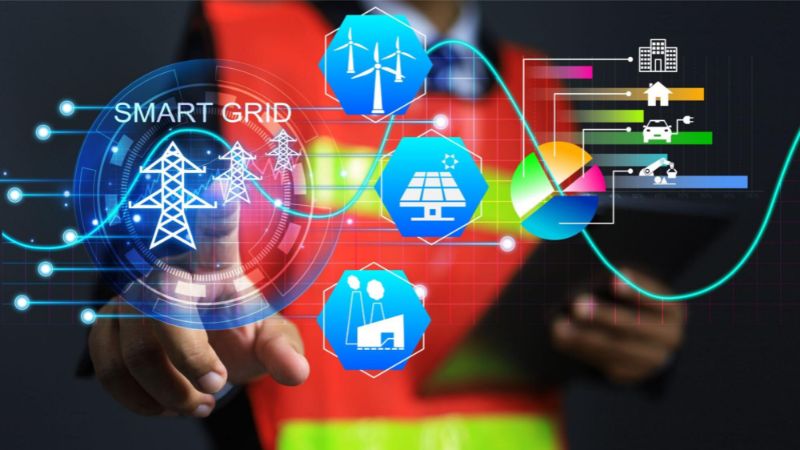
Smart grid concept. Image used courtesy of Adobe Stock
IoT in Microgrids
Microgrids can act as a bridge between the renewables and the wider grid distribution network, and the IoT can play a key role. Integrating the IoT into microgrids helps improve the optimization and operation of local energy systems using renewables. When IoT systems are connected to microgrids with renewable systems and distributed energy resources, such as energy storage systems, they form a network.
The IoT’s real-time monitoring capacities within microgrid environments enable operators to have greater control over the microgrid, for example, through precise energy scheduling. Monitoring also improves the microgrid’s reliability and efficiency. When microgrid IoT systems are further integrated with machine learning algorithms and advanced data analytics, operators can optimize resource allocation, predict energy demand, and reduce operational costs for renewable resources.
IoT in Renewable Integration
The real-time monitoring capabilities, data analysis, and optimization protocols make it easier to manage the integration of renewables into the grid.
For example, ESP32 controllers collect data from current and voltage sensors and transmit the data to a central cloud server. Operators can then manage energy loads and optimize the performance of new renewable sources added to the grid network. IoT sensors can also be directly integrated into photovoltaic systems to better manage energy production and distribution while maintaining a reliable supply.
The latest IoT-based energy optimization and demand response systems can manage energy-consuming devices, predict demand, facilitate load balancing, and reduce the peak load of new renewables. Using IoT systems, renewables can be seamlessly integrated into the grid and optimized, improving the wider power grid network’s overall efficiency.
IoT in Renewables Management
IoT systems also play a crucial role in managing renewables once they become permanent fixtures in the grid. IoT systems enable utility companies to remotely balance the grid and operate different renewable systems to automate load scheduling for peak demand. They can optimize energy usage, release it when the grid requires it, and improve reliability by leveraging the data at their disposal.
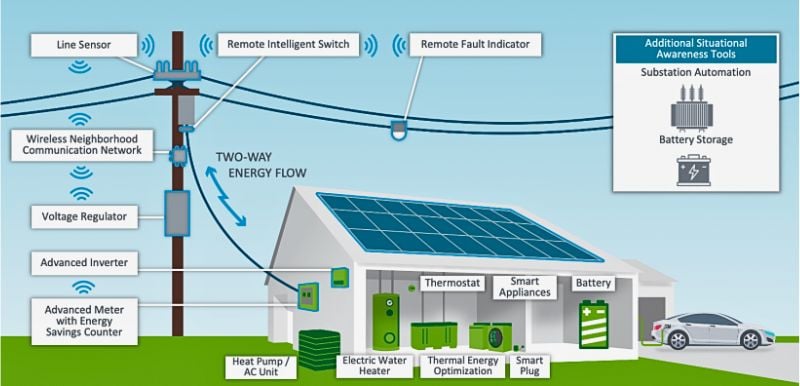
IoT sensors assist with real-time monitoring of renewables and distributed energy resources. Image used courtesy of the Department of Energy
Ensuring renewables are reliable and stable when integrated into the grid is highly important, especially in the age of cyberattacks on digitally connected systems. Robust control strategies are implemented to integrate and manage new renewables properly. Some key control strategies for ensuring renewable integration include:
- Load frequency control (LFC) for multi-area power systems
- Model predictive control (MPC) and event-triggered scheme (ETS) controls for managing the intermittent output of wind turbines
- Using a combination of LFC, MPC, and ETS control frameworks to improve the resilience against false data injection attacks
With greater control over energy management in the grid, IoT methods enable the management of more renewables in the grid, which helps drive sustainability.
IoT in Hydrogen Production
IoT strategies are also applied to other renewable energy areas, such as hydrogen production. Industrial IoT advancements have been used to develop complex data acquisition and monitoring systems for proton exchange membrane hydrogen generators.
IoT is used in hydrogen energy to optimize the hydrogen production process and monitor the operational parameters. The IoT’s real-time analysis capabilities within hydrogen production environments have resulted in improved energy management and the development of more hydrogen-producing infrastructure.
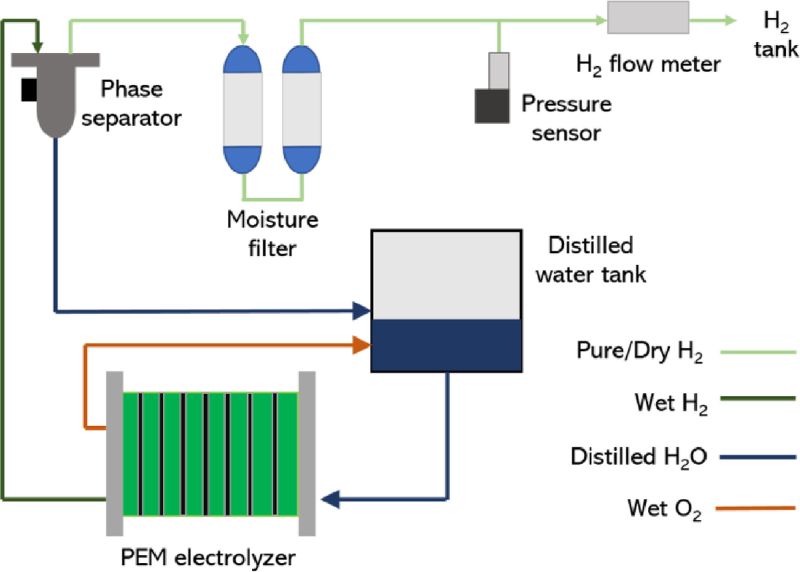
IOT sensors integrated into PEM electrolyzer. Image used courtesy of Foldago et al.
IoT in Renewable Energy Storage Systems
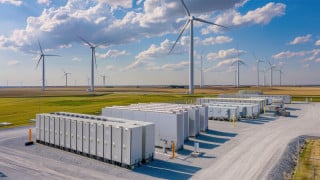
Batteries and energy storage systems store energy from renewables during peak harvesting periods and distribute it to the grid when required. For example, the IoT can control PV and battery systems simultaneously with the Message Queuing Telemetry Transport protocol, which provides remote control and real-time data transmission. The IoT offers a digital connection between energy storage systems and other grid components to balance energy demand and distribution and prevent grid failures.