Facebook
 Google
 GitHub
 Linkedin
Briefs: Meeting Demand for Data Center Power and EV Batteries
Babcock & Wilcox, Applied Digital, Siemens, GridAI, Amp Z, Donut Lab, and Integrals Power have advanced goals in data center power and batteries for electric vehicles and storage systems.
AI data centers, electric vehicles, and battery energy storage centers are driving demand for high-quality, efficient power systems. In the latest, Babcock & Wilcox has signed a $2.4 billion contract to develop power for a data center campus in North Dakota, while GridAI has agreed to supply Amp Z with diverse power management for its centers. In batteries, Donut Lab has test results that counter objections to its solid-state battery, and Integrals Power has challenged China’s dominance on lithium phosphate by manufacturing its own supply.
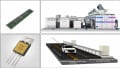
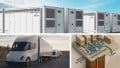
![]() AI data centers and batteries are leading power tech innovations.
AI data centers and batteries are leading power tech innovations.
Babcock & Wilcox To Develop $2.4B Power Supply for ‘AI Factory’
Babcock & Wilcox (B&W) will design and build a $2.4 billion, 1.2 GW power generation project to supply power to Applied Digital’s AI Factory campuses in North Dakota. Base Electron will own and develop power plants that will provide behind-the-meter energy to the campuses.
The project will also include four 300 MW natural gas boilers and a Siemens steam turbine generator. The power plant is expected to be operational in 2028.
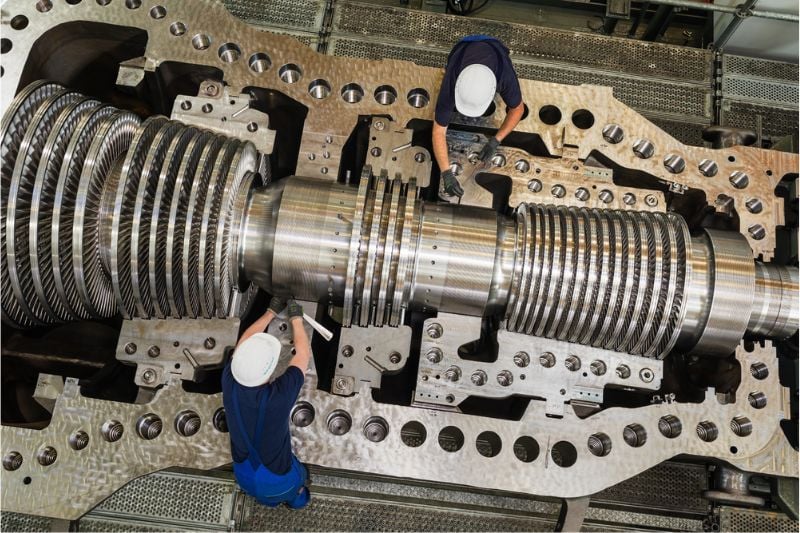
Siemens steam turbine. Image used courtesy of Siemens
Applied Digital’s Polaris Forge data center campus is located on 900 acres near Harwood, North Dakota.
GridAI Signs Agreement with Amp Z for 5 GW of Data Center Power
GridAI Technologies has signed a letter of intent (LOI) to supply data center infrastructure company Amp Z with 5 GW of capacity across North America.
Under the agreement, GridAI will coordinate and optimize grid-connected energy for Amp Z’s data center portfolio over the next 5 to 10 years. Energy resources will include on-site and distributed generation, renewable energy, and battery energy storage systems. The energy orchestration aims to create a unified system to operate reliably and efficiently while keeping costs and carbon emissions low.
The companies signed the LOI in November 2025, but Amp Z was not identified as the data center hyperscaler at that time.
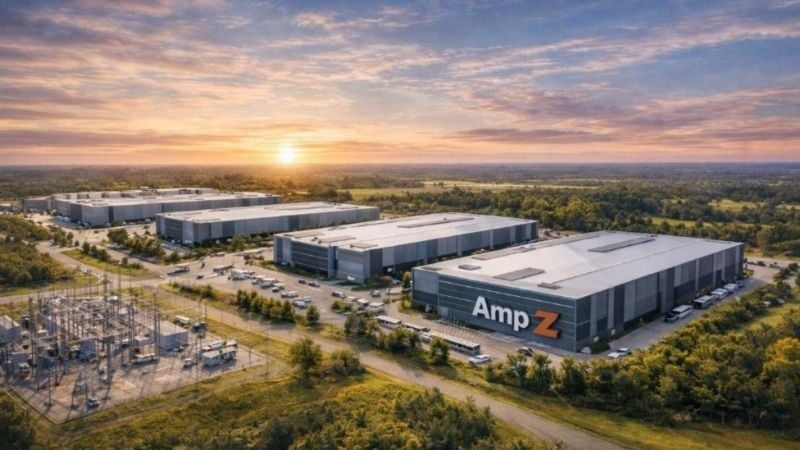
Amp Z data center campus. Image used courtesy of Leo Eyre
Amp Z has several data center projects in the works, including a 2.1 GW capacity facility on more than 1,000 acres near Lufkin, Texas, as the site of a former paper mill. The site is grid-connected, but Amp Z plans to build out 1 GW of independent generation capacity by 2029.
Tests Show Donut Lab SSB Is Not a Supercapacitor
Donut Lab has released test results dispelling the criticism that its all-solid-state battery (ASSB) is actually a supercapacitor.
Since the company announced in January that its ASSB was ready for commercial production and would be used in a motorcycle, the Finland-based startup has faced widespread skepticism. Many critics said that the cell’s fast charging (5 to 10 minutes) suggests that it’s a supercapacitor, not a battery. Supercapacitors lack a battery’s energy density and storage capacity.
In response, Donut Lab contracted with an independent firm, VTT Technical Research Centre of Finland, to assess the battery’s key characteristics and performance. The test results are available on the company’s I Donut Believe website.
The tests measured fast-charge performance, high-temperature performance, and self-discharge.
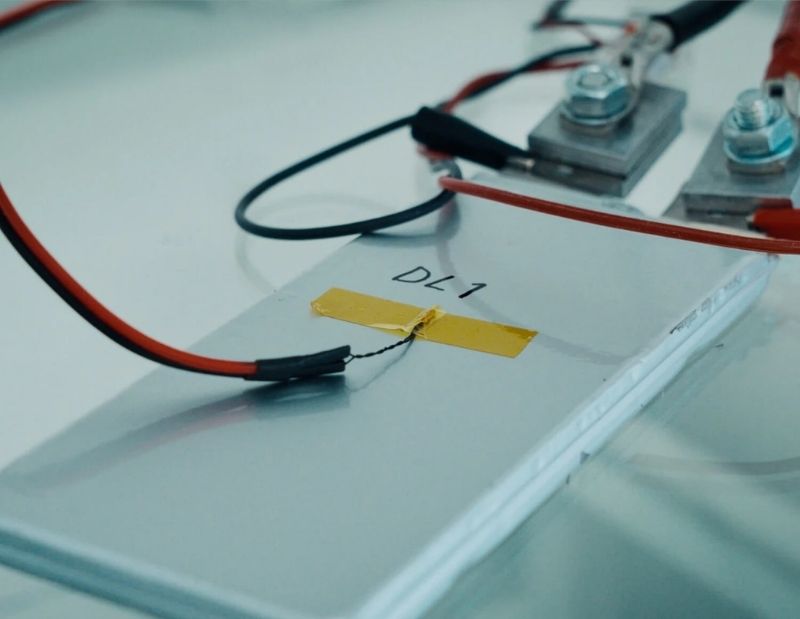
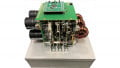
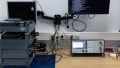
Self-discharge test. Image used courtesy of Donut Lab
Fast charging: VTT tested charging rates of 5C and 11C without active cooling. The battery reached 80% capacity in 4.5 minutes at the 11C rate, demonstrating temperature stability in charging.
High-temperature performance: The battery was heated to 80°C (176°F) and then to 100°C (212°F) for several hours while discharging. According to VTT, at 80°C, the battery delivered 110.5% of its room-temperature capacity because its internal resistance dropped. At 100°C, it maintained full functionality. It recharged without degradation.
Self-discharge: According to Donut Lab, this test proves the cell is a true battery and not a supercapacitor. VTT charged the cell to 50% and left it at room temperature for 10 days, measuring voltage every 10 seconds. The battery stabilized quickly and retained 97.,7% of its charge. A supercapacitor would have shown a fast, continuous drop in voltage.
Integrals Power Develops Sustainable Iron Phosphate for Manufacturing LFPs
Integrals Power has developed a sustainable method for manufacturing lithium-iron phosphate (LFP) cathodes using local raw materials. Almost all LFPs use iron phosphate sourced in China.
The company’s synthesis process uses low temperatures, which reduces energy consumption and carbon footprint. Tests show that the iron phosphate has a higher purity than the Chinese product and lacks impurities found in by-products of the steel industry.
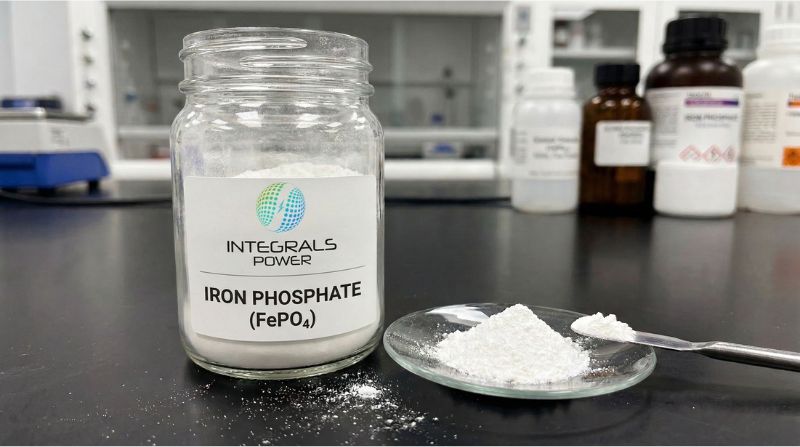
Iron phosphate. Image used courtesy of Integrals Power
After the validation phase, Integrals Power will send samples to OEMs and battery manufacturers for benchmarking. The company aims to manufacture the iron phosphate across the U.K., U.S., and Europe.
Integrals Power stated that localized production will assist designers in meeting the 2027 Rules of Origin requirements and in avoiding the 10% tariffs on electric vehicles sold between the U.K. and the EU.