Facebook
 Google
 GitHub
 Linkedin
Briefs: Tech Companies Advance AI, Wind, Nuclear and More
Wise Integration, Eaton, Xendee, LatWind, Nuclearn, Conflux, and Honeywell are strategically addressing changes in the energy landscape.
Technology companies are responding to a diversified mix of energy sources and applications with planning, collaborations, innovations, and smart energy management. The latest strategies involve a new CEO, microgrids, wind farm modeling, funding for AI-enhanced nuclear energy, and hybrid-electric aircraft.
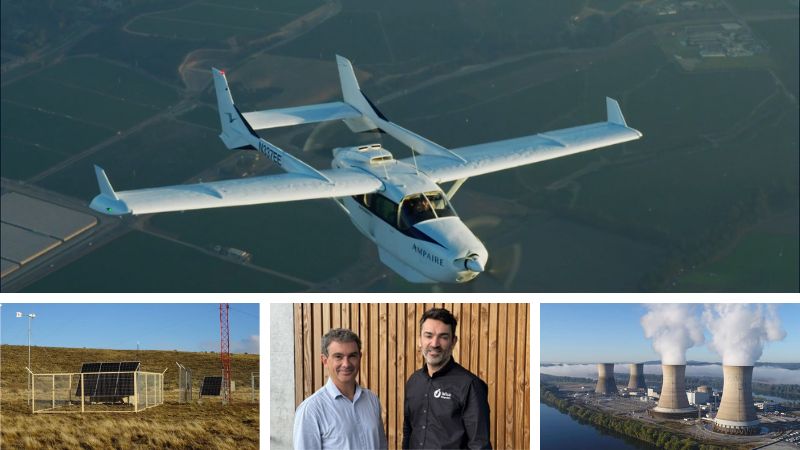
News highlights include hybrid-electric aircraft, Lidar, a new CEO, and nuclear energy. Adapted using images from Ampaire et al.
Wise Integration Selects Kaiser as New CEO
Wise Integration has appointed Ghislain Kaiser as Chief Executive Officer. He succeeds company co-founder Thierry Bouchet, who will transition to Chief Technology Officer and General Manager.
Kaiser began his career at STMicroelectronics. He then led the French startup Docea Power, a full-chip, system-level power and thermal modeling startup, from 2006 until 2015, when Intel acquired it. He continued at Intel in senior director roles. He has experience with IC power consumption and thermal challenges, system-simulation engineering, and performance and design in consumer, data center, and AI systems.
_and_outgoing_CEO_Thierry_Bouchet,_now_CTO.jpg)
New CEO Ghislain Kaiser (left) and outgoing CEO Thierry Bouchet, now CTO. Image used courtesy of Wise Integration
Wise Integration plans to scale globally in markets such as AI data centers and electric vehicles, where compact and digitally controlled power architectures are essential. The company has been a leader in gallium nitride technology with its WiseGan IC and WiseWare microcontroller.
Eaton and Xendee Partner for AI-Powered Microgrid
Eaton has joined with Xendee Corporation to create a complete microgrid solution. The agreement will combine Eaton’s power distribution technology with Xendee’s AI-powered Model Predictive Control software. To advance the collaboration and AI-powered tools for distributed energy resources, Eaton led a Series B funding round for Xendee.
Xendee’s software uses AI to forecast and optimize microgrid systems in real time. The agnostic software can manage more than 27 types of distributed energy technology, including solar, battery storage, and nuclear power. The integrated system can reduce emissions, enhance resilience, extend equipment lifespans, and reduce costs.
LatWind, EDF Use Lidar for Wind Flow Modeling in Chile
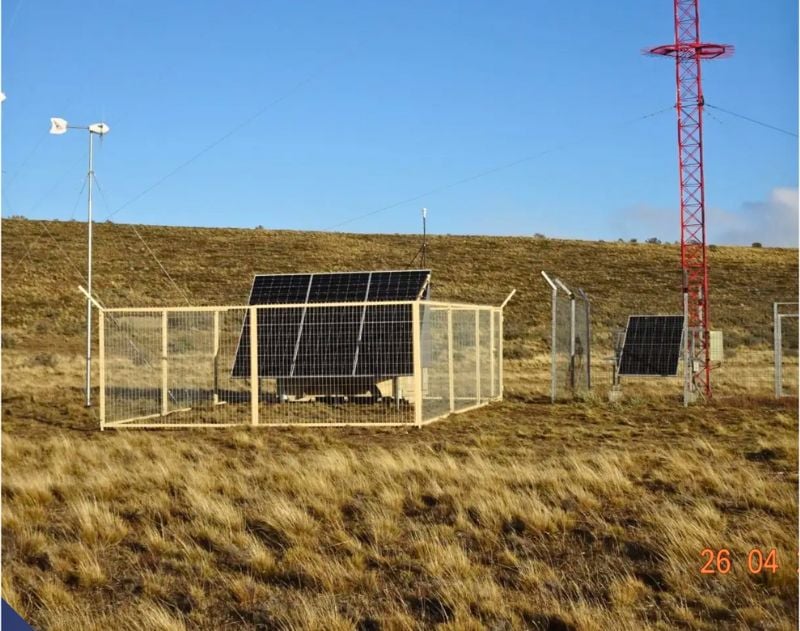
LatWind is conducting enhanced wind flow modeling with Lidar for EDF power solutions in South Patagonia, Chile. The project aims to capture wind data across complex terrain where a large-scale wind energy development is planned.
The ZX 300 Lidar system. Image used courtesy of ZX Lidars
LatWind is using its ZX 300 wind Lidar systems to provide Lidar and operations, Lidar-to-tower verification, and data management. The wind flow model uses remote systems to evaluate complex wind flow in challenging environments, such as Chilean Patagonia, to reduce uncertainty in wind development planning.
$10.5 Million Funding Boosts AI-Powered Nuclear Platform
Nuclearn has raised $10.5 million in Series A funding for its AI platform designed for nuclear operations, supporting engineering and regulatory compliance. The funding aims to accelerate product development and expand its market reach.
The platform combines advanced AI with nuclear domain knowledge, automating workflows that usually require weeks of specialized human effort.
Nuclearn aims to meet growing energy demand for carbon-free nuclear energy to power data centers, which are expected to double by 2030.
Blue Bear Capital led the funding with SJF Ventures and existing investors, AZ-VC, and Nucleation Capital.
Conflux Joins Consortium for Hybrid-Electric Aircraft Thermal Management
Conflux Technology has joined the Thermal Management for Hybrid Electric Regional Aircraft (TheMa4HERA) consortium, led by Honeywell. The consortium aims to develop advanced thermal management systems for next-generation hybrid-electric aircraft to develop climate-neutral aviation by 2035.

The Ampaire AMP-H570 hybrid-electric aircraft. Image used courtesy of Ampaire
Conflux will contribute its expertise in thermal management to accelerate a lightweight additive-manufacture heat exchanger for aircraft. Projects include an air-to-air heat exchange for air cycle systems and an air-to-liquid heat exchanger for vapor cycle systems.
Phase 1 of the Ma4HERA project aims to improve heat exchanger technologies using digital twins, virtual demos, and ground testing by 2026. In Phase 2, the consortium will conduct flight testing and further implementation of the solutions.
The consortium has 28 partners across 10 European countries.