Facebook
 Google
 GitHub
 Linkedin
Radioactive Decay Powers a Novel Nuclear Battery
Researchers used alpha particles from isotopes of the element americium to produce light that generates electricity in photovoltaic cells.
Chinese researchers have developed an innovative nuclear “battery” that utilizes the radioactive decay of isotopes of the element americium to generate electricity. While in its infancy, this technology is promising in the nuclear battery field, offering several unique features and potential applications.
Animated breakdown of the radioisotope thermoelectric generator. Video used courtesy of NASA
Nuclear-powered devices, often called nuclear batteries, are currently used in space exploration to provide electrical energy to spacecraft that travel far enough away from the sun that solar panels become less effective. The most common are radioisotope thermoelectric generators (RTG) that use the heat from radioactive decay of isotopes like plutonium-238 or thorium to generate electricity via thermoelectric couples. RTGs have been used in numerous space missions, including Voyager, Curiosity, and New Horizons.
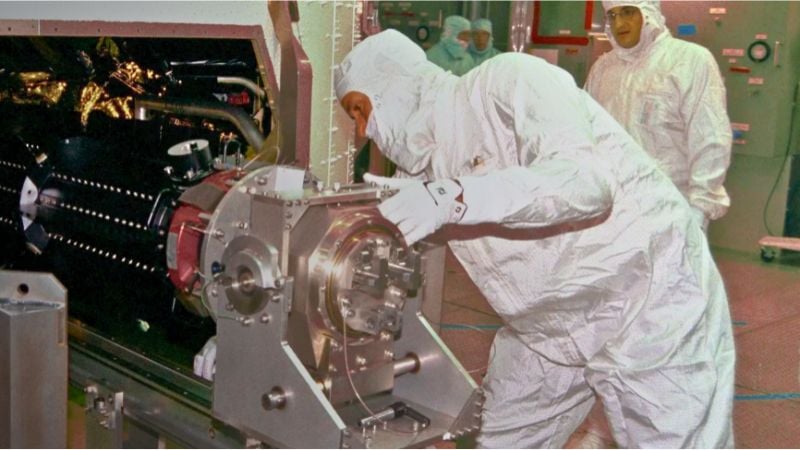
An RTG powering the Cassini spacecraft. Image used courtesy of NASA
Let There Be Light—From Radioactivity
In the journal Nature, Chinese scientists described a new nuclear battery that uses the radioactive decay of americium-241 or americium-243 into alpha particles to energize a polymeric crystal to produce light. This light is then captured by a photovoltaic solar cell that generates electricity. Americium has a long half-life of 7,380 years, allowing for potentially decades-long operation, and its -241 and -243 isotopes are commonly found in nuclear waste from uranium fission reactors, making its supply reasonably plentiful.
Novel Nuclear Battery Architecture
The researchers developed an innovative architecture for the americium nuclear battery, incorporating americium-243 into a luminescent lanthanide coordination polymer. This design achieved an efficiency increase of up to 8,000 times compared to previous models.
The coordination polymer is a compound where organic ligands link metal ions (in this case, lanthanides) to form a repeating structure. Lanthanides are a series of elements known for their unique luminescent properties. When excited, they can emit light efficiently. The polymer is designed to convert the radiation from the americium isotope into visible light, specifically a green glow that the attached solar cell converts into electricity. These batteries are extremely compact, with some designs packaged in quartz cells as small as a millimeter. However, the power output remains relatively low, in the range of microwatts.
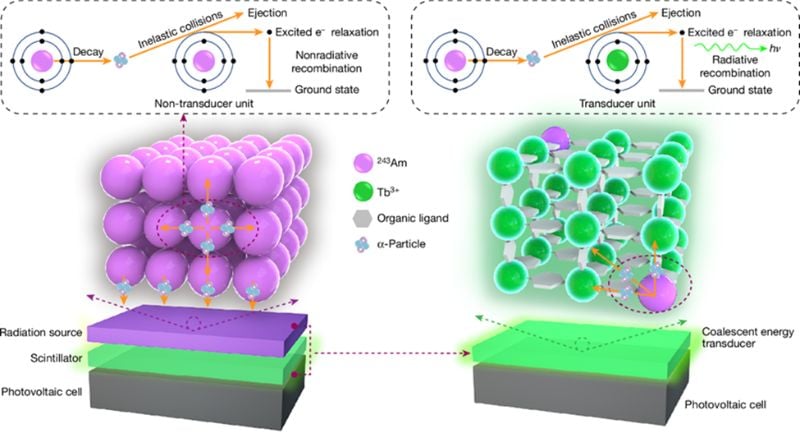
Schematic diagram of the actinide-based micronuclear batteries. Image used courtesy of Soochow University
The architecture addresses a significant challenge in nuclear battery design—the severe self-absorption of alpha particles—that traditional designs had suffered from. The research team reports a dramatic 8,000 times efficiency increase.
The radioactive decay process is unaffected by external factors like temperature, pressure, or magnetic fields, making these batteries suitable for harsh environments. Potential applications might include powering deep space exploration missions, remote sensing in challenging environments (e.g., deep sea), and powering miniature sensors or devices where battery replacement is impractical. Possible future uses include medical devices like pacemakers.
Tiny Amounts of Electricity
While highly efficient for their size, these batteries currently produce very small amounts of electricity, on the order of 139 microwatts per curie. The conversion efficiency from the radioactive decay energy to light energy was measured at 3.43 percent. For context, these micro-batteries would take billions to power a standard 60-watt light bulb. Suffice it to say that a nuclear-powered electric vehicle won’t happen anytime soon. This technology is still in the early stages of research and development. However, further efficiency and power output improvements are needed before widespread adoption is feasible.
Americium
Americium was first synthesized and isolated in 1944 by Glenn T. Seaborg and his team at the University of Chicago as part of the Manhattan Project. The americium-241 isotope was made commercially available in 1962 by the U.S. Atomic Energy Commission and manufactured at the Rocky Flats Plant in Colorado as a byproduct of plutonium processing. However, production ceased in 1984.
In the 2000s, there was renewed interest in americium nuclear batteries, particularly for space applications. The U.K.'s National Nuclear Laboratory and the European Space Agency began exploring americium-241 as a power source for space missions. Los Alamos National Laboratory reestablished U.S. domestic production of americium-241 in 2017, delivering its first shipment to customers in 2020. The most recent Chinese research has brought about a renewed interest in isotopes of the element.