Facebook
 Google
 GitHub
 Linkedin
Are Small Nuclear Reactors the Answer to Modern Energy Needs?
Multiple companies are on the brink of commercializing compact nuclear reactors that can be quickly deployed.
Nuclear energy continues as a cornerstone of the world's low-carbon energy sources, currently providing approximately one-quarter of global electricity. This contribution has become increasingly important as countries worldwide strive to meet net-zero emissions targets while simultaneously addressing growing energy demands, particularly from data centers powering artificial intelligence and high-performance computing.
Learn more about small modular reactors. Video used courtesy of Rolls-Royce
In 2025, nuclear power stands at a critical inflection point in the global energy landscape, with innovations in alternative reactors. Small modular reactors could meet the world’s growing energy demand.

Small modular reactors. Image used courtesy of Rolls-Royce SMR
Energy Costs
The relative costs per megawatt-hour for electricity generation technologies vary significantly based on factors such as capital costs, fuel expenses, and capacity. The levelized cost of electricity differs for coal, natural gas, nuclear, hydro, geothermal, wind, and solar power generation as of 2025.
Table 1. Levelized cost of energy by source.
| Energy Source | Cost Range ($/MWh) | Key Notes |
| Coal | $68–$166 | Conventional coal remains relatively expensive due to fuel costs and emissions. |
| Natural Gas | $83–$221 | Combined-cycle gas turbines are more efficient but still face rising fuel costs. |
| Nuclear | $81–$221 | High upfront capital costs make nuclear expensive despite low operating costs. |
| Hydropower | $20–$60 | Large-scale hydro is one of the cheapest options but site-dependent. |
| Geothermal | $61–$102 | Dispatchable and clean, with potential for significant cost reductions by 2035. |
| Wind (Onshore) | $27–$75 | Onshore wind is competitive, but capacity factors vary widely. |
| Wind (Offshore) | $67–$146 | Offshore wind has higher costs due to complex installations. |
| Solar PV | $35–$41 | Utility-scale solar is among the cheapest sources and continues to decline in cost. |
Solar photovoltaic systems and onshore wind are consistently the cheapest sources of electricity generation. However, because they are intermittent, they must be partnered with a battery energy storage system to be most effective. Meanwhile, despite its relative reliability and low-carbon benefits, nuclear power's high capital costs place it at the upper end of the cost spectrum, often making it the most expensive way to produce electricity. In addition, an effective way to deal with high-level nuclear waste from spent fuel has yet to be developed.
Recent breakthroughs in fusion technology, accelerating deployment of small modular reactors (SMRs), and renewed government commitments indicate a potential nuclear renaissance, though timelines and implementation challenges vary significantly across technologies and regions.
Small Modular Reactors
Small modular reactors represent the most immediate evolution in nuclear power technology, with development underway since the mid-2000s. The International Atomic Energy Agency defines small modular reactors as advanced nuclear reactors with power capacity up to 300 MW(e) per unit, approximately one-third of traditional reactor capacity.
The Nuclear Energy Association has identified 98 SMR technologies undergoing development worldwide, with many designs moving toward licensing, operation, and commercialization. Many are pressurized water reactors (PWR), using ordinary water as a coolant and a neutron moderator. It is the most widely used nuclear reactor design globally, accounting for the majority of nuclear power plants.
Table 2. Top six SMR projects worldwide.
| Project Name | Country | Capacity | Technology Type | Expected Operation |
| HTR-PM | China | 210 MWe | High-temperature gas-cooled | Operational |
| ACP100 "Linglong One" | China | 125 MWe | Water-cooled integral PWR | 2026 |
| NuScale VOYGR | United States | 77 MWe | Integral PWR | 2030 |
| BWRX-300 | Canada/Poland/US | 300 MWe | Boiling Water Reactor | 2029 |
| CAREM25 | Argentina | 27 MWe | Integral PWR | 2027 |
| Clinch River SMR | United States | TBD | TBD (NuScale/GE Hitachi likely) | 2033 |
Many other smaller demonstration and prototype projects are underway worldwide, such as Rolls-Royce SMR. The British company has decades of experience building nuclear reactors for the U.K. nuclear submarine fleet. It plans to use that expertise to construct land-based power stations that can generate 470 MWe of low-carbon energy. The proposed PWR-type reactor will produce the equivalent of more than 150 onshore wind turbines and provide consistent baseload generation for at least 60 years. The Rolls-Royce SMR footprint will be one-tenth the size of a traditional nuclear power plant. It will be factory-built, with complete modules transported by truck, train, or barge and assembled at the site, reducing risks and shortening construction times.
Producing electricity isn’t the only application envisioned for SMRs. The French company Newcleo is working with Italian steel maker Danieli to produce steel using nuclear energy. The plan is to use Newcleo’s lead-cooled fast reactor, an ultra-compact SMR that is transportable and delivers up to 200 MWe, to provide a combination of electricity and high heat for green steel production, melt metals, and produce green hydrogen to power ore pellet processing and hydrogen burners.
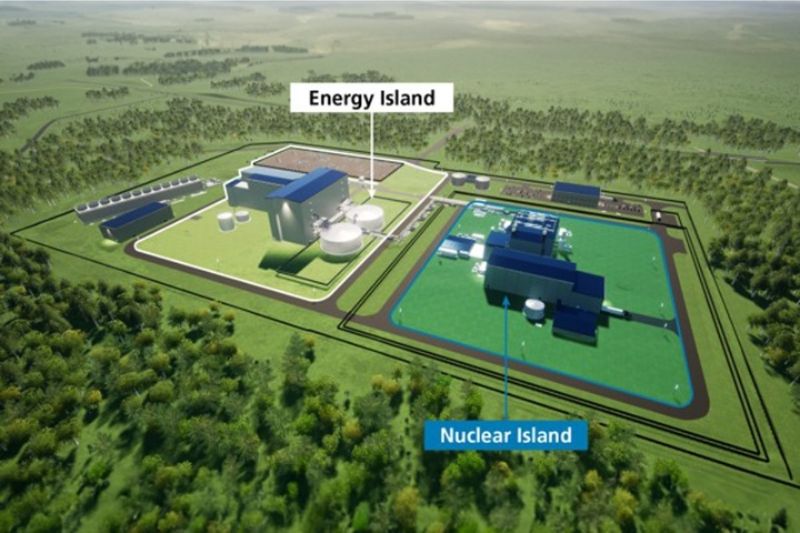
The Natrium reactor. Image courtesy of TerraPower
TerraPower is developing the Natrium reactor, an advanced SMR nuclear technology combining a 345 MWe sodium-cooled fast reactor with a molten salt thermal energy storage system. Designed for flexibility and efficiency, the SMR supports decarbonization by integrating with renewable energy sources while providing reliable, carbon-free power. HD Hyundai is working with TerraPower to apply HD Hyundai's manufacturing expertise to establish commercial-scale production capacity for global Natrium deployment. In 2024, HD Hyundai signed a contract with TerraPower to supply the cylindrical reactor vessel used in the first Natrium reactor.
Nuclear Future
While SMRs could resolve immediate energy needs, the long-term solution could be nuclear fusion. Look for Part 2 of our update, featuring fusion, next week.