
 Facebook
 Google
 GitHub
 Linkedin
Hadron Energy Set to Produce ‘Plug and Play’ Nuclear Energy
In this interview, Hadron Energy CEO Samuel Gibson discusses nuclear micro modular reactors, AI data centers, and Hadron’s plans to take the company public.
Hadron Energy’s solution for the data center energy crisis is compact, easily scalable, and powerful. The California-based energy innovator is developing a nuclear-powered micro modular reactor (MMR), which could provide essentially “plug and play” power for data centers, industries, and other sites, according to founder and CEO Samuel Gibson.
The company is set to go public in early 2026, thanks to $1.2 billion in capital funding with GigCapital7 Corp. The financial move will give Hadron the resources to accelerate the MMR’s development, with commercial deployment expected around 2030.
EEPower spoke with Gibson, who explained how the MMR’s design and flexibility could offer a solution for anyone needing a 24/7, carbon-free, uninterruptible energy supply.
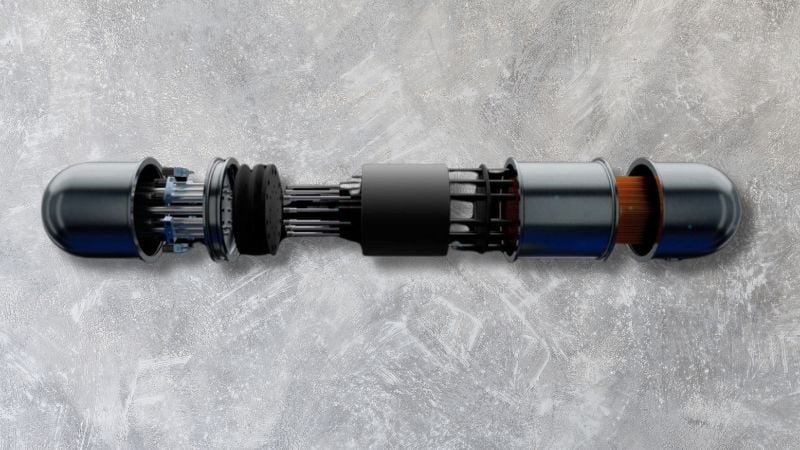
Hadron's micro reactor unit. Image used courtesy of Hadron Energy
Micro Reactor Technology
About 440 nuclear fission power plants operate worldwide, supplying gigawatts of energy to local grids, according to the World Nuclear Association.
“Full-scale plants are considered 300 MW plus, which in the United States, that’s what operating today—all full-scale plants,” Gibson explained.
These plants could soon be supplemented by smaller, more advanced nuclear production. Small modular reactors (SMRs) and micro modular reactors are in late development stages and could be operational by the decade’s end. The Department of Energy classifies an SMR as producing between 20 and 300 MW per unit, while an MMR produces between 1 and 20 MW per unit.
Hadron is developing a light-water MMR that provides 10 MW of electricity and 35 MW of thermal heat. Each unit uses a uranium oxide fuel pellet and other fission products surrounded by several containment layers. A zirconium alloy cladding surrounds the fuel pellet to create a pressurized, sealed fuel pin. Around that is a 3-4” thick steel reactor pressure generator, which also contains a steam generator and the primary coolant. The outer layer is a 1”-thick steel containment vessel. The unit is immersed in a pool of water for cooling.
Gibson said the fission process releases heat, producing steam from a water supply. A turbine pushes the steam to a generator, which generates the electricity. The MMR unit can be refueled and has an expected lifespan of about 50 years.
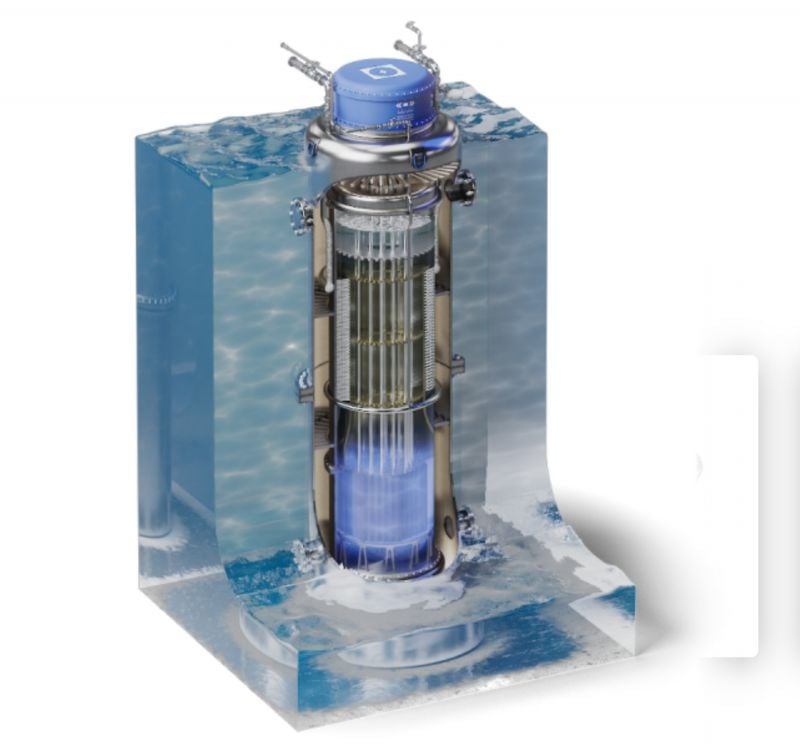
Hadron’s MMR design. Image used courtesy of Hadron Energy
Gibson said SMRs and MMRs have several advantages. They can power microgrids or community grids, industrial buildings, military sites, and other facilities that need reliable, continuous energy but may not have adequate generation or transmission infrastructure. The units are pre-assembled and transported to the site, where they are installed, and the fuel pellet is added.
In a way, it’s a “plug and play installation,” Gibson said, though some site preparation is needed, such as pouring concrete and creating the water pool. He added that the units can also be air-cooled.
“Compared to conventional nuclear power plants, which feed into the grid, these have more flexibility,” Gibson said. “These can be behind-the-meter solutions, and you can also tie it into the grid. That’s important for communities or areas, for example, that maybe don’t have all the infrastructure in place.”
The MMRs also take up less land.
“One of our 10 MW units sits on less than an acre of land, whereas a large-scale reactor requires far more,” Gibson explained.
The footprint is also much smaller than that of renewable resources like solar or wind farms.
To achieve more generation capacity, individual units can be operated in parallel.
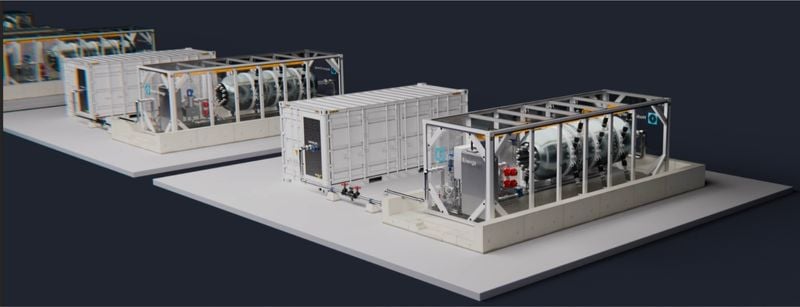
Concept of MMRs used in microgrid. Image used courtesy of Hadron Energy
“In one of our data center conversations that we’re having right now with a potential end use, they would like to see a 100 MW project with Hadron,” Gibson said. “That means for us, we have the capability of lining up 10 of our units. With data centers, you typically need a little redundancy … so we’ll probably have 11 units.”
The extra unit enables technicians to take a unit offline for maintenance and refueling.
Nuclear Energy for Data Centers
Gibson said the International Energy Agency expects energy demand from AI data centers to quadruple by 2030. MMRs could be the answer because they are cheaper and faster to develop than other nuclear technologies.
“This is what we’re hearing across the board,” Gibson said. “Data centers really only care about, all right, how much is this project going to cost? When is it available?”
Nuclear energy typically faces a long and arduous approval process with the Nuclear Regulatory Commission.
“Our reactors have an accelerated timeline over small modular reactors and full-scale plants, given how condensed they are,” Gibson explained. “They’re actually considered to be low-consequence reactors given the threshold of the special nuclear reactor. Basically, it means they’re a very safe reactor.”
Future of Hadron and Micro Reactors
Hadron’s business combination, which will make it a publicly traded company, is expected to be finalized early in 2026. Existing security holders will receive 100 million shares of GIG stock. After expenses, Hadron will have access to about $200 million in cash. Gibson said the move was needed, and the time is right, because Hadron is ready to accelerate its growth.
“This industry is very capital-intensive,” he said. “Ultimately, we need to raise a pretty sizable amount of capital in order to be successful and deliver hardware for the end customer.”







Interesting indeed. I do have questions as to the operation of that steam turbine generator portion is supervised, and how the required operation of the system is maintained.