Facebook
 Google
 GitHub
 Linkedin
Are High-Temperature Superconductors the Key to Nuclear Fusion?
Proxima Fusion has raised €20M in seed funding to accelerate development of the first generation of fusion power plants using quasi-isodynamic stellarators and high-temperature superconductors.
Munich-based start-up Proxima Fusion, a spin-out of the Max Planck Institute for Plasma Physics (IPP), has raised €20M in additional seed funding to continue its work developing fusion power solutions based on its novel, simulation-enabled stellarator design.
The funding follows €7.5M in pre-seed funding received less than one year ago and was led by Swiss venture capital firm redalpine with participation from German government-backed Bayern Kapital and DeepTech & Climate Fonds, the Max Planck Foundation, and existing investors.
Fusion power is the holy grail of clean energy production because the energy-producing combination of light atomic nuclei produces no negative byproducts. Stellarators are a type of magnetic confinement used in fusion reactors and have been under research for more than six decades.
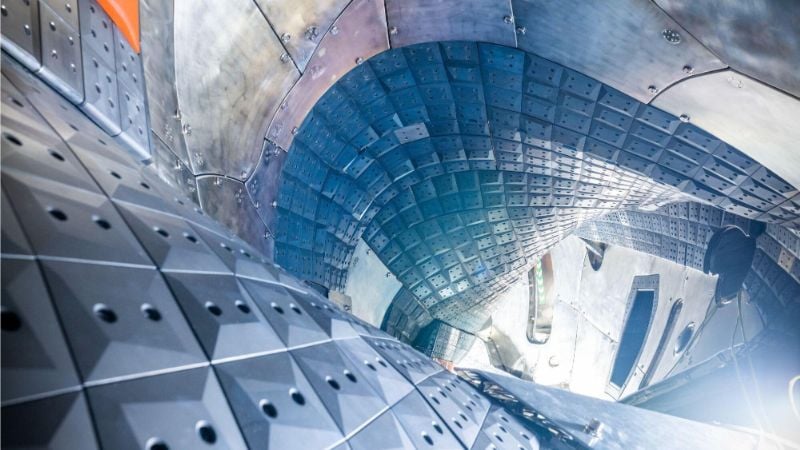
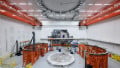
Inside the Wendelstein 7-X stellerator. Image used courtesy of the Max Planck IPP
Recent breakthroughs in quasi-isodynamic stellarator design have made the technology a viable candidate for commercial fusion power production.
Magnetic Fusion Confinement
The first laboratory fusion reaction was achieved in 1934, but the real challenge to fusion is sustaining these reactions for extended periods in a manner that produces more energy than it consumes.
To achieve conditions for fusion, gasses must be transformed into plasma through exposure to very high temperatures. In plasma, electrons are stripped from atoms, producing ions (atoms without electrons orbiting around the nucleus). Scientists can then stimulate the ions to collide with one another, creating a fusion reaction that releases energy.
Controlling the turbulent and super-hot plasma in a manner that allows for sustained fusion reactions is a significant engineering challenge. Scientists use magnetic containment devices to manipulate the plasma since strong magnetic fields can contain highly charged ions. The most common forms of magnetic containment used in fusion reactors are tokamak and stellarator.

Tokamak magnetic fusion confinement configuration. Image used courtesy of International Atomic Energy Agency
In a tokamak reactor (derived from the Russian expression for a toroidal magnetic chamber), a series of electric fields bend the plasma column into a helix-like shape that can be organized and contained within a vessel.
A stellarator uses twisting magnetics to configure the plasma in a similar helical shape without needing an additional transformer. Stellarators are more difficult to build but are better at keeping plasmas stable.
Quasi-Isodynamic Stellarators
According to Proxima, unlike other stellarator and tokamak concepts, quasi-isodynamic stellarators employ a design where toroidal currents cancel out to zero, resulting in more robust capabilities.
Modern high-temperature superconductors allow for stronger magnetic field strengths at more practical temperatures, significantly widening the design space and relaxing requirements for commercial viability.
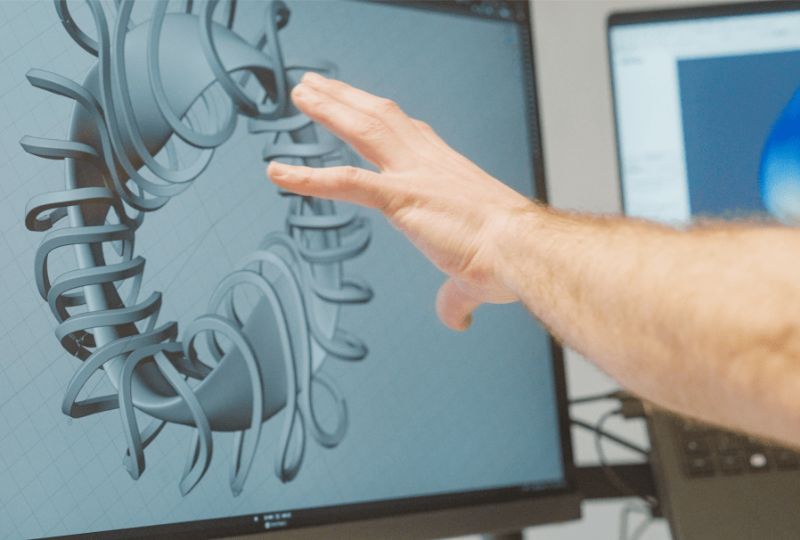
Fusion concept with a quasi-isodynamic stellarator. Image used courtesy of Proxima Fusion
To accelerate the development of its stellarator concept, Proxima Fusion uses a simulation-first approach with modeling capabilities aimed at quickening the design iteration process while reducing development costs. Proxima plans to use its optimization tools to investigate the critical trade-offs between scientific theory and engineering and to improve manufacturing tolerances for key components.
Wendelstein 7-X Experiment
In its work, Proxima Fusion draws heavily from and expands on the results of the Wendelstein 7-X (W7-X) experiment, the largest stellarator in the world located at the Max Planck IPP. The W7-X project was funded by €1.3 billion in public investment from the German Government and European Union to advance fusion power to the grid.