Facebook
 Google
 GitHub
 Linkedin
Underground Energy: How This Mile-Deep Nuclear Reactor Works
Deep Fission adds an underground twist to conventional nuclear reactor technology.
California-based startup Deep Fission is introducing its underground nuclear power concept to place a standard light water reactor inside a one-mile-deep borehole.
With natural rock coverage and thermal resources, a subterranean reactor would reduce the need for expensive containment domes and pressure vessels. The modular layout also allows arrays with multiple boreholes at 15 MW each, unlocking gigawatt-scale capacity.
Safety is another draw, as the industry’s reputation remains tarnished by the Fukushima and Chornobyl meltdowns. Deep Fission’s underground reactor would be shielded from natural disasters, missile strikes, and other safety hazards. The company’s initial seismic observations also suggest it would remain intact during an earthquake.
Basing its technology on a conventional pressurized water reactor (PWR) design, Deep Fission expects to complete licensing quickly within existing NRC regulations. The company recently attracted a $4 million pre-seed investment round led by Texas-based venture capital firm 8VC. It will use the funding for hiring and regulatory activities.
Deep Fission recently submitted its conceptual design review to the Nuclear Regulatory Commission (NRC), marking an early step in the approval process.
A concrete platform inside a reactor under construction. Image used courtesy of Pexels/by Wendelin Jacober
Deep Fission’s Innovation: Scalable Underground Arrays
Deep Fission’s design borrows features from typical PWRs at most nuclear power plants. It uses low-enriched uranium fuel with less than 5% U-235 content and the same conventional fuel assemblies, power control rods, and boron for the coolant fluid. Each core contains four 14-foot-tall assemblies with 17x17 rod configurations.
Deep Fission’s 30-foot-tall PWR operates at 160 atmospheres or 2,250 psi pressure, roughly equal to ambient water conditions a mile underground. The core’s 275-315°C temperature is comparable to a standard PWR (290-325°C).
First, the reactor receives water input, then churns out 30 MW of thermal steam from boiled water in a steam generator. Then, the non-radioactive steam rises via in-borehole tubing to the surface, traveling via lifting cables. Near the surface, a turbine converts the energy to 10 MW of electricity. This process is similar to geothermal power plants. A primary loop carries hot water from the core, while a secondary loop heats and vaporizes the water.
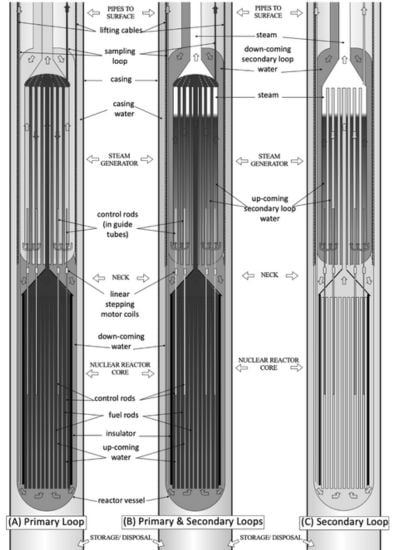
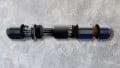
Underground components and setup. Image used courtesy of NRC (Page 28, Figure 2)
The base design produces 15 MW with just one 30-inch borehole. However, the modular setup makes the output scalable because the boreholes are spaced close together, with the reactors sharing a condenser and steam generator. Ten boreholes can produce 150 MW, while 100 translates to 1.5 GW. For comparison, a typical nuclear reactor in a power plant produces 1 GW, according to the U.S. Department of Energy.
With no moving parts buried underground besides the control rods and coolant flow, the design requires less maintenance than above-ground reactors. When inspection is necessary, the reactor’s cables can be raised in a few hours. The chemical and volume control, boron system, and filters are located at the surface and linked to the core via pressure tubes, allowing plant staff to sample the primary loop water.
_and_a_cross-section_of_the_casing_above_the_generator_(right).jpg)
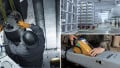
Core view (left) and a cross-section of the casing above the generator (right). Image used courtesy of NRC (Pages 29 and 30, Figures 3 and 4)
Nuclear Value in the U.S.
Nuclear fission is well-proven, carbon-free, and has the highest capacity factor of all energy sources, producing power for more than 92% of the year. According to the Energy Information Administration, nuclear accounted for 18.6% of the U.S.’s utility-scale electricity generation in 2023. It can also supply baseload power to offset the intermittency of solar and wind farms.
Despite nuclear’s value, competition with coal and reputational damage from high-profile accidents have stalled development. The number of operating reactors in the U.S. peaked decades ago at 112. Today, the country only has 93 reactors across 54 plants, and 21 are undergoing decommissioning.
While the NRC still grants licenses for new reactors, the application review process alone can take at least five years. Construction could last another five years. Deep Fission’s reactor uses an existing NRC-certified PWR design and standard fuels, likely leading to a shorter approval timeline than novel small modular reactors. The underground arrangement removes many surface-specific construction issues and delays from non-standard components.
The company is working with the NRC to address skyrocketing energy demands from artificial intelligence, computing, and industrial production. The modular design allows flexibility for different settings. One reactor can power thousands of homes, ten could serve an industrial factory, and 100 can replace a decommissioning nuclear plant.
The company is confirming its initial locations and customers and plans to begin operating the first reactor within three years of securing a site.