Facebook
 Google
 GitHub
 Linkedin
Turning Nuclear Waste Into Electricity
Energy can be harvested from nuclear waste using scintillator crystal-based “batteries.”
The United States stores more than 88,000 metric tons of spent nuclear fuel, and approximately 275,000 tons are distributed in 14 countries worldwide. Finding permanent storage solutions for nuclear waste remains a global challenge, and most countries, including the U.S., are seeking long-term solutions.
However, researchers at Ohio State University have found a positive use for nuclear waste. They have developed an innovative “battery” system that harnesses the gamma radiation emitted by nuclear waste to generate electricity.
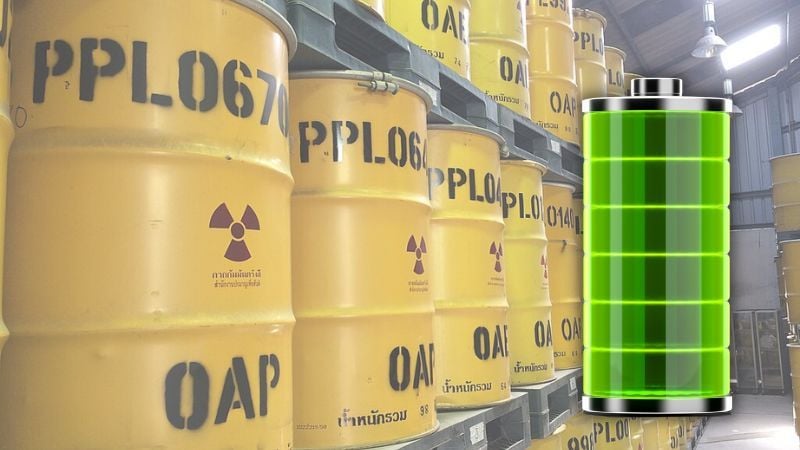
Can nuclear waste be used like a battery? Adapted from images used courtesy of Wikimedia Commons and Canva
The Scintillator-Photovoltaic Mechanism
OSU’s College of Engineering developed the technology, which can be called a "nuclear photovoltaic battery" or "gammavoltaic battery." Unlike traditional batteries, which undergo electrochemical reactions to produce electricity, the OSU battery operates through a dual-conversion process that transforms harmful gamma radiation into usable electrical power.
First, specialized materials called scintillator crystals absorb high-energy gamma radiation emitted by nuclear waste. When these crystals absorb the radiation, they convert the energy into visible light. The light functions similarly to glow-in-the-dark objects but activates using radiation rather than sunlight. A photovoltaic solar cell can capture that light to produce electricity.
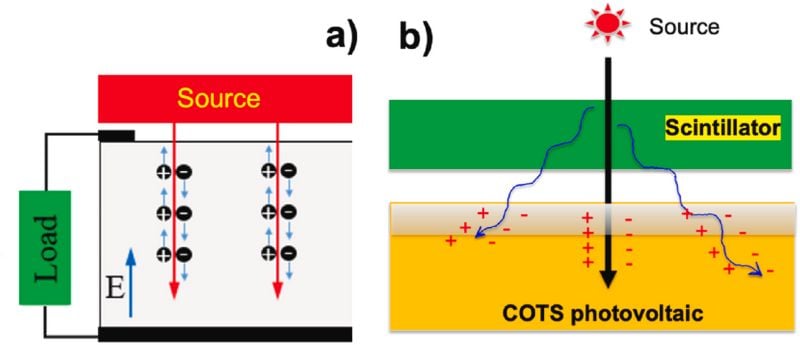
The scintillator captures external radiation. Image used courtesy of Oksuz et al.
The scintillation process in these crystals can be broken down into three main stages:
- Absorption: When ionizing radiation (such as gamma rays or X-rays) interacts with the crystal, it excites electrons within the crystal structure.
- Energy Transfer: The excited electrons create electron-hole pairs called excitons when they move from the valence band to the conduction band. These excitons travel through the crystal lattice until defects or deliberately introduced dopants (activators) trap them.
- Light Emission: The trapped electrons eventually decay, emitting photons of visible or near-visible light. This process is called luminescence.
The research team tested various scintillator materials to determine the most efficient options for radiation conversion. Two types of high-density scintillator crystals were found superior. Gadolinium aluminum gallium garnet crystals (GAGG) emerged as the best performer, producing approximately 25 times more power than alternative materials when exposed to identical radiation conditions. Lutetium-yttrium oxyorthosilicate crystals were also tested but proved less efficient in the energy conversion process.
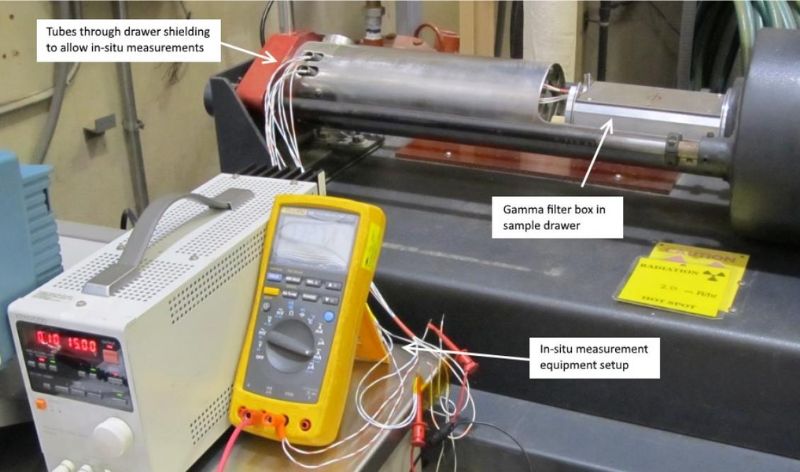
Cs-137 benchtop irradiator at Ohio State University’s Nuclear Reactor Laboratory. Image used courtesy of OSU
In the second stage of the process, this visible light is captured by photovoltaic cells (similar to those found in solar panels) and converted into electrical current. The approach effectively creates a radiation-to-electricity conversion system without directly incorporating radioactive materials into the battery itself, making the device safe to handle despite its high-energy source.
Performance Metrics and Power Generation
The prototype battery, measuring just four cubic centimeters (roughly the size of a sugar cube), was tested using two common radioactive isotopes found in nuclear waste: cesium-137 (Cs-137) and cobalt-60 (Co-60). These tests were conducted at Ohio State's Nuclear Reactor Laboratory under controlled conditions to measure power output accurately.
When exposed to Cs-137, the battery generated 288 nanowatts of electrical power. When tested with the more radioactive Co-60 isotope, power output increased significantly to 1.5 microwatts—enough energy to potentially power microelectronic systems such as sensors or emergency equipment. While these power levels seem modest compared to conventional energy sources measured in kilowatts, they represent a significant advancement in radiation energy harvesting technology and should be sufficient to power sensors and monitoring systems within a nuclear storage facility. Unlike conventional batteries that degrade over time, nuclear waste remains radioactive for thousands of years. A properly designed scintillator-based battery could theoretically provide stable power for extended periods in environments where maintenance is difficult or impossible.
_and_the_Co-60_(10kRadh)_irradiators_.jpg)
Power and voltage with the GAGG scintillator comparing the Cs-137 (1.5 kRad/h) and the Co-60 (10kRad/h) irradiators. Image used courtesy of Oksuz et al
The study was published in Optical Materials: X.
Challenges and Limitations
Despite its promise, several challenges exist and must be addressed before scintillator-based nuclear batteries can achieve widespread implementation. High levels of radiation gradually damage both the scintillator crystals and the photovoltaic cells. Further development of more durable, radiation-resistant materials is necessary to ensure the system's longevity in high-radiation environments. Scaling up this technology also presents economic challenges if the batteries are to be reliably manufactured. The current prototypes that produce power in the nanowatt to microwatt range are really only sufficient for ultra-low-power microelectronics. Significant advancements in efficiency and scale would be necessary to reach higher power outputs suitable for more energy-intensive applications.
Future Research Directions
Future research will likely focus on more radiation-resistant scintillator materials and photovoltaic cells and optimizing the geometry and configuration of components to maximize power output. This should help to scale up the technology to achieve watt-level power generation to make them practical energy-generating devices.