Facebook
 Google
 GitHub
 Linkedin
Floating Nuclear Reactors Bring Power To Ports
Nuclear microreactors can power ships at ports and dramatically reduce greenhouse gas emissions.
Port facilities face significant emissions challenges that impact both the environment and human health. U.S. port-related activities are a substantial source of greenhouse gas (GHG) emissions, but they are often included within broader transportation sector emissions. Transportation accounts for about 28% of total U.S. greenhouse gas emissions. For maritime transport, shipping emissions in U.S. ports accounted for approximately 10% of total shipping emissions in 2022. Worldwide, international shipping accounts for about 2-3% of global GHG emissions, and ports represent about 5% of total shipping GHG emissions globally.
Can nuclear microreactors solve port pollution? Video used courtesy of Westinghouse
To reduce emissions, the maritime industry is exploring several opinions, including floating nuclear power plants.
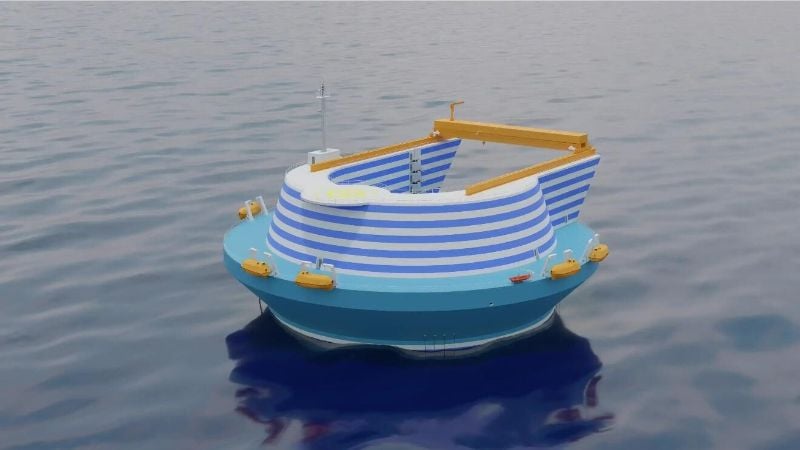
Concept of a floating nuclear power plant. Image used courtesy of Core Power
Ports, Ships, and Vehicles
Ships are a primary pollution source at ports. When docked, ships often continue to run their engines for power, and burning heavy fuel oil in ship engines produces high levels of sulfur dioxide, nitrogen oxides, and particulate matter. Ports also employ a vast array of diesel-powered machinery, including straddle carriers, terminal tractors, and reach lifters. These vehicles contribute significantly to air pollution within port areas.
Moving cargo to and from ports via trucks and trains adds to the overall emissions profile. Heavy-duty vehicles and locomotives running on diesel fuel release pollutants like nitrogen oxides and particulate matter.
These emissions contribute to climate change, air quality degradation, and various health issues in nearby communities; however, ports face several obstacles in reducing emissions. These include the high costs of implementing cleaner technologies, a lack of standardized regulations across different jurisdictions, and the need for significant infrastructure upgrades.
Despite these challenges, many ports are taking steps to address emissions. One effective tool is implementing more shore power to allow ships to use land-based electricity while docked. Combined with renewable sources, it can reduce CO2 emissions by up to 98% when using renewable energy sources such as solar installations, wind power, and microgrids with battery storage.
The Nuclear Option
A U.S.-based company called Core Power is developing a concept for a floating nuclear power plant (FNPP) to power ports. The company will work with Westinghouse Electric Company on the design and development of an FNPP using the Westinghouse eVinci microreactor.
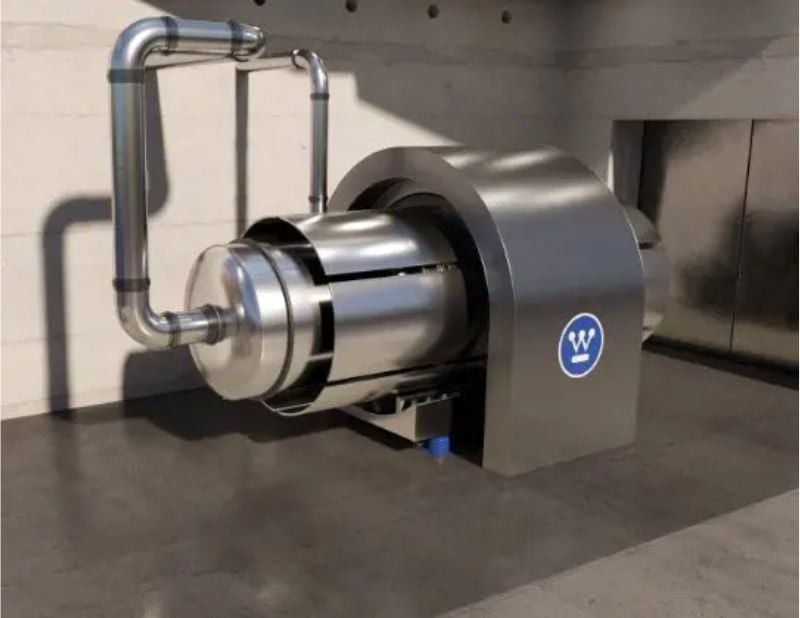
The eVinci microreactor. Image used courtesy of Westinghouse
The eVinci has a monolithic block core with channels for fuel, neutron moderators, and heat pipes. It uses TRISO (tristructural isotropic) fuel, which is made from a uranium, carbon, and oxygen fuel kernel. Three layers of ceramic-based materials encapsulate the fuel to prevent releasing radioactive fission products. A graphite moderator controls the fission reaction, and the reactor itself is surrounded by a radial neutron reflector, neutron shield, and gamma radiation shield to reduce radioactivity escape.
The eVinci’s cooling system uses hundreds of sealed pipes containing non-pressurized liquid sodium to replace the traditional water-cooling system, creating a safer and more compact design. The entire reactor setup requires less than 2-3 acres, while its modular design allows for transport in shipping containers and on-site deployment in less than 30 days. The reactor is built in a factory and pre-assembled before shipping.
Westinghouse says its eVinci microreactor has few moving parts. It can create power systems ranging from several kW to 5 MW of electricity and can operate for more than eight years without refueling. The microreactors can be used in myriad applications, including electricity production and domestic heating for remote communities, powering mining operations, industrial centers, data centers, defense facilities, lunar surface power sources, and FNPPs for ports.
Core Power plans to produce 175 GWh of electricity per year from its FNPP.
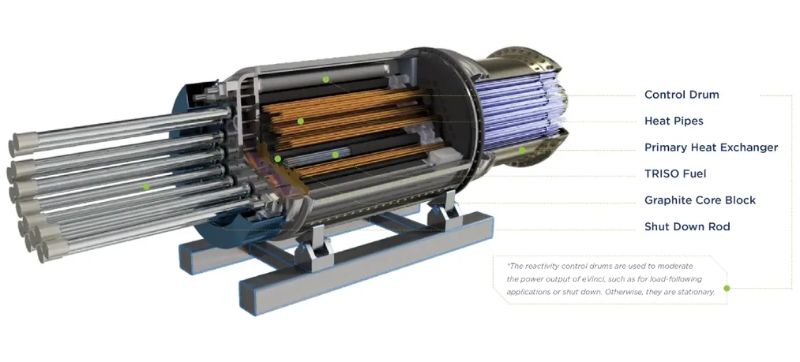
Heat pipe reactor. Image used courtesy of Core Power
Core Power is working with naval architecture firm Glosten to develop the operation concept and design the floating barge that will be used to contain the floating power plant.
Floating Nuclear Power Plants: Some History
The concept of an FNPP is not exactly new. The Russian state atomic energy corporation, Rosatom, has operated a floating plan with two reactors since May 2020. The Akademik Lomonosov operates in the Russian Arctic region of Chukotka, and in January, the FNPP generated its first billion kWh of energy and completed its first fuel cycle. The plant produces electricity for a population of 5,000 and also doubles as a cogeneration facility and repurposes waste heat that is then used for community heating. The plant also supplies energy for copper mining in the Baimskaya region zone, while a desalinization plant provides up to 240,000 cubic meters of fresh water daily.
Is Floating Nuclear Safe at Ports?
Placing a nuclear reactor on a floating platform at a port location in a busy urban setting brings to mind a number of potential safety concerns, including accidents, radioactivity discharge, radioactive wastes, sabotage, terrorism, and facility security.
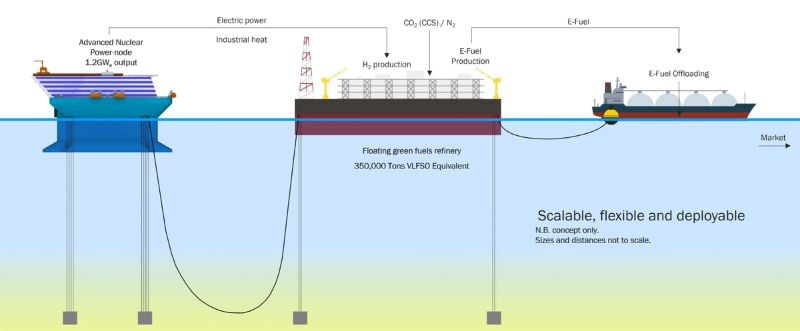
Diagram of FNNP placement. Image used courtesy of Core Power
The nature of heat pipe reactors (HPRs) like the eVinci offers several unique safety advantages while also presenting some specific safety concerns. Because HPRs provide passive, gravity-independent cooling, they enhance reactor safety by eliminating the need for pumps or external power for core heat removal. This passive operation increases reliability and simplifies the reactor design. The passive nature of heat pipes allows for automatic temperature regulation, further enhancing safety. HPRs also often exhibit reduced corrosion issues compared to traditional reactor designs, which can improve long-term safety and reliability.
From a technical view, the primary safety concern is the potential for heat pipe failure. While a single heat pipe failure doesn't necessarily cause system-wide failure, it can increase the thermal load on neighboring heat pipes. Designers must ensure that the failure of one or two heat pipes doesn't lead to cascading failures.
While heat pipe reactors offer significant safety advantages through passive operation and inherent safety features, addressing the identified concerns is crucial for their successful deployment, particularly in the dynamic environment of an FNPP. Ongoing research and development efforts will include extensive testing of heat pipe performance under various conditions and continuing development of advanced materials and manufacturing techniques. Safety concerns will also dictate the design of redundant systems to handle potential heat pipe failures. Regulators and other officials must address societal concerns over locating a nuclear power plant on a barge in the heart of an ocean-side urban center.