Facebook
 Google
 GitHub
 Linkedin
3 Strategies All Utilities Can Use for Grid Modernization
Utilities take different approaches to modernizing their grids, but an IBM Institute for Business Value report outlines three strategies they all can use.
All utilities share the same goal: to establish reliable, stable, and flexible grids to meet today’s fast-growing energy needs and scale up for the future. However, they differ in which goals to tackle first, depending on local power demands, budget, existing assets, and available resources.
The IBM Institute for Business Value (IBM IBV) interviewed 900 utility executives from around the world about their grid modernization plans and analyzed their responses. They identified four groups of grid modernizers and outlined three strategies for modernization that all utilities can use to improve the grid and meet individual goals.
What are the best strategies for grid modernization? Image used courtesy of Adobe Stock
The State of Grid Modernization
Modernizing the power grid is no easy task. Utilities must handle a growing number and diversity of distributed energy sources, which fluctuate in reliability. Energy demands are increasing due to electrification, industrial growth, and artificial intelligence. Additionally, much existing infrastructure is outdated and cannot handle the needed upgrades.
In the IBM IBV survey, most utility executives surveyed reported having made efforts in modernization, spending, on average, about 9.8% of their annual revenue. However, 21% stated they had made no progress. Transmission and distribution systems were the most commonly reported investment (40%).
Nearly half of all respondents indicated they wished to improve grid reliability, energy efficiency, and capacity. They named reducing carbon emissions and integrating renewable energy resources as top priorities.
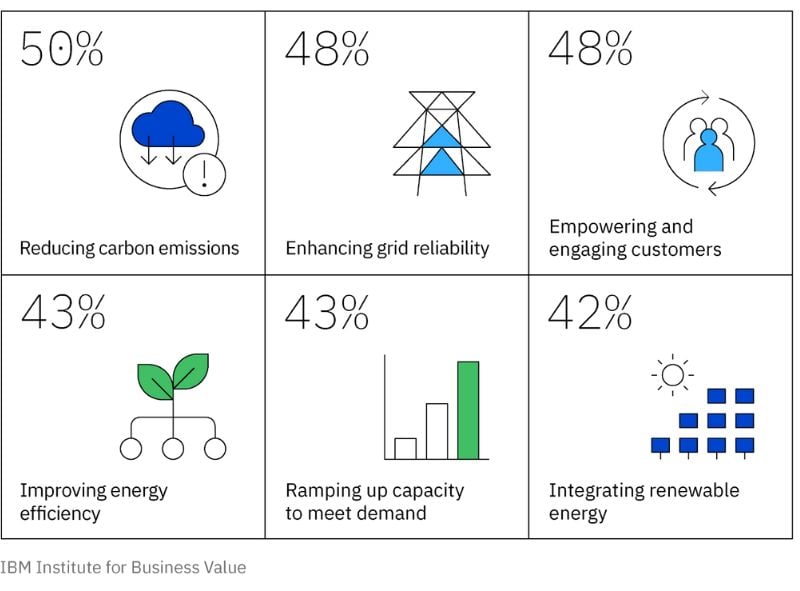
Top grid modernization goals. Image used courtesy of IBM Institute for Business Value
Four Types of Grid Modernizers
From the survey results, IBM IBV identified four groups of modernization strategizers based on their progress in demand flexibility, grid optimization, smart assets, and energy exchange.
- Pioneering Integrators: These are executives who have made the most advances in grid modernization, particularly in energy exchange, demand flexibility, and using digital twins to optimize grid operations. They may be less advanced in monitoring assets to mitigate outages and in using advanced meter infrastructure.
- Energy Optimizers: This group is committed to integrating smart assets and prioritizes demand flexibility and grid optimization. They may be less advanced in using bidirectional networks, which aid in adopting renewable energy.
- Power Connectors: These utility leaders are advanced in energy exchange and prosumer engagement. They may lag in demand flexibility and smart asset use, and their use of digital twins for energy optimization still needs development.
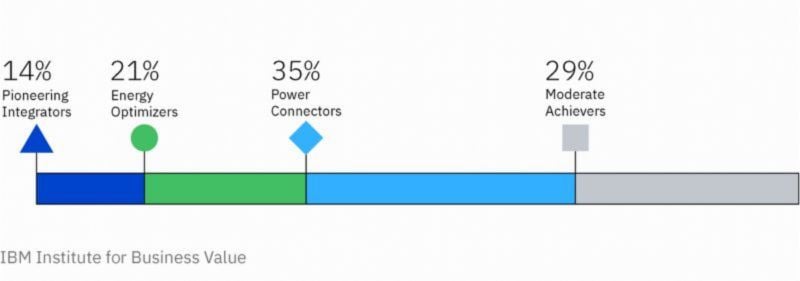
Percentage of respondents in each group. Image used courtesy of IBM Institute for Business Value
- Moderate achievers: This group has progressed in demand flexibility but needs more development in grid optimization and energy exchange. They may need to integrate third-party data sharing in order to achieve smart asset management.
Three Strategies for Grid Improvement
The IBM IBV report concluded that utilities should pursue three strategies for grid modernization: resilience and reliability, clean energy transition, and operational excellence.
Strategy 1: Increasing Grid Resilience and Reliability
Grid optimization systems use predictive performance to provide prompt responses to changes in supply and demand. These systems can work autonomously to adjust to fluctuations and provide a steady power flow. The IBM IBV report uses the example of Volt/VAR optimization, which can control voltage and reactive power and reduce energy losses.
Grid interconnectivity and integration can include adopting an advanced distribution management system to control, monitor, and optimize grid operations. Another recommended technology is a fault detection, isolation, and restoration system (FDIR), which can detect and resolve difficulties to prevent outages. FDIR can transfer power between utilities and share resources to balance out peak demand. For flexible load management, the IBM IBV report recommends dynamic pricing programs that can adjust by the minute to market fluctuations.

Survey respondents using grid optimization strategies. Image used courtesy of IBM Institute for Business Value
Strategy 2: Accelerating Clean Energy Transition
Transitioning to renewable and distributed energy sources includes both physical upgrades and digital tools. For example, storage batteries are necessary to make intermittent renewable energy supplies reliable, while software such as distributed energy resource management (DERM) can balance and optimize power inflow and outflow.
Strategy 3: Improving Operations
Grid optimization requires monitoring existing infrastructure and planning for future needs. Utilities can minimize the need for infrastructure upgrades by monitoring and adjusting energy supply and managing grid congestion. Accurate weather forecasting can help grid operators maximize renewable energy capacity.
Real-time asset monitoring and predictive maintenance allow utilities to detect and address problems before they interfere with grid performance. Many respondents stressed the importance of vegetation management and line inspections by drone.
The Enablers: How to Achieve Modernization
All grid leaders, regardless of style or priorities, will need two enablers to achieve modernization, according to the IBM IBV report. First, they should implement the “control room of the future,” involving digitization and advanced grid management technologies, such as DERM, AMI, SCADA, IoT devices, and network modeling.
Finally, utilities should also consider new ways of working, including investing in training and talent development. The grid of the future requires collaboration among engineers, cybersecurity experts, and IT professionals.